What it is
Bill to quickly evict people who illegally occupy properties
It is a members’ bill. Introduced by parliamentary groups, the Senate, regional governments or citizens. It was introduced on 12 February 2024. Introduced by: Senado.
Official title: Organic Private member's bill against illegal occupation and for neighborhood coexistence and the protection of the safety of persons and things in owners' associations.
Source: Congreso de los Diputados, file 124/000003· updated 11 Nov
Automatic summary, not yet reviewed
- The bill defines illegal occupation as holding someone else's property without title or payment, and says it applies to all real estate in the country.
- Illegal occupants could not claim protection of dwelling or home. Once required by the authorities, they would have 24 hours to leave or prove their title; in flagrant crime cases, eviction would be immediate.
- The Criminal Code would be toughened: higher penalties if the occupation lasts more than 15 days, aggravated penalties for organized groups, and punishment for anyone who incites occupation or marks properties to be occupied.
- All individuals and legal entities could request the immediate recovery of possession of a home, and procedural deadlines in criminal cases would be sped up.
- Homeowners' communities would gain tools against prohibited activities by occupants: they could ask the authorities to stop them without prior warning, and a judge could order the immediate eviction of an occupant with no rights. It also provides for warning owners about preventive measures in vacant homes.
- Illegal occupation would not allow municipal registration: the registration would be null and town councils would remove it on their own or at the owner's request. In addition, within two months the Government would have to allow refunds of property tax and wealth tax paid during the occupation.
Who it affects
- Legitimate owners and holders of real estate: They could recover possession faster and get back taxes paid during the occupation.
- Homeowners' communities: They would have new actions against occupants who disturb neighborly coexistence.
- People occupying property without title: They would lose home protection and could be evicted within 24 hours.
- Town councils: They would have to remove municipal registrations based on illegal occupation.
Words worth knowing
- Lanzamiento
- Forced eviction from a home or premises, carried out by the authorities.
- Título jurídico
- Document or right that legally justifies possession of a property, such as a deed or a lease.
- IBI
- Impuesto sobre Bienes Inmuebles: the local property tax paid by owners of homes and premises.
- Empadronamiento
- Registration in a municipality's resident registry, the padrón municipal.
It summarizes the text as it was introduced. It is written by artificial intelligence and may contain mistakes: the official text is what counts. Read the official text · How we make summaries
Where it stands
How far did it get?
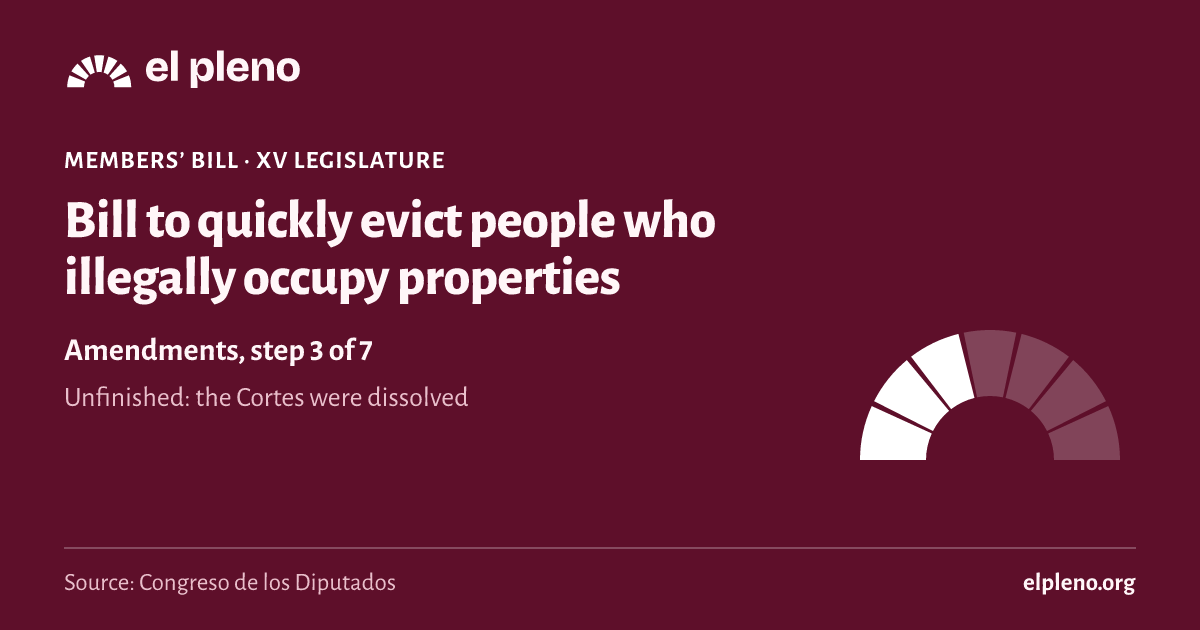
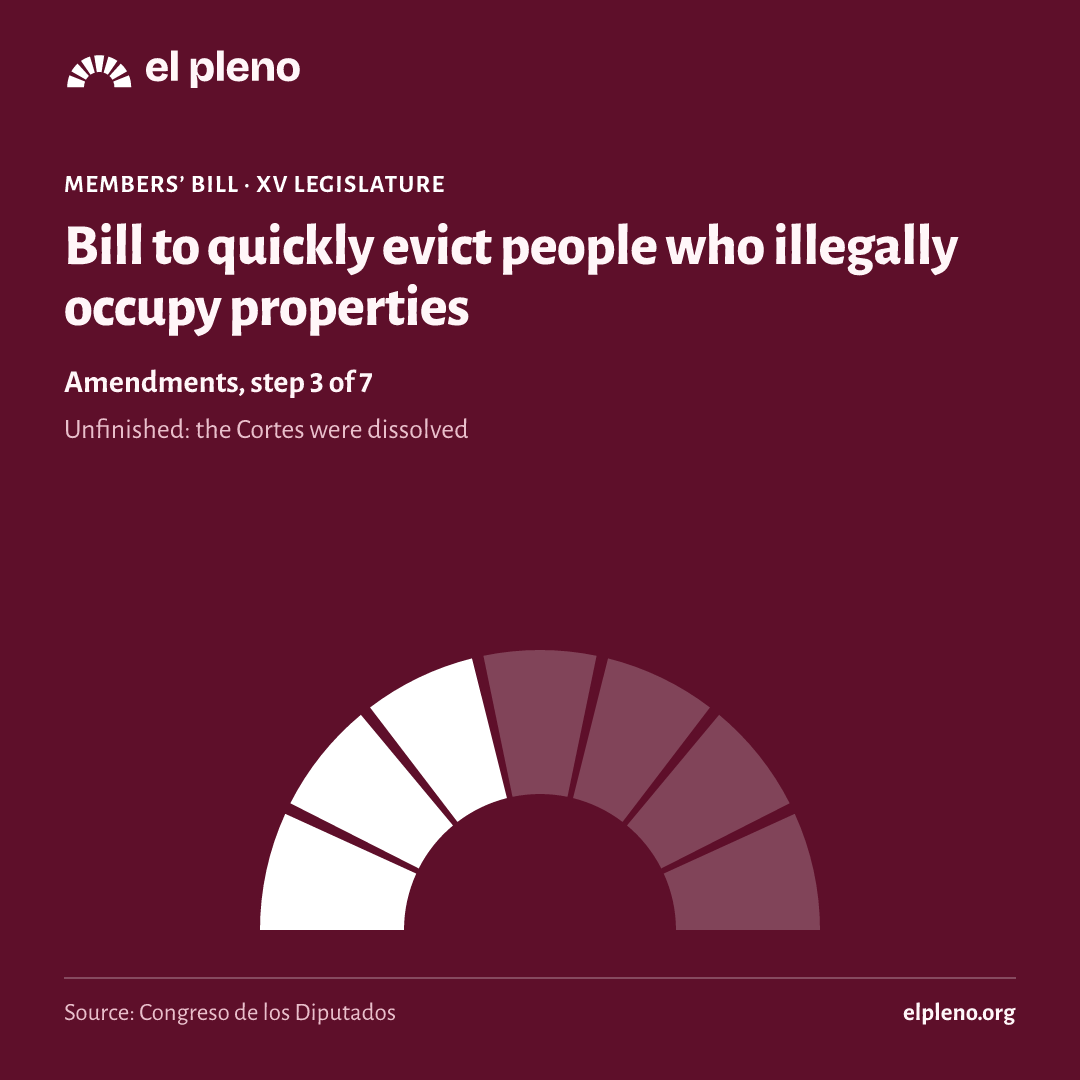
It took 3 of 7 steps. It reached Amendments, and today it is unfinished.
- Introduced12 February 2024Someone registers the text in the Congreso.
- Admitted20 February 2024The Bureau of the Congreso accepts it and, for a members’ bill, the plenary decides whether to consider it.
- Amendments23 February 2024Groups propose changes.
- Committeenot reachedA committee goes through the text in detail.
- Plenarynot reachedAll 350 deputies vote.
- Senatenot reachedThe Senate can pass it, amend it or veto it.
- BOEnot reachedIt is published in the Official State Gazette (BOE) and comes into force.
See the 5 official steps on a timeline
Was there a plenary vote?
We have no plenary vote linked to this law in the Congreso’s data.
What happens next
What happens now?
The legislature ended before it finished. To go on, someone would have to introduce it again in the new Cortes.
It has not been presented again yet.
The same initiative in the other chamber:
- XV Legislature, Senate Organic Private member's bill against illegal occupation and for neighborhood coexistence and the protection of the safety of persons and things in owners' associations.
Presented before in:
- XII Legislature, Congreso de los Diputados· Unfinished Bill to toughen penalties for illegally occupying properties
- XIII Legislature, Congreso de los Diputados· Unfinished Bill to toughen measures against illegal squatting of homes
- XIV Legislature, Congreso de los Diputados· Rejected Bill to quickly evict people who illegally occupy homes
- XIV Legislature, Congreso de los Diputados· Rejected Bill to evict illegal squatters faster and protect neighbors
Sources
Where does all this come from?
- Congreso de los Diputados, file 124/000003
Official title, type, author, dates and stage.
Retrieved 11 November 2026
- Congreso de los Diputados, procedure
The date of each step, with its official wording.
Retrieved 12 November 2026
- The data comes from the open files of the Congreso, the Senate and the BOE, unaltered.
- Each deputy’s province is the one of their seat on the day of the vote.
- We only say “passed” or “rejected” when the majority needed is certain; otherwise we say which side had more votes.