14 February 2013, in the Congreso
Cuts to electric power premiums and rules for SAREB insurance investments
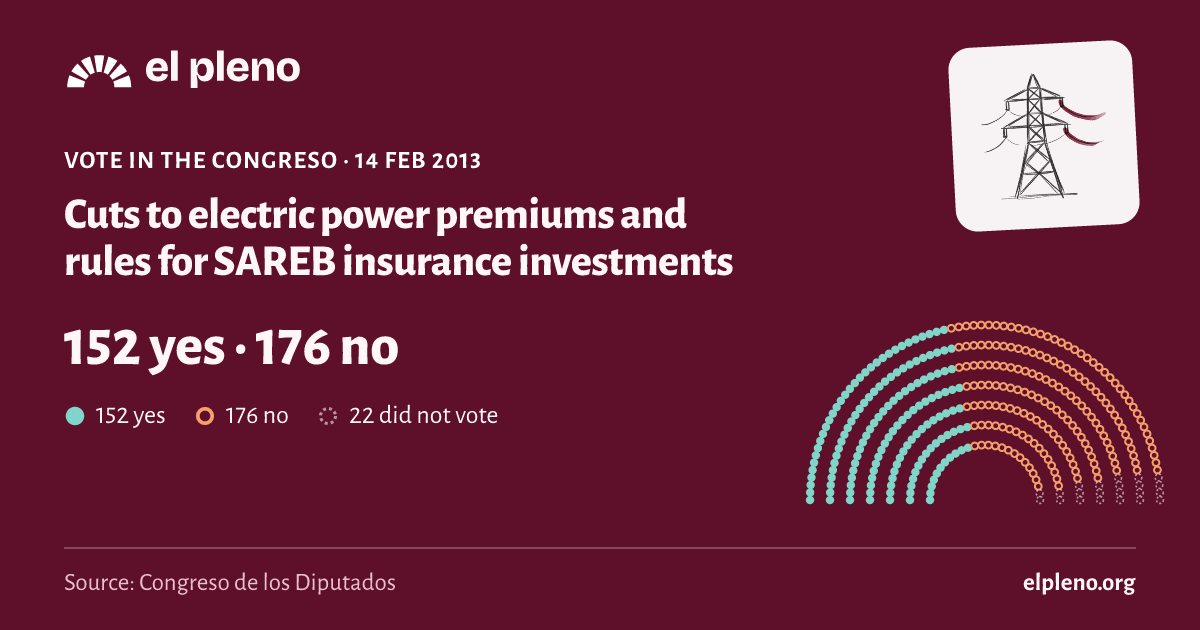
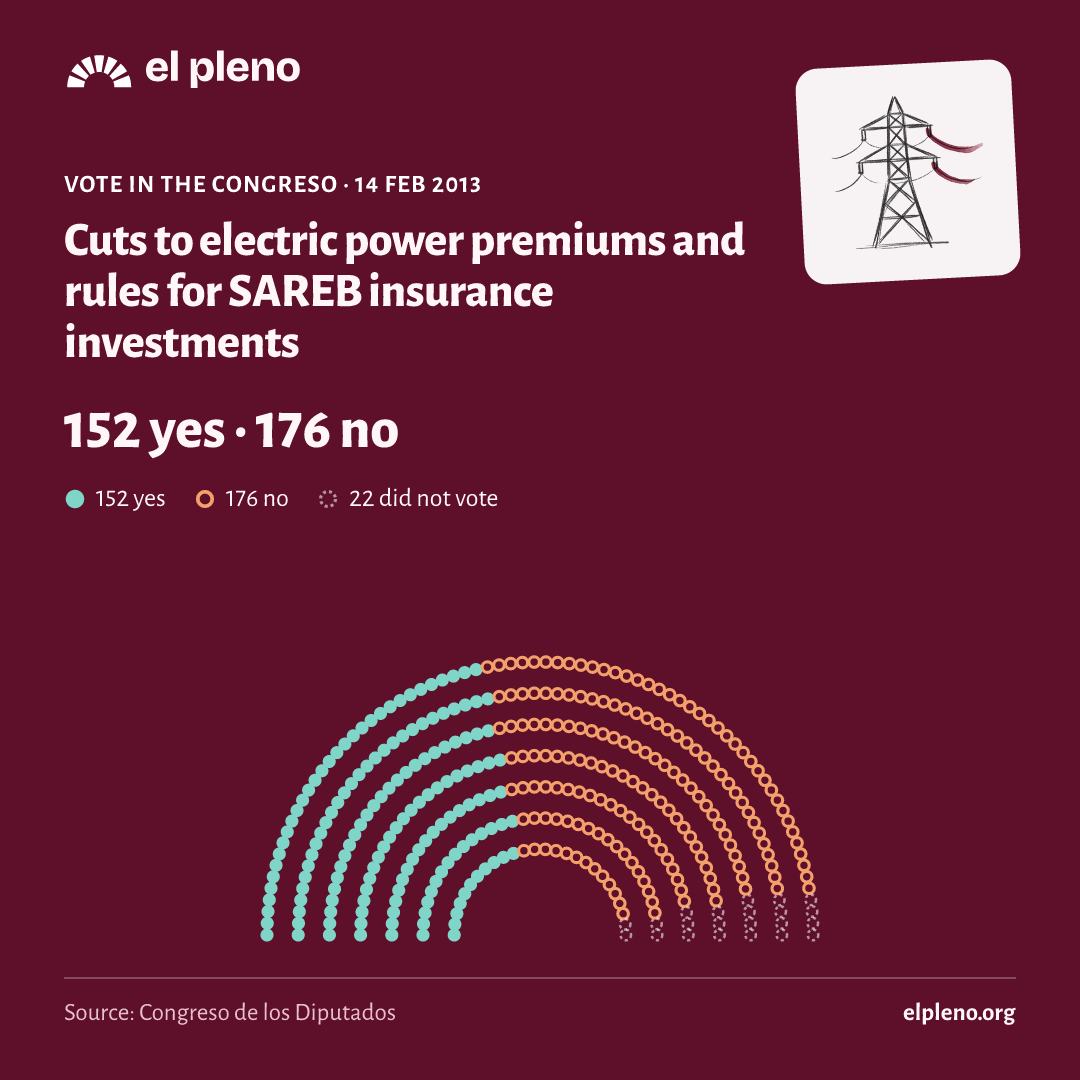
More votes against 152 yes · 176 noMore votes against: 176 no and 152 yes, a margin of 24. 22 did not vote.
BOE step 7 of 7 · Passed Royal Decree-Law 2/2013, of 1 February, on urgent measures in the electricity system and the financial sector.
When we cannot be sure which majority was needed, we do not say whether this means it “passed”: the official file does not say.
Source: Congreso de los Diputados, vote 6 of sitting 84· updated 10 Nov
The chamber
Who voted how?
152 in favour, 176 against. 22 did not vote.
Each dot is a seat. Tap one, or use the arrow keys, to see who it is.
Your province
How did the deputies from your province vote?
Or see how most of each province voted
- A Coruña More votes against 3 yes · 5 no
- Albacete More votes against 1 yes · 3 no
- Alicante/Alacant More votes against 3 yes · 7 no
- Almería More votes against 2 yes · 4 no
- Araba/Álava More votes in favour 3 yes · 1 no
- Asturias More votes in favour 5 yes · 3 no
- Ávila More votes against 1 yes · 2 no
- Badajoz More votes against 2 yes · 4 no
- Barcelona More votes in favour 21 yes · 7 no
- Bizkaia More votes in favour 7 yes · 1 no
- Burgos More votes against 1 yes · 3 no
- Cáceres Tie 2 yes · 2 no
- Cádiz More votes against 3 yes · 5 no
- Cantabria More votes against 1 yes · 4 no
- Castellón/Castelló More votes against 2 yes · 3 no
- Ceuta No count 0 yes · 0 no
- Ciudad Real More votes against 2 yes · 3 no
- Córdoba Tie 3 yes · 3 no
- Cuenca Tie 1 yes · 1 no
- Gipuzkoa More votes in favour 3 yes · 1 no
- Girona More votes in favour 4 yes · 1 no
- Granada Tie 3 yes · 3 no
- Guadalajara More votes against 1 yes · 2 no
- Huelva Tie 2 yes · 2 no
- Huesca More votes against 1 yes · 2 no
- Illes Balears More votes against 3 yes · 5 no
- Jaén More votes against 2 yes · 3 no
- La Rioja More votes against 1 yes · 3 no
- Las Palmas More votes against 2 yes · 4 no
- León More votes against 2 yes · 3 no
- Lleida More votes in favour 2 yes · 1 no
- Lugo More votes against 1 yes · 3 no
- Madrid More votes in favour 17 yes · 16 no
- Málaga More votes against 3 yes · 6 no
- Melilla More votes against 0 yes · 1 no
- Murcia More votes against 2 yes · 8 no
- Navarra More votes in favour 4 yes · 1 no
- Ourense More votes against 1 yes · 3 no
- Palencia More votes against 1 yes · 2 no
- Pontevedra More votes against 1 yes · 4 no
- Salamanca More votes against 1 yes · 3 no
- Santa Cruz de Tenerife More votes against 3 yes · 4 no
- Segovia More votes against 1 yes · 2 no
- Sevilla More votes in favour 7 yes · 5 no
- Soria Tie 1 yes · 1 no
- Tarragona More votes in favour 4 yes · 2 no
- Teruel More votes against 1 yes · 2 no
- Toledo More votes against 2 yes · 4 no
- Valencia/València More votes against 7 yes · 9 no
- Valladolid More votes against 2 yes · 3 no
- Zamora More votes against 1 yes · 2 no
- Zaragoza More votes against 3 yes · 4 no
The groups
How did each group vote?
In favour, most of Socialista, Vasco (EAJ-PNV), Mixto, GC-CiU, GIP and GUPyD. Against, most of Popular en el Congreso.
Coloured by how most of each province’s deputies voted.
- In favour: 11
- Against: 34
- Tie: 6
| Group | Seats | How it voted |
|---|---|---|
| Socialista | 110 | 104 in favour · 6 did not vote |
| Vasco (EAJ-PNV) | 5 | 5 in favour |
| Mixto | 18 | 14 in favour · 4 did not vote |
| GC-CiU | 16 | 13 in favour · 3 did not vote |
| GIP | 11 | 11 in favour |
| GUPyD | 5 | 5 in favour |
| Popular en el Congreso | 185 | 176 against · 9 did not vote |
Sources
Where does all this come from?
Official wording of what was voted on: Tramitación como Proyecto de ley por el procedimiento de urgencia del Real Decreto-Ley 2/2013, de 1 de febrero, de medidas urgentes en el sistema eléctrico y en el sector financiero.
- Congreso de los Diputados, vote 6 of sitting 84
The count and every seat’s vote.
Retrieved 10 November 2026
- The data comes from the open files of the Congreso, the Senate and the BOE, unaltered.
- Each deputy’s province is the one of their seat on the day of the vote.
- We only say “passed” or “rejected” when the majority needed is certain; otherwise we say which side had more votes.