How it works
Who decides what in Spain
Spain is a social and democratic State under the rule of law: the law binds everyone, including those in government, and people’s rights are protected. It is a parliamentary monarchy: the King is Head of State, but the country is governed by whoever has the confidence of the Congreso. And every power comes from the Spanish people, who exercise it above all by voting.
Everything you read here comes from the 1978 Constitution and the laws that build on it; every fact links to its article in the BOE. Constitution, art. 1

- 350 deputies in the Congreso, elected by province Constitution, art. 68
- 209 senators elected directly from the November 29 election on; the regional parliaments appoint more Constitution, art. 69
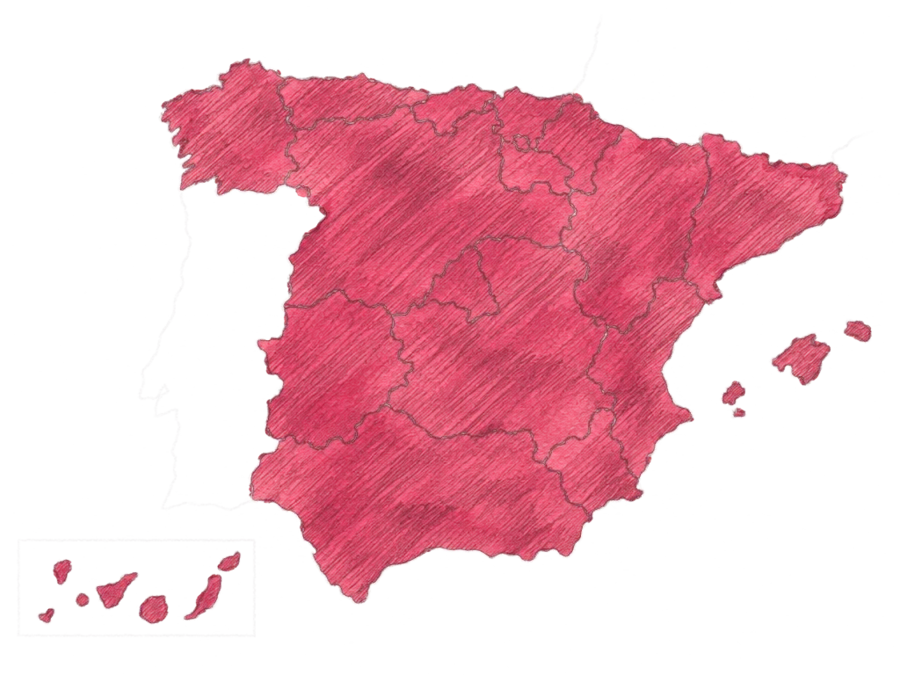
- 17 + 2 autonomous communities (regions) and the autonomous cities of Ceuta and Melilla Constitution, art. 137
- 8,132 municipalities (INE, January 1, 2025) INE
1 · Sharing out power
The three branches, and who checks whom
Power is divided so that no one holds all of it. Pick each one to see what it does and who checks it.
What it does
They make laws, pass the budget and oversee the Government with questions, interpellations and committees.
Whom it checks
- The Government: the Congreso elects the prime minister and can remove them by a motion of censure
- They propose 8 of the 20 members of the CGPJ and 8 of the 12 judges of the Constitutional Court
Who checks it
- The Constitutional Court can strike down a law that goes against the Constitution
- Voters, at every election
2 · Parliament
The Cortes Generales: Congreso and Senate
The Cortes are Spain’s Parliament. They make laws, pass the budget and oversee the Government. They have two chambers, and the two do not carry the same weight.


Congreso de los Diputados
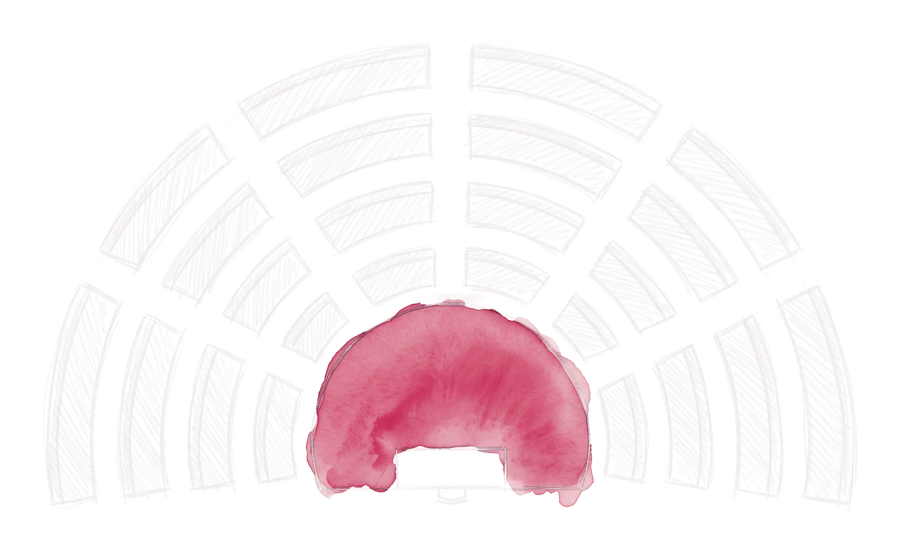
- 350 deputies, elected by province: at least two each, one for Ceuta and one for Melilla, and the rest by population.
- Closed lists, with seats shared out by the D’Hondt method among the lists that get at least 3% of the valid votes in their province.
- It has the last word on laws.


Senate
- The chamber of territorial representation.
- Four senators per mainland province, with their own rules for the islands, Ceuta and Melilla: 209 elected from the 2026 election on, with Formentera.
- Each regional parliament appoints one more, plus one for every million residents.
The number of appointed senators depends on each region’s population register. We will give it from the Senate’s open data once the new Senate meets, on December 23, 2026.
3 · How a law is made
How a law is made, in seven steps
These are the same seven steps you will see on every law in El Pleno. Pick one.
Introduced
The Government introduces a bill. A members’ bill can also be introduced by the groups in the Congreso or fifteen deputies, the Senate, the regional parliaments or 500,000 citizens with their signatures.
Constitution, arts. 87 and 88
Organic law
For fundamental rights, statutes of autonomy and the electoral system, among other subjects. It needs 176 votes in the Congreso in a final vote on the whole text.
Constitution, art. 81The Government’s shortcuts
The decree-law, for cases of extraordinary and urgent need: it applies from publication, but the Congreso must validate it within 30 days of its promulgation. The legislative decree: the Cortes, through a law, ask the Government to draft a text on a set subject within a set deadline.
Constitution, arts. 82 and 864 · The Government
How the prime minister is elected
After an election, the King consults the groups and proposes a candidate for prime minister (Presidente del Gobierno). The Congreso votes. Try it: move the votes.
Abstentions and absences: 7
First vote. It needs 176 yes votes, the absolute majority. 172 is not enough.
Second vote, 48 hours later. More yes votes than no votes is enough: 172 to 171. The candidate is elected.
If no one has been elected two months after the first vote, the Cortes are dissolved and a new election is held. Constitution, art. 99
Motion of censure
At least 35 deputies sign it, naming another candidate. If it gets 176 votes, that candidate becomes prime minister.
Constitution, arts. 113 and 114Question of confidence
The prime minister calls it to check that the Congreso still backs the Government. A simple majority is enough; if it is lost, the Government resigns.
Constitution, arts. 112 and 114The Council of Ministers
The prime minister chooses the ministers. Together they direct policy, the civil service and defense, and prepare the budget that the Cortes pass.
Constitution, arts. 97 and 134

5 · The Head of State
The King signs, but does not decide
The King is the Head of State and represents Spain, but has no political power of his own. Almost all of his acts need a countersignature (refrendo): the signature of the prime minister, a minister or, in some cases, the President of the Congreso, who takes responsibility for it. Without it, the act is not valid.
- He gives royal assent to the laws the Cortes pass, within 15 days.
- He proposes the candidate for prime minister, after consulting the groups.
- He calls and dissolves the Cortes on the prime minister’s proposal.
6 · Close to home
Regions and town councils
There are 17 autonomous communities (regions) and 2 autonomous cities, Ceuta and Melilla. Each has its statute, which the Cortes pass as an organic law, its parliament and its government, and runs many everyday services, such as health care and education, within common rules set by the State. Closer still are the 8,132 municipalities: their councillors elect the mayor.
Constitution, arts. 137, 140 and 147 INE, municipalities on January 1, 2025
El Pleno follows the Cortes, not the regional parliaments or town councils.



7 · Your vote
Elections
In a general election, Spanish citizens aged 18 or over who are on the electoral roll can vote, including those living abroad. The Cortes are elected every four years, or sooner if they are dissolved. For the Congreso you vote for a closed list; for the Senate the list is open and you mark names: up to three in a province that elects four.
LOREG arts. 2, 163 and 1668 · Words worth knowing
A short glossary
- Legislature (term)
- The period between one general election and the next, four years at most.
- Absolute majority
- Half of all the members of the chamber plus one: 176 of 350 in the Congreso.
- Simple majority
- More votes in favor than against, not counting abstentions.
- Government bill
- A proposed law introduced by the Government.
- Members’ bill
- A proposed law introduced by parliamentary groups or fifteen deputies, the Senate, a region or citizens.
- Amendment
- A proposal to change the text of a bill while it is going through Parliament.
- Validate
- When the Congreso approves a Government rule, such as a decree-law, so that it stays in force.
- Countersignature
- The signature of another authority on an act of the King, who takes responsibility for it.
- D’Hondt method
- The formula that shares out each province’s seats according to each list’s votes.

Where El Pleno fits
We follow the Cortes Generales: every law, from the day it is introduced until it appears in the BOE, and every vote in the Congreso and the Senate, with how the deputies and senators of your province voted. All with its official source.
Start with the laws