What it is
Bill to use Spain's official languages before State bodies
It is a members’ bill. Introduced by parliamentary groups, the Senate, regional governments or citizens. It was introduced on 19 November 2025. Introduced by: Rufián Romero, Gabriel (GR) Álvaro Vidal, Francesc-Marc (GR) Estrems Fayos, Etna (GR) Granollers Cunillera, Inés (GR) Jordà i Roura, Teresa (GR) Salvador i Duch, Jordi (GR) Vallugera Balañà, Pilar (GR) Aizpurua Arzallus, Mertxe (GEH Bildu) Fullaondo la Cruz, Marije (GEH Bildu) Iñarritu García, Jon (GEH Bildu) Matute García de Jalón, Oskar (GEH Bildu) Otero Gabirondo, Mikel (GEH Bildu) Pozueta Fernández, Isabel (GEH Bildu) Agirretxea Urresti, Joseba Andoni (GV (EAJ-PNV)) Legarda Uriarte, Mikel (GV (EAJ-PNV)) Renteria Lasanta, Nerea (GV (EAJ-PNV)) Sagastizabal Unzetabarrenetxea, Idoia (GV (EAJ-PNV)) Vaquero Montero, Maribel (GV (EAJ-PNV)) Rego Candamil, Néstor (GMx) Micó Micó, Àgueda (GMx) Ibáñez Mezquita, Alberto (GSUMAR) Vidal Matas, Vicenç (GSUMAR) López Tagliafico, Candela (GSUMAR) Vidal Sáez, Aina (GSUMAR).
Official title: Private member's bill for an Organic Law guaranteeing multilingualism and the linguistic rights of citizens before the institutions of the State.
Source: Congreso de los Diputados, file 123/000001· updated 11 Nov
Automatic summary, not yet reviewed
- The bill would let people who go to courts in a region with its own language use that language and receive notifications in it, without documents filed in that language needing to be translated into Spanish.
- To work as a judge, prosecutor, court clerk or court staff in regions with their own language or civil law, the bill would require an official certificate proving sufficient knowledge of that language, at the level required of Group A1 civil servants in that region.
- In dealings with the State's central administration, the bill would allow starting a procedure in any official language of an autonomous community, and that language would become the language of the procedure. Digital services would also have to work in the different official languages.
- Civil servants who get a position in regions with their own language would have to prove knowledge of that language at the level required of staff in the same group in that region, whether through competitive openings, free designation or transfers.
- The bill would add language criteria to public procurement in regions with two official languages, require music radio stations to reserve 15% of their programming in official languages other than Spanish, and create a fund for dubbing and subtitling audiovisual works in those languages.
- On consumer matters, the bill would let regions with more than one official language require labeling to appear in their own language too, and require pre-contract information, warranties and package travel information to be given in the official language chosen by the consumer.
Who it affects
- People living in regions with their own language, such as Catalan, Galician or Basque: They could use their language before courts and the State's central administration and receive documents in it.
- Judges, prosecutors, court clerks and court staff: They would need to prove sufficient knowledge of the regional language to get positions in those regions.
- Civil servants and job applicants: They would have to prove knowledge of the regional language for positions, transfers or mobility in those regions.
- Companies that contract with the public sector or sell to consumers: They could be affected by language criteria in tenders and by labeling and information in more languages.
- Radio stations and TV platforms: They would have to reserve part of their programming or promote content in official languages other than Spanish.
Words worth knowing
- Lengua cooficial
- A language that, along with Spanish, is official in an autonomous community, such as Catalan, Galician or Basque.
- Lengua vehicular
- The language used as the main language for teaching school subjects.
- Grupo A y Subgrupo A1
- The highest level of Spanish civil servants, requiring a university degree.
- Radiofórmula
- A radio station with continuous programming, usually music, without hosted shows.
- Pliego de cláusulas administrativas
- The document setting out the conditions companies must meet to win a public contract.
It summarizes the text as it was introduced. It is written by artificial intelligence and may contain mistakes: the official text is what counts. Read the official text · How we make summaries
Where it stands
How far did it get?
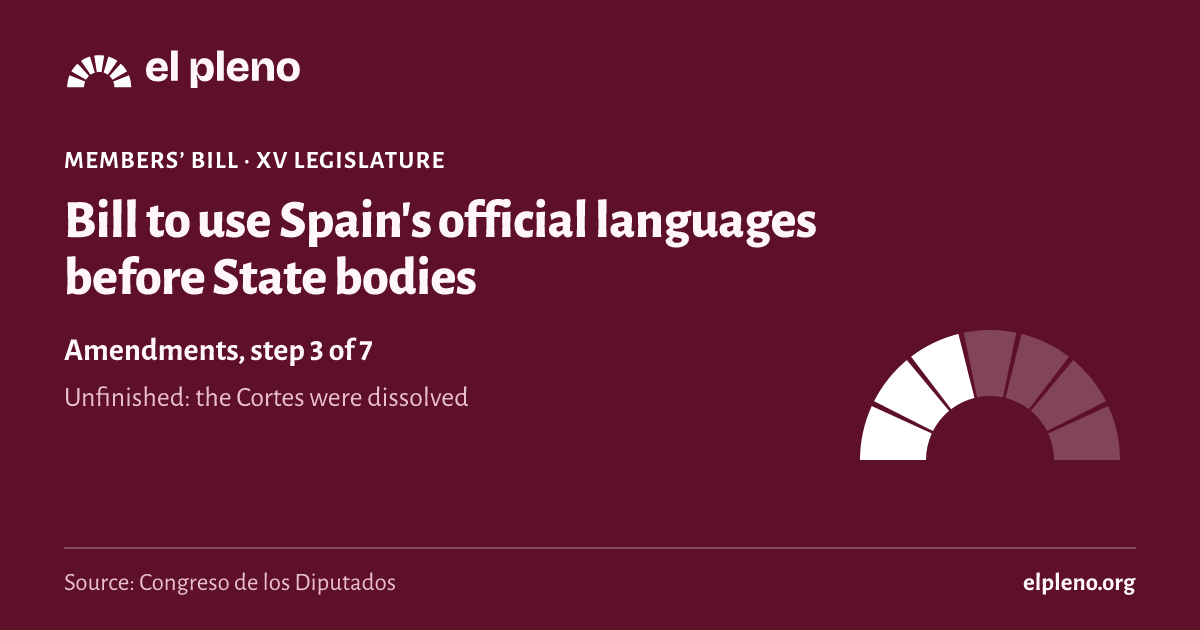
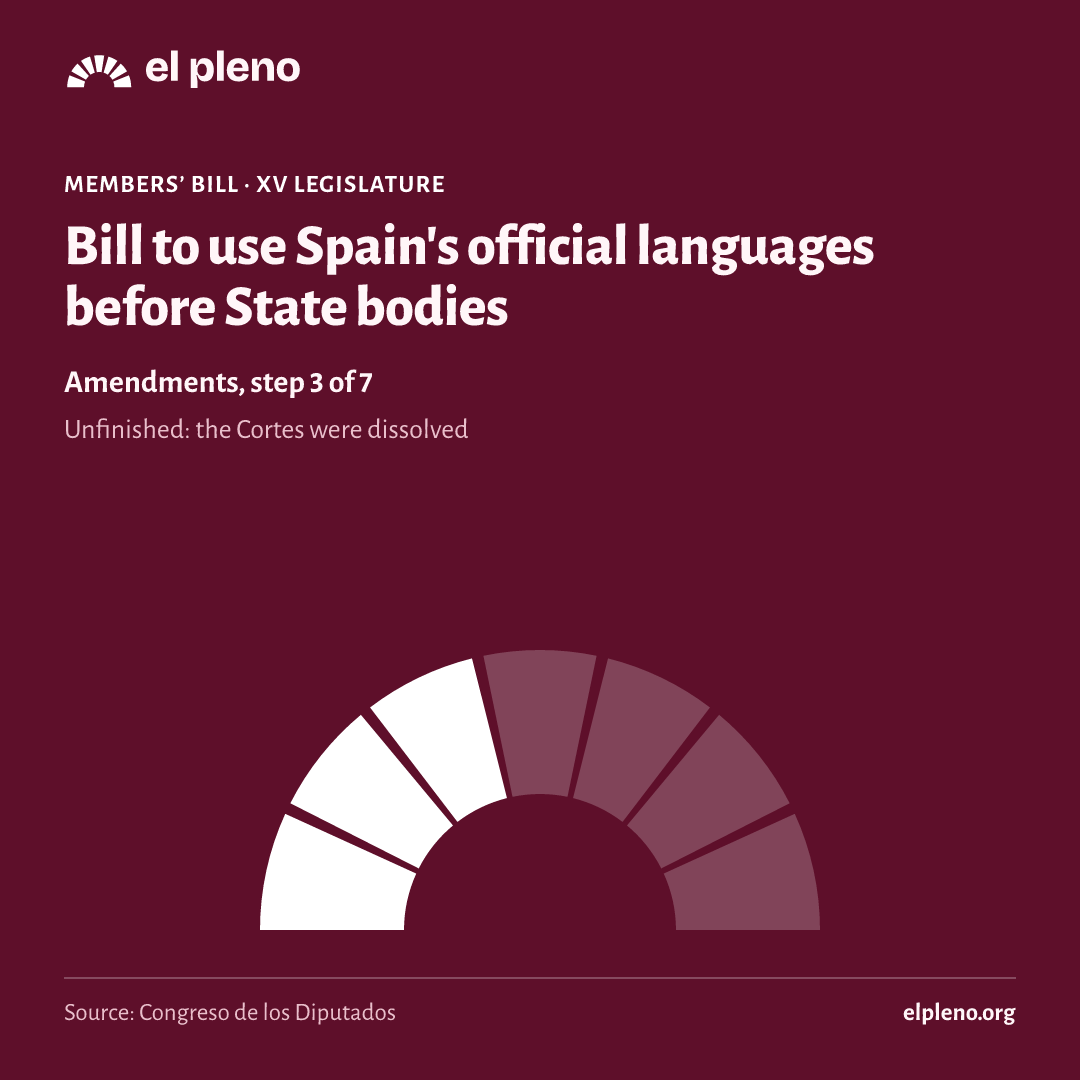
It took 3 of 7 steps. It reached Amendments, and today it is unfinished.
- Introduced19 November 2025Someone registers the text in the Congreso.
- Admitted25 November 2025The Bureau of the Congreso accepts it and, for a members’ bill, the plenary decides whether to consider it.
- Amendments19 December 2025Groups propose changes.
- Committeenot reachedA committee goes through the text in detail.
- Plenarynot reachedThe deputies vote, usually in the plenary; some laws are passed by a committee without going to it.
- Senatenot reachedThe Senate can pass it, amend it or veto it.
- BOEnot reachedThe King gives royal assent and it is published in the Official State Gazette (BOE). It comes into force on the date it sets, or after 20 days if it sets none.
See the 9 official steps on a timeline
9 December 2025
How did the plenary vote?
Voted on: Private member's bill by Mr. Rufián Romero and 23 other Deputies, Organic Law on the guarantee of plurilingualism and the linguistic rights of citizens before the State institutions.
Source: Congreso de los Diputados, vote 3 of sitting 152· updated 10 Nov
Each dot is a seat. Tap one, or use the arrow keys, to see who it is.
Your province
How did the deputies from your province vote?
And your senators: the Senate does not link its votes to this law in its open data, so we cannot put them side by side here.
Or see how most of each province voted
- A Coruña Tie 4 yes · 4 no
- Albacete Tie 2 yes · 2 no
- Alicante/Alacant More votes against 5 yes · 7 no
- Almería More votes against 2 yes · 4 no
- Araba/Álava More votes in favour 3 yes · 1 no
- Asturias More votes against 3 yes · 4 no
- Ávila More votes against 1 yes · 2 no
- Badajoz More votes against 2 yes · 3 no
- Barcelona More votes in favour 25 yes · 7 no
- Bizkaia More votes in favour 7 yes · 1 no
- Burgos Tie 2 yes · 2 no
- Cáceres Tie 2 yes · 2 no
- Cádiz More votes against 4 yes · 5 no
- Cantabria More votes against 2 yes · 3 no
- Castellón/Castelló More votes against 2 yes · 3 no
- Ceuta More votes against 0 yes · 1 no
- Ciudad Real More votes against 2 yes · 3 no
- Córdoba Tie 3 yes · 3 no
- Cuenca More votes against 1 yes · 2 no
- Gipuzkoa More votes in favour 6 yes · 0 no
- Girona More votes in favour 6 yes · 0 no
- Granada More votes against 3 yes · 4 no
- Guadalajara More votes against 1 yes · 2 no
- Huelva More votes against 2 yes · 3 no
- Huesca More votes against 1 yes · 2 no
- Illes Balears Tie 4 yes · 4 no
- Jaén More votes against 2 yes · 3 no
- La Rioja Tie 2 yes · 2 no
- Las Palmas Tie 4 yes · 4 no
- León Tie 2 yes · 2 no
- Lleida More votes in favour 4 yes · 0 no
- Lugo More votes against 1 yes · 3 no
- Madrid More votes against 14 yes · 20 no
- Málaga More votes against 4 yes · 7 no
- Melilla More votes against 0 yes · 1 no
- Murcia More votes against 4 yes · 6 no
- Navarra More votes in favour 3 yes · 2 no
- Ourense More votes against 1 yes · 3 no
- Palencia More votes against 1 yes · 2 no
- Pontevedra More votes in favour 4 yes · 3 no
- Salamanca More votes against 1 yes · 3 no
- Santa Cruz de Tenerife More votes in favour 4 yes · 3 no
- Segovia More votes against 1 yes · 2 no
- Sevilla More votes in favour 6 yes · 5 no
- Soria Tie 1 yes · 1 no
- Tarragona More votes in favour 5 yes · 1 no
- Teruel More votes against 1 yes · 2 no
- Toledo More votes against 2 yes · 4 no
- Valencia/València More votes against 7 yes · 8 no
- Valladolid More votes against 1 yes · 3 no
- Zamora More votes against 1 yes · 2 no
- Zaragoza More votes against 3 yes · 4 no
More details: how each group and each province voted
The groups
Who voted in favour and who against?
In favour, most of Euskal Herria Bildu, Plurinacional SUMAR, Republicano, Socialista, Vasco (EAJ-PNV), Junts per Catalunya and Mixto. Against, most of Popular en el Congreso and VOX. 1 deputy voted differently from their group.
By province: in 11 most voted in favour; in 31, against.
Coloured by how most of each province’s deputies voted.
- In favour: 11
- Against: 31
- Tie: 10
| Group | Seats | How it voted |
|---|---|---|
| Euskal Herria Bildu | 6 | 6 in favour |
| Plurinacional SUMAR | 26 | 25 in favour · 1 did not vote |
| Republicano | 7 | 7 in favour |
| Socialista | 120 | 117 in favour · 3 did not vote |
| Vasco (EAJ-PNV) | 5 | 5 in favour |
| Junts per Catalunya | 7 | 7 in favour |
| Mixto | 9 | 7 in favour · 1 against · 1 did not vote |
| Popular en el Congreso | 137 | 136 against · 1 did not vote |
| VOX | 33 | 33 against |
What happens next
What happens now?
The legislature ended before it finished. To go on, someone would have to introduce it again in the new Cortes.
It has not been presented again yet.
Sources
Where does all this come from?
- Congreso de los Diputados, file 123/000001
Official title, type, author, dates and stage.
Retrieved 11 November 2026
- Congreso de los Diputados, procedure
The date of each step, with its official wording.
Retrieved 13 November 2026
- Congreso de los Diputados, vote 3 of sitting 152
The count and every seat’s vote.
Retrieved 10 November 2026
- The data comes from the open files of the Congreso, the Senate and the BOE, unaltered.
- Each deputy’s province is the one of their seat on the day of the vote.
- We only say “passed” or “rejected” when the majority needed is certain; otherwise we say which side had more votes.