What it is
Bill to guarantee an ATM in towns without banking services
It is a members’ bill. Introduced by parliamentary groups, the Senate, regional governments or citizens. It was introduced on 28 November 2023. Introduced by: Grupo Parlamentario Junts per Catalunya.
Official title: Private member's bill guaranteeing the service of automatic teller machines in municipalities at risk of financial exclusion.
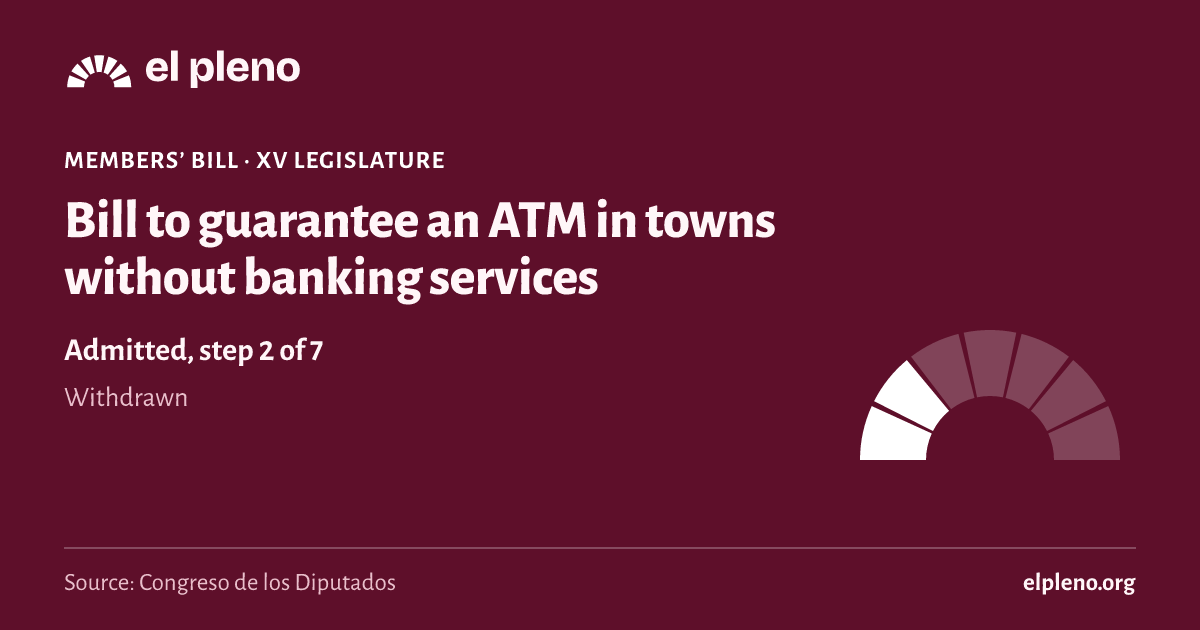
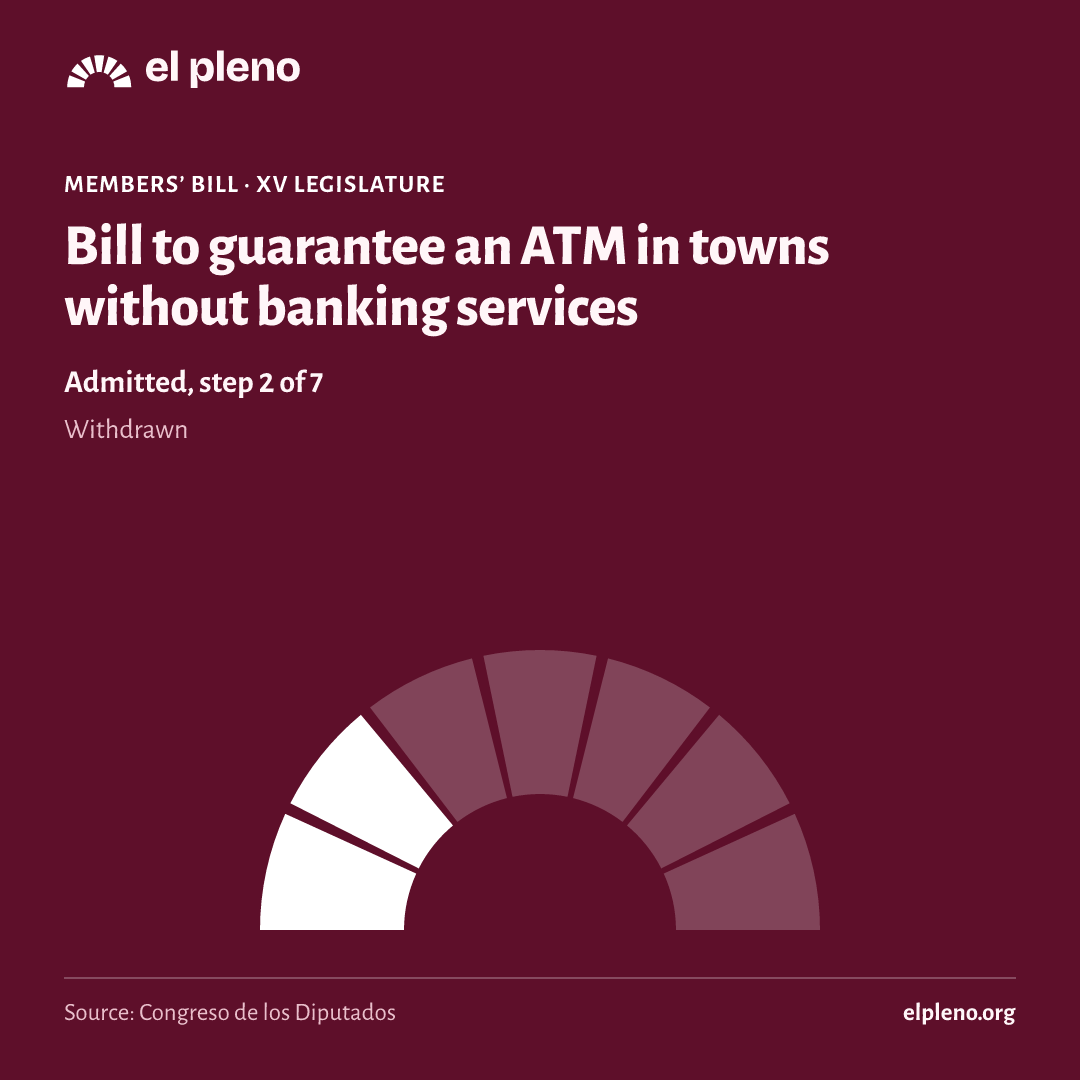
Source: Congreso de los Diputados, file 122/000022· updated 11 Nov
Automatic summary, not yet reviewed
- The bill would give everyone the right to access basic banking services through a nearby ATM, regardless of their town of residence. Towns with no ATM within their boundaries would be considered at risk of financial exclusion and would need to have at least one.
- The ATM would have to work 24 hours a day, every day of the year, be accessible, and offer a minimum set of services: cash withdrawals and deposits, bill and tax payments, balance and transaction inquiries, statements, and transfers. Setup and maintenance costs could not be passed on to users.
- First, a list of at-risk towns would be drawn up: the Banco de España would send a preliminary list, a provisional list would be published, town councils and regions could comment, and a final list would be approved and reviewed every two years. Town councils would propose the locations for the ATMs.
- Installation would be voluntary as the preferred route: financial institutions could choose which towns to place ATMs in and would cover the costs. If a town receives no offer, mandatory installation would kick in.
- Under mandatory installation, the ministry would distribute ATMs among institutions based on their market share. If an institution fails to install one, the Administration could carry out the installation itself, paid for by a guarantee fund funded by contributions from the institutions. In some cases, service could be provided through mobile ATMs.
- The bill also includes supporting measures: keeping the ATMs of closed bank branches running, more support staff in branches for people with fewer digital skills, ATMs reserved for vulnerable people, and in-person service for older people and other groups.
Who it affects
- Residents of towns without an ATM: Would have a guaranteed nearby ATM with basic services, without paying the costs of setting it up.
- Financial institutions with ATMs in Spain: Could install ATMs voluntarily and, if not, be required to install them based on market share and contribute to the guarantee fund.
- Town councils: Would take part in the consultation, propose ATM locations, and coordinate installations.
- People with fewer digital skills or vulnerable groups: Would get support staff in branches, reserved ATMs, and in-person service.
Words worth knowing
- Exclusión financiera (financial exclusion)
- The situation of someone who cannot access basic banking services, such as withdrawing cash from an ATM, because there is none in their town.
- Ejecución subsidiaria (subsidiary enforcement)
- When the public Administration does itself what an entity was required to do and did not do, in this case installing the ATM.
- Cuota de mercado (market share)
- The percentage of the market each financial institution holds, calculated here from its deposits and loans in each province.
- Entidad financiera proveedora referente (designated reference institution)
- The institution in charge of making sure a mandatorily installed ATM works and is properly maintained.
It summarizes the text as it was introduced. It is written by artificial intelligence and may contain mistakes: the official text is what counts. Read the official text · How we make summaries
Where it stands
How far did it get?
It took 2 of 7 steps. It reached Admitted, and today it is withdrawn.
- Introduced28 November 2023Someone registers the text in the Congreso.
- Admitted5 December 2023The Bureau of the Congreso accepts it and, for a members’ bill, the plenary decides whether to consider it.
- Amendmentsnot reachedGroups propose changes.
- Committeenot reachedA committee goes through the text in detail.
- Plenarynot reachedThe deputies vote, usually in the plenary; some laws are passed by a committee without going to it.
- Senatenot reachedThe Senate can pass it, amend it or veto it.
- BOEnot reachedThe King gives royal assent and it is published in the Official State Gazette (BOE). It comes into force on the date it sets, or after 20 days if it sets none.
See the 6 official steps on a timeline
Was there a plenary vote?
We have no plenary vote linked to this law in the Congreso’s data.
What happens next
What happens now?
Whoever introduced it withdrew it, or it was merged into another one. It goes no further.
The same initiative in the other chamber:
- XV Legislature, Senate Private member's bill guaranteeing the service of automatic teller machines in municipalities at risk of financial exclusion.
Presented before in:
- XIV Legislature, Congreso de los Diputados· Unfinished Bill to guarantee ATMs in towns without banks
- XIV Legislature, Congreso de los Diputados· Unfinished Bill to guarantee ATMs in towns without banks
- XIV Legislature, Senate Private member's bill guaranteeing the service of automatic teller machines in municipalities at risk of financial exclusion.
Sources
Where does all this come from?
- Congreso de los Diputados, file 122/000022
Official title, type, author, dates and stage.
Retrieved 11 November 2026
- Congreso de los Diputados, procedure
The date of each step, with its official wording.
Retrieved 13 November 2026
- The data comes from the open files of the Congreso, the Senate and the BOE, unaltered.
- Each deputy’s province is the one of their seat on the day of the vote.
- We only say “passed” or “rejected” when the majority needed is certain; otherwise we say which side had more votes.