What it is
VOX bill would recriminalize picketing and scrap workplace equality plans
It is a members’ bill. Introduced by parliamentary groups, the Senate, regional governments or citizens. It was introduced on 28 March 2023. Introduced by: Grupo Parlamentario VOX.
Official title: Private member's bill for an Organic Law on the protection of workers' constitutional rights.
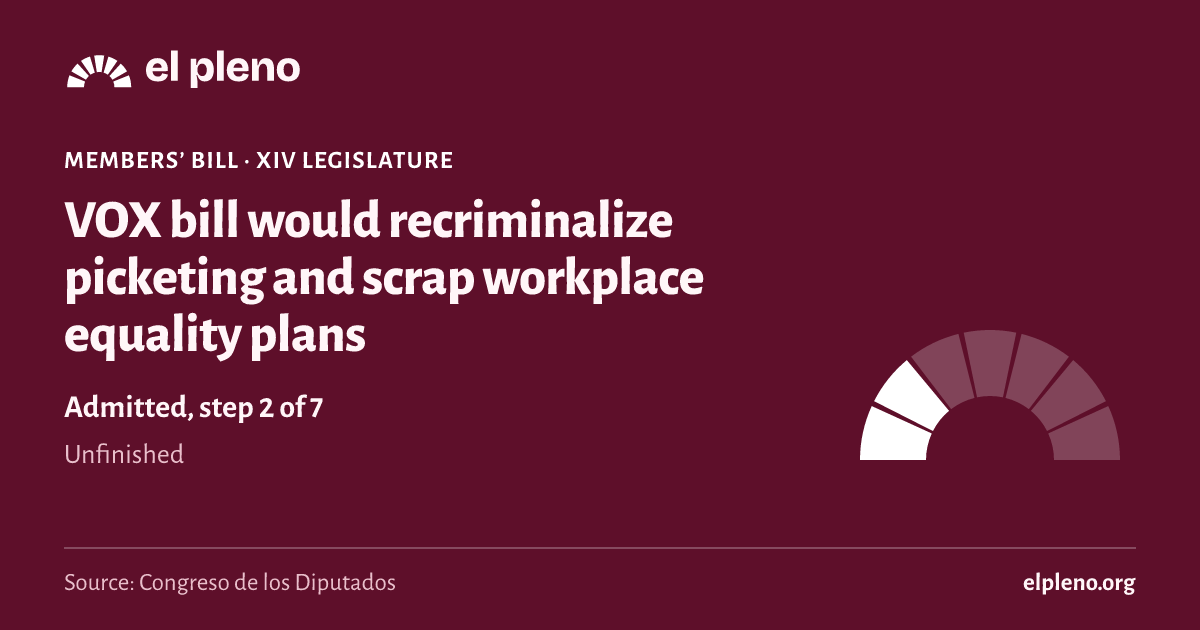
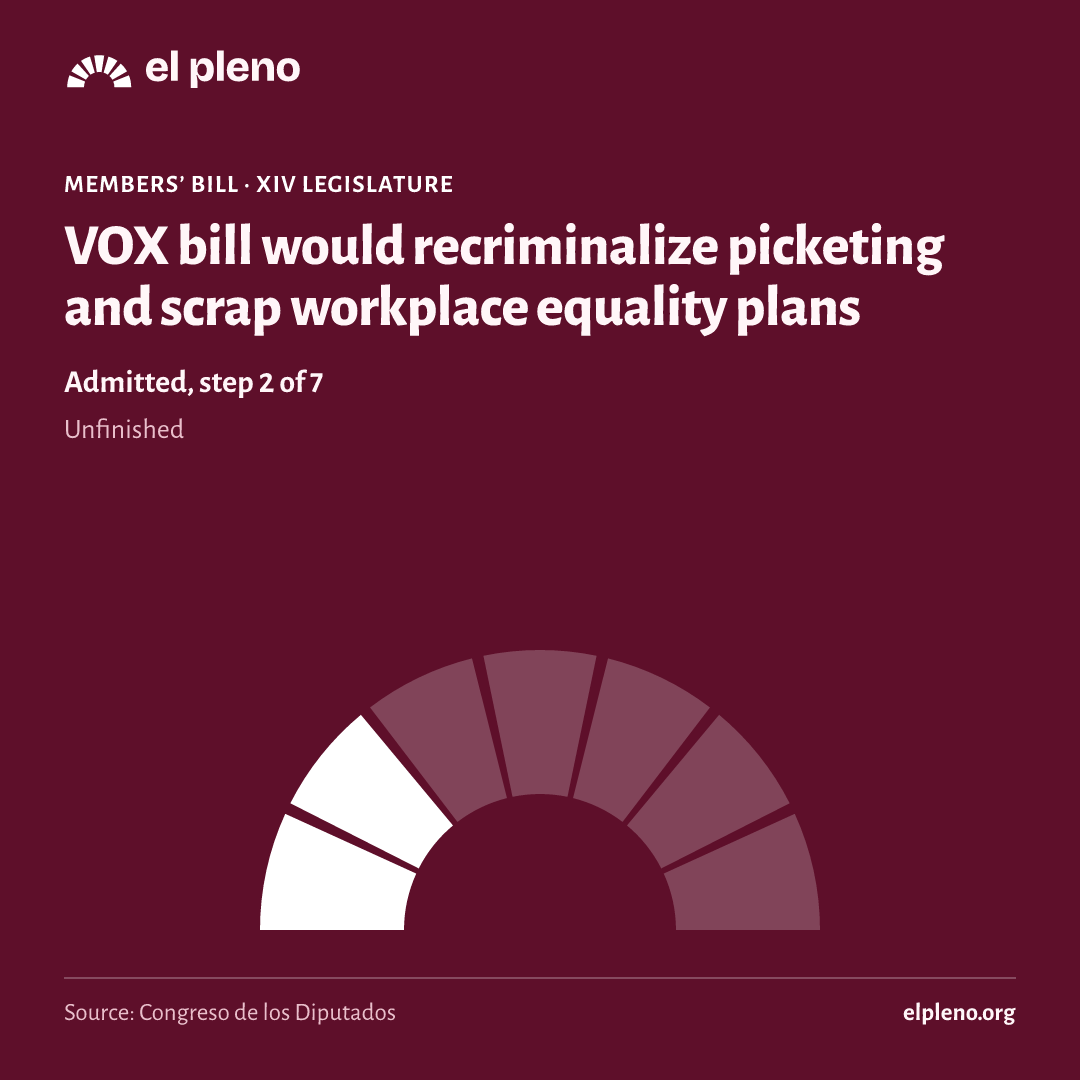
Source: Congreso de los Diputados, file 122/000315· updated 11 Nov
Automatic summary, not yet reviewed
- The bill would punish with two to four years and six months in prison, or a fine, anyone who coerces others to start or continue a strike. In other words, it would again make so-called violent picketing a crime.
- The bill would remove workplace gender equality plans and void the ones already in place. Companies would still have to respect equality among workers and prevent crimes against sexual freedom at work.
- The bill would delete the rule that presumes delivery platform couriers are employees. According to the text, the affected workers themselves have complained that a regime they do not want is being applied to them.
- The bill would trim the role of equality plans in the Workers' Statute: it removes references to them in several articles and adjusts rules on collective agreements and on companies opting out of agreed working conditions.
- The criminal changes and the changes to the equality law would be organic in nature, meaning a more demanding approval process. The remaining provisions would be ordinary.
- The law would take effect the day after its publication in the Official State Gazette (Boletín Oficial del Estado), if it were passed.
Who it affects
- Workers deciding whether to join a strike: Coercing them to start or continue a strike would become a crime again.
- Companies: They would no longer have to have equality plans, and existing ones would be voided.
- Delivery platform couriers: They would no longer be presumed to be employees.
- Unions and employers in collective bargaining: Some rules on collective agreements and opting out of working conditions would change.
Words worth knowing
- Proposición de ley
- A bill introduced by a parliamentary group so it can become law. It is not approved yet.
- Ley orgánica
- A type of Spanish law that requires special majorities and is reserved for major matters such as fundamental rights or the Criminal Code.
- Piquete
- A group of people who, during a strike, try to stop other workers from going to work, sometimes by pressuring them.
- Plan de igualdad
- A set of measures a company must adopt to treat men and women equally at work.
- Convenio colectivo
- An agreement setting working conditions (pay, hours, etc.) for a sector or a company.
It summarizes the text as it was introduced. It is written by artificial intelligence and may contain mistakes: the official text is what counts. Read the official text · How we make summaries
Where it stands
How far did it get?
It took 2 of 7 steps. It reached Admitted, and today it is unfinished.
- Introduced28 March 2023Someone registers the text in the Congreso.
- Admitted11 April 2023The Bureau of the Congreso accepts it and, for a members’ bill, the plenary decides whether to consider it.
- Amendmentsnot reachedGroups propose changes.
- Committeenot reachedA committee goes through the text in detail.
- Plenarynot reachedAll 350 deputies vote.
- Senatenot reachedThe Senate can pass it, amend it or veto it.
- BOEnot reachedIt is published in the Official State Gazette (BOE) and comes into force.
See the 6 official steps on a timeline
Was there a plenary vote?
We have no plenary vote linked to this law in the Congreso’s data.
What happens next
What happens now?
The legislature ended before it finished. To go on, someone would have to introduce it again in the new Cortes.
It was presented again:
- XV Legislature, Congreso de los Diputados· Unfinished VOX bill would recriminalize picket coercion and remove workplace equality plans
Sources
Where does all this come from?
- Congreso de los Diputados, file 122/000315
Official title, type, author, dates and stage.
Retrieved 11 November 2026
- The data comes from the open files of the Congreso, the Senate and the BOE, unaltered.
- Each deputy’s province is the one of their seat on the day of the vote.
- We only say “passed” or “rejected” when the majority needed is certain; otherwise we say which side had more votes.