What it is
Bill to strengthen political and judicial oversight of Spain's intelligence agency
It is a members’ bill. Introduced by parliamentary groups, the Senate, regional governments or citizens. It was introduced on 18 November 2022. Introduced by: Grupo Parlamentario Vasco (EAJ-PNV).
Official title: Private member's bill amending Law 11/2002, of May 6, regulating the National Intelligence Center; and Organic Law 2/2002, of May 6, regulating the prior judicial control of the National Intelligence Center.
Source: Congreso de los Diputados, file 122/000274· updated 11 Nov
Automatic summary, not yet reviewed
- The bill would have the person holding the presidency of the Government directly propose the appointment of the CNI Centro Nacional de Inteligencia: Spain's intelligence service, which gathers information to protect the State's interests.'s Secretary of State Director, creating direct political responsibility. It would also expand what the Congressional committee overseeing the CNI can know, including the means used in court-authorized interceptions.
- The bill would have three Supreme Court judges authorize, unanimously and through a reasoned decision, CNI activities affecting the home and the secrecy of communications. The ordinary deadline would be 72 hours, reduced to 24 hours for duly justified urgency.
- The bill would require the CNI Director's request to specify the means and resources to be used, with their concrete features, so the judges can weigh proportionality. It would also set maximum time limits: 24 hours for entering homes and 3 months for intercepting communications, both renewable for equal periods.
- The bill would add after-the-fact oversight: when each authorization or extension ends, the CNI Director must inform the judges of how it was carried out, so they can check it matched its content. Material obtained that is unrelated to the authorization's purpose must be destroyed immediately.
- The bill would have the General Council of the Judiciary propose, for a five-year term, three Supreme Court judges (from the Criminal or Administrative Chamber, with at least 3 years in the post) to authorize these activities, with substitute judges also provided for.
- The bill would make several wording changes to the CNI law: the Government's Delegated Commission for Intelligence Affairs would be chaired by a vice presidency of the Government chosen by its president, and the CNI Director's term would be set at five years, with the possibility of replacement at any time.
Who it affects
- The National Intelligence Centre (CNI) and its director: Their appointments, government commission and activities would face more political and judicial oversight.
- The President of the Government: Would directly propose the appointment of the CNI Director and bear political responsibility for it.
- The designated Supreme Court judges: Would unanimously authorize CNI measures affecting homes and communications, and later check how they were carried out.
- People investigated or affected by CNI operations: Would get more safeguards: a detailed request, maximum time limits and destruction of material unrelated to the authorization.
- The Congress of Deputies: Its oversight committee could learn about the means used in court-authorized interceptions.
Words worth knowing
- CNI
- Centro Nacional de Inteligencia: Spain's intelligence service, which gathers information to protect the State's interests.
- Proposición de ley
- A bill introduced by a parliamentary group. It is not an approved law: it must be debated and voted on in the Congress and the Senate.
- Ley Orgánica
- Organic law: a type of law reserved for major matters, such as fundamental rights. It requires an absolute majority in the Congress to pass.
- Resolución motivada
- A reasoned decision: a written ruling by a judge or court explaining the reasons for its decision.
- Principio de proporcionalidad
- Principle of proportionality: a measure can only be adopted if it is suitable, necessary and does not go beyond what is essential.
It summarizes the text as it was introduced. It is written by artificial intelligence and may contain mistakes: the official text is what counts. Read the official text · How we make summaries
Where it stands
How far did it get?
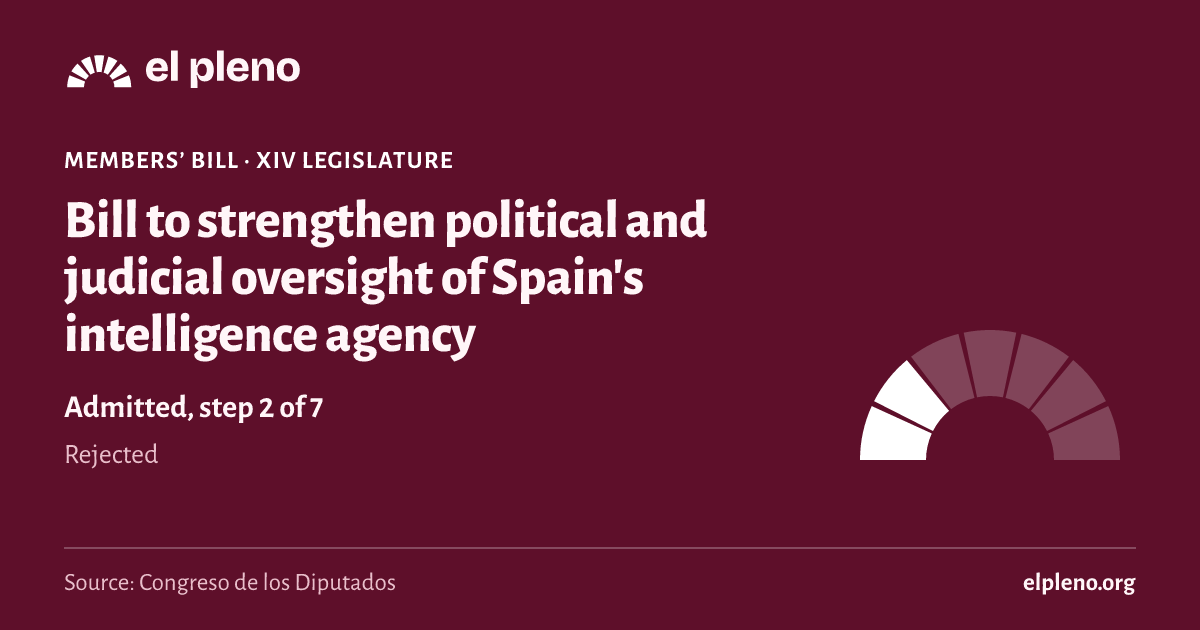
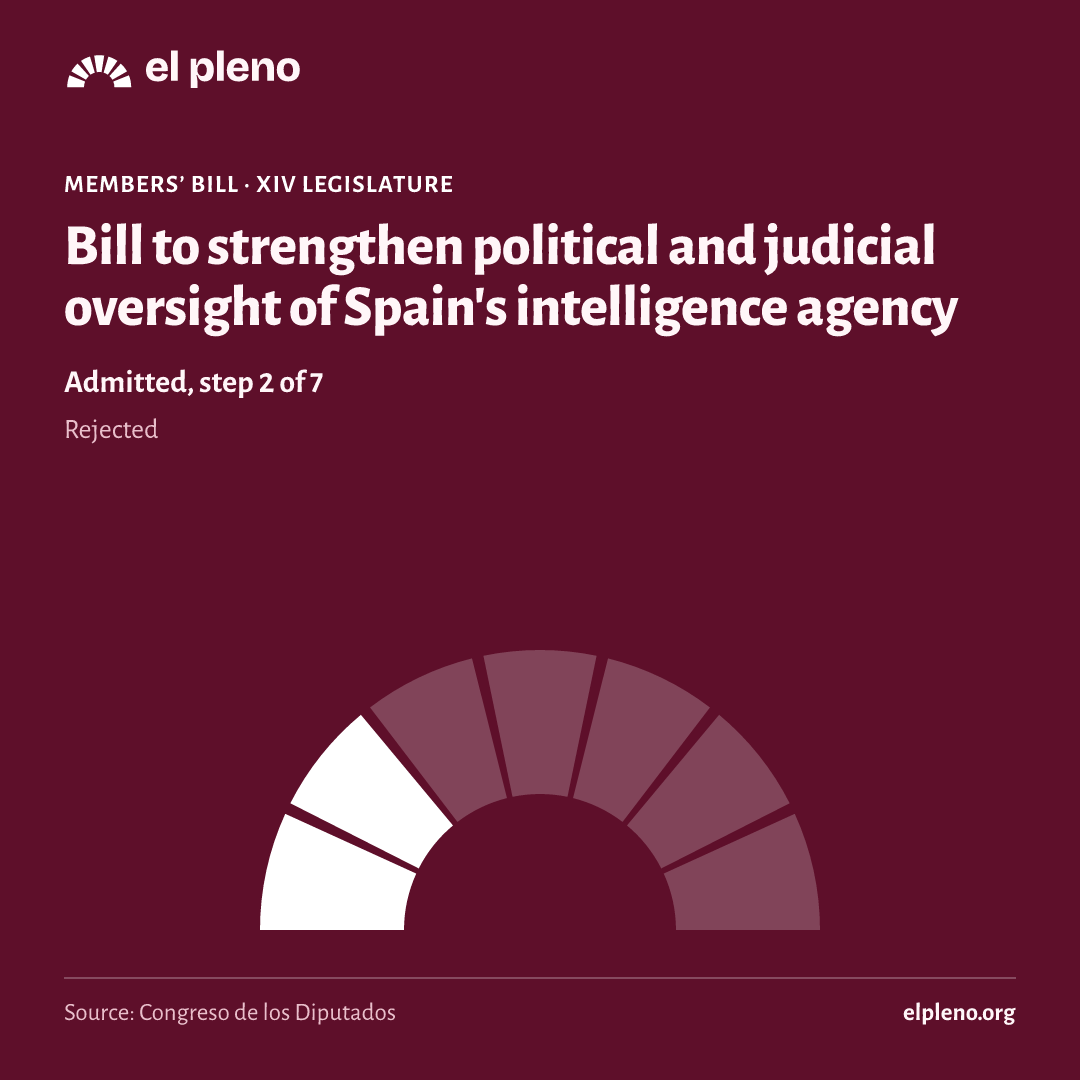
It took 2 of 7 steps. It reached Admitted, and today it is rejected.
- Introduced18 November 2022Someone registers the text in the Congreso.
- Admitted21 November 2022The Bureau of the Congreso accepts it and, for a members’ bill, the plenary decides whether to consider it.
- Amendmentsnot reachedGroups propose changes.
- Committeenot reachedA committee goes through the text in detail.
- Plenarynot reachedAll 350 deputies vote.
- Senatenot reachedThe Senate can pass it, amend it or veto it.
- BOEnot reachedIt is published in the Official State Gazette (BOE) and comes into force.
See the 5 official steps on a timeline
13 December 2022
How did the plenary vote?
Voted on: Private Member's Bill of the Basque Parliamentary Group (EAJ-PNV), amending Law 11/2002, of May 6, regulating the National Intelligence Center; and Organic Law 2/2002, of May 6, regulating the prior judicial control of the National Intelligence Center.
Source: Congreso de los Diputados, vote 1 of sitting 223· updated 10 Nov
Each dot is a seat. Tap one, or use the arrow keys, to see who it is.
Your province
How did the deputies from your province vote?
And your senators: the Senate does not link its votes to this law in its open data, so we cannot put them side by side here.
Or see how most of each province voted
- A Coruña More votes against 1 yes · 6 no
- Albacete More votes against 0 yes · 4 no
- Alicante/Alacant More votes against 0 yes · 11 no
- Almería More votes against 0 yes · 6 no
- Araba/Álava Tie 2 yes · 2 no
- Asturias More votes against 0 yes · 6 no
- Ávila More votes against 0 yes · 3 no
- Badajoz More votes against 0 yes · 6 no
- Barcelona More votes against 11 yes · 19 no
- Bizkaia Tie 4 yes · 4 no
- Burgos More votes against 0 yes · 4 no
- Cáceres More votes against 0 yes · 4 no
- Cádiz More votes against 0 yes · 9 no
- Cantabria More votes against 0 yes · 4 no · 1 abst.
- Castellón/Castelló More votes against 0 yes · 5 no
- Ceuta More votes against 0 yes · 1 no
- Ciudad Real More votes against 0 yes · 5 no
- Córdoba More votes against 0 yes · 6 no
- Cuenca More votes against 0 yes · 3 no
- Gipuzkoa More votes in favour 4 yes · 2 no
- Girona More votes in favour 3 yes · 2 no
- Granada More votes against 0 yes · 7 no
- Guadalajara More votes against 0 yes · 3 no
- Huelva More votes against 0 yes · 5 no
- Huesca More votes against 0 yes · 3 no
- Illes Balears More votes against 0 yes · 8 no
- Jaén More votes against 0 yes · 5 no
- La Rioja More votes against 0 yes · 4 no
- Las Palmas More votes against 2 yes · 6 no
- León More votes against 0 yes · 4 no
- Lleida More votes in favour 3 yes · 1 no
- Lugo More votes against 0 yes · 4 no
- Madrid More votes against 2 yes · 34 no
- Málaga More votes against 0 yes · 11 no
- Melilla More votes against 0 yes · 1 no
- Murcia More votes against 0 yes · 10 no
- Navarra More votes against 1 yes · 4 no
- Ourense More votes against 0 yes · 4 no
- Palencia More votes against 0 yes · 3 no
- Pontevedra More votes against 0 yes · 6 no
- Salamanca More votes against 0 yes · 4 no
- Santa Cruz de Tenerife More votes against 1 yes · 5 no
- Segovia More votes against 0 yes · 3 no
- Sevilla More votes against 0 yes · 11 no
- Soria More votes against 0 yes · 2 no
- Tarragona More votes against 2 yes · 3 no
- Teruel More votes against 0 yes · 2 no
- Toledo More votes against 0 yes · 6 no
- Valencia/València More votes against 1 yes · 14 no
- Valladolid More votes against 0 yes · 5 no
- Zamora More votes against 0 yes · 3 no
- Zaragoza More votes against 0 yes · 7 no
More details: how each group and each province voted
The groups
Who voted in favour and who against?
In favour, most of Euskal Herria Bildu, Republicano, Vasco (EAJ-PNV), Mixto and GPlu. Against, most of Socialista, Ciudadanos, Gcup-ec-gc, Popular en el Congreso and VOX. 4 deputies voted differently from their group.
By province: in 3 most voted in favour; in 47, against.
Coloured by how most of each province’s deputies voted.
- In favour: 3
- Against: 47
- Tie: 2
| Group | Seats | How it voted |
|---|---|---|
| Euskal Herria Bildu | 5 | 5 in favour |
| Republicano | 13 | 13 in favour |
| Socialista | 120 | 118 against · 2 did not vote |
| Vasco (EAJ-PNV) | 6 | 6 in favour |
| Mixto | 11 | 5 in favour · 3 against · 1 abst. · 2 did not vote |
| Ciudadanos | 9 | 9 against |
| Gcup-ec-gc | 33 | 31 against · 2 did not vote |
| GPlu | 12 | 8 in favour · 4 did not vote |
| Popular en el Congreso | 88 | 87 against · 1 did not vote |
| VOX | 52 | 52 against |
What happens next
What happens now?
It goes no further. A similar one could be introduced later.
It was presented again:
- XV Legislature, Congreso de los Diputados· Unfinished Bill to strengthen political and judicial oversight of Spain's intelligence agency
Sources
Where does all this come from?
- Congreso de los Diputados, file 122/000274
Official title, type, author, dates and stage.
Retrieved 11 November 2026
- Congreso de los Diputados, vote 1 of sitting 223
The count and every seat’s vote.
Retrieved 10 November 2026
- The data comes from the open files of the Congreso, the Senate and the BOE, unaltered.
- Each deputy’s province is the one of their seat on the day of the vote.
- We only say “passed” or “rejected” when the majority needed is certain; otherwise we say which side had more votes.