What it is
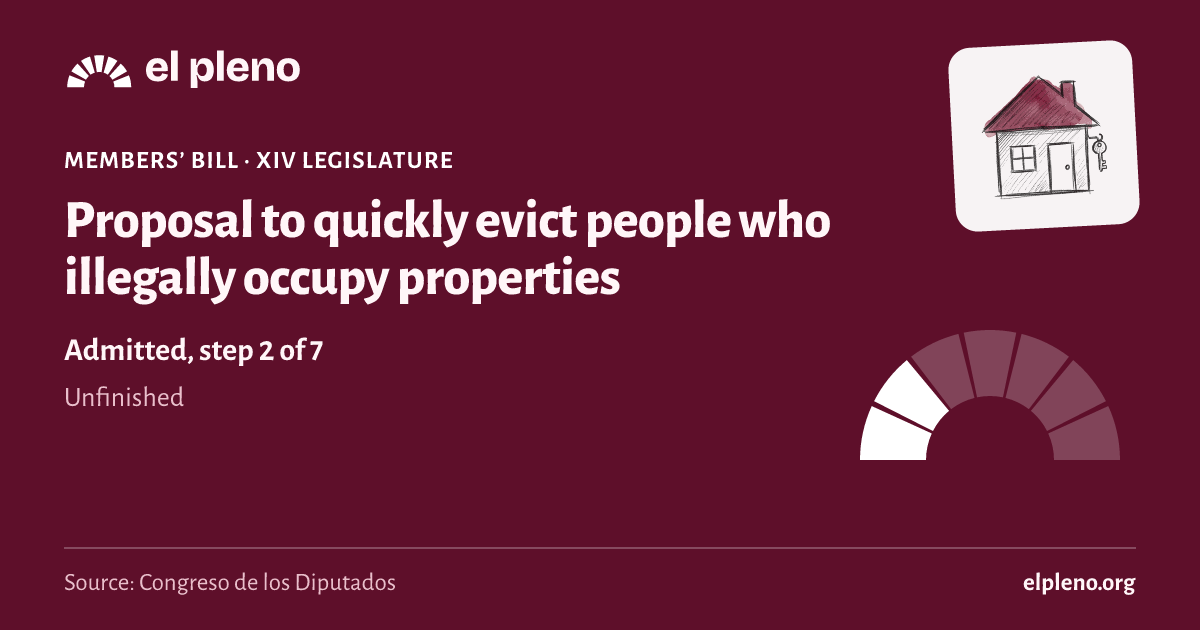
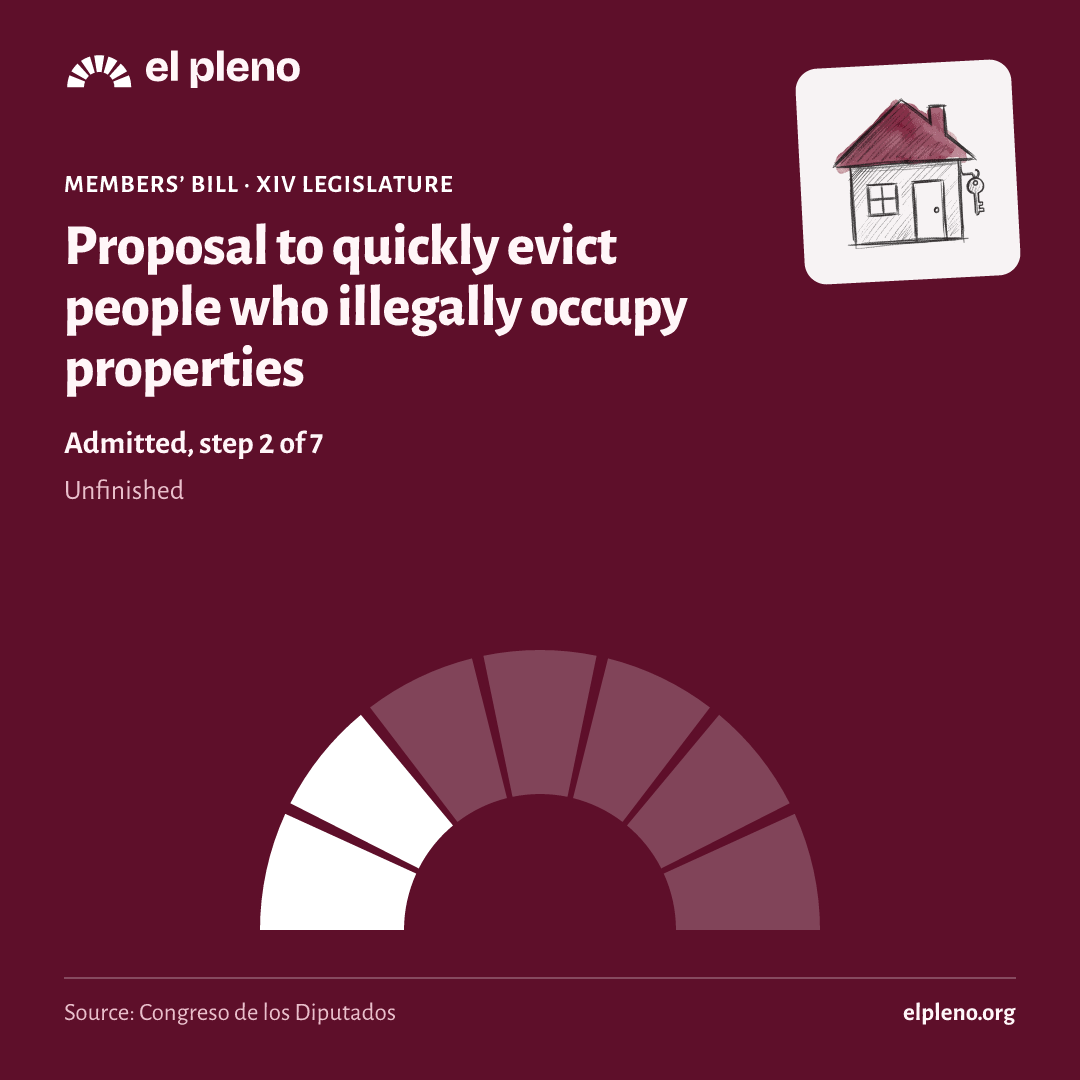
Proposal to quickly evict people who illegally occupy properties
It is a members’ bill. Introduced by parliamentary groups, the Senate, regional governments or citizens. It was introduced on 31 May 2022. Introduced by: Grupo Parlamentario Plural.
Official title: Private member's bill for urgent measures to address the illegal occupation of properties.
Source: Congreso de los Diputados, file 122/000231· updated 11 Nov
Automatic summary, not yet reviewed
- The bill would allow a judge to order the eviction of an occupied property within a maximum of 48 hours from the request, with no bond required, as long as the occupants cannot show a legal title justifying their presence. The judge could notify municipal social services to rehouse especially vulnerable occupants.
- The Code of Criminal Procedure would be amended so that initial steps include immediately protecting the victims of a crime, through adequate and proportionate precautionary measures.
- Homeowners' associations could request precautionary measures, including eviction, against occupants without title who carry out prohibited or illegal activities in the building. If the lawful possessor does not act within ten days, the association could bring the action in their place, though the possessor bears the costs.
- Municipal security and community coexistence in cases of illegal occupation of properties would be added to the powers of municipalities, enabling Local Security Boards to act.
- The law would take effect the day after its publication in the Official State Gazette.
Who it affects
- Owners of occupied homes or premises: Could recover the property through a court-ordered eviction within 48 hours.
- Homeowners' associations: Could request an end to harmful activities and the eviction of occupants, even in place of the lawful possessor.
- Occupants of properties: Could be evicted within 48 hours if they cannot prove a title; social services could rehouse the most vulnerable.
- City councils: Would have authority over security and community coexistence in cases of illegal occupation.
Words worth knowing
- Medida cautelar
- Provisional court decision adopted while a case is ongoing to protect a right, for example evicting the property before the final ruling.
- Delito de consumación permanente
- A continuing offense: the crime keeps being committed as long as the offender maintains the illegal situation, as the text says happens with occupation.
- Título jurídico
- Document or right that legally justifies being in a property, such as a rental contract or ownership.
- Caución
- A bond or guarantee required from whoever asks for a court measure, in case they lose the case.
- Usurpación (artículo 245 del Código Penal)
- The crime of entering or staying in someone else's property against the owner's will.
It summarizes the text as it was introduced. It is written by artificial intelligence and may contain mistakes: the official text is what counts. Read the official text · How we make summaries
Where it stands
How far did it get?
It took 2 of 7 steps. It reached Admitted, and today it is unfinished.
- Introduced31 May 2022Someone registers the text in the Congreso.
- Admitted7 June 2022The Bureau of the Congreso accepts it and, for a members’ bill, the plenary decides whether to consider it.
- Amendmentsnot reachedGroups propose changes.
- Committeenot reachedA committee goes through the text in detail.
- Plenarynot reachedAll 350 deputies vote.
- Senatenot reachedThe Senate can pass it, amend it or veto it.
- BOEnot reachedIt is published in the Official State Gazette (BOE) and comes into force.
See the 6 official steps on a timeline
Was there a plenary vote?
We have no plenary vote linked to this law in the Congreso’s data.
What happens next
What happens now?
The legislature ended before it finished. To go on, someone would have to introduce it again in the new Cortes.
It was presented again:
- XV Legislature, Congreso de los Diputados· Unfinished Private member's bill for an Organic Law of urgent measures to address the illegal occupation of real estate.
Sources
Where does all this come from?
- Congreso de los Diputados, file 122/000231
Official title, type, author, dates and stage.
Retrieved 11 November 2026
- The data comes from the open files of the Congreso, the Senate and the BOE, unaltered.
- Each deputy’s province is the one of their seat on the day of the vote.
- We only say “passed” or “rejected” when the majority needed is certain; otherwise we say which side had more votes.