What it is
The bill would set minimum quality rules for customer service
It is a government bill. Introduced by the Government. It was introduced on 1 June 2022. Introduced by: Gobierno.
Official title: Government bill regulating customer service.
Source: Congreso de los Diputados, file 121/000104· updated 11 Nov
Automatic summary, not yet reviewed
- The bill would set mandatory minimum quality levels for customer service departments of large companies and companies providing basic services of general interest, such as water, energy, transport, postal, telecommunications and financial services.
- Companies would have to accept queries, complaints and claims through the same channel used to start the contract and, at minimum, also by post, phone and an electronic means. Physical stores open to the public would also have to accept them.
- Answering machines or bots could not be the only way to reach customer service. If customers ask, the company would have to provide attention from a trained person, with 95% of such requests answered on average in under three minutes. Calls could not be cut off for long waiting times.
- Calls could cost no more than a call to a standard landline or cell phone, and free phone numbers could not be redirected to paid numbers. For continuous basic services, phone support would have to be available 24 hours a day to report outages.
- Each query, complaint or claim would receive an identification key and a written receipt on a durable medium, so customers can track it. Decisions would have to be reasoned and sent within a maximum of 15 business days, or two hours for incidents affecting the continuity of basic services.
- Customer service channels would have to appear in the contract, invoices and website, and replies would have to be in the language of the contract and, on request, at least in Spanish. Vulnerable people, people with disabilities and older people would be entitled to accessible formats and personalized assistance.
- Companies would have to set up an annual system to evaluate service quality, audited by an accredited entity, and publish the documentation on their website. Non-compliance would be punished as a consumer offense.
- Companies would have nine months from the law's entry into force to adapt. The bill would also amend consumer, financial system and telecommunications rules, and in the financial sector oversight would remain with the Bank of Spain (Banco de España), the CNMV and the Directorate General for Insurance and Pension Funds.
Who it affects
- Large companies and providers of basic services (water, energy, transport, postal, telecommunications, banking and insurance): Would have to meet these quality, accessibility and response time requirements in their customer service.
- Consumers and users: Would get free, accessible customer service with response deadlines and the option to speak with a person.
- Vulnerable people, people with disabilities and older people: Could choose their communication format and receive individualized, personalized assistance.
- Financial institutions: Their customer service rules would be updated, with one-month deadlines for complaints and oversight by their sector supervisors.
- Telecommunications operators: Would have to adapt their customer service to the new sector rules.
Words worth knowing
- Servicio de tracto sucesivo
- A service provided continuously over time, such as electricity, water or phone, rather than once.
- Soporte duradero
- Any medium that lets you store information and access it later, such as email or paper.
- Resolución extrajudicial de conflictos
- Systems to settle a dispute without going to court, such as consumer arbitration boards.
- Entidad Nacional de Acreditación
- The public body that certifies that audit firms and laboratories are competent and reliable.
- Subsanación
- Fixing or completing a claim that is missing information, within the period the company gives.
It summarizes the text passed by the full Congreso. It is written by artificial intelligence and may contain mistakes: the official text is what counts. Read the official text · How we make summaries
Where it stands
How far did it get?
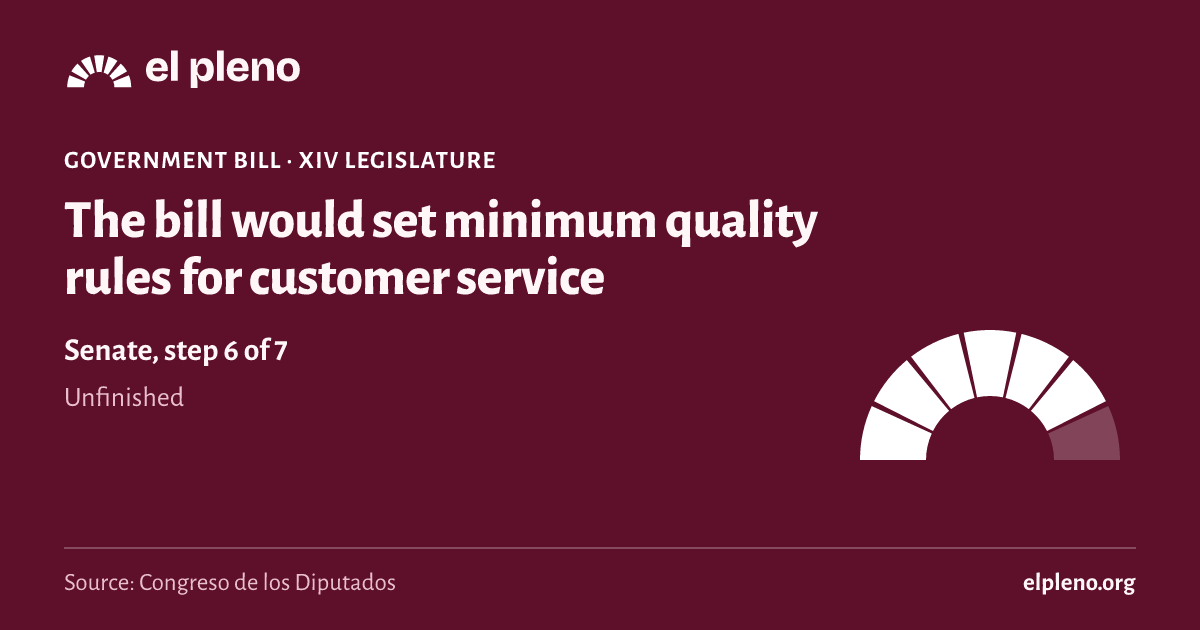
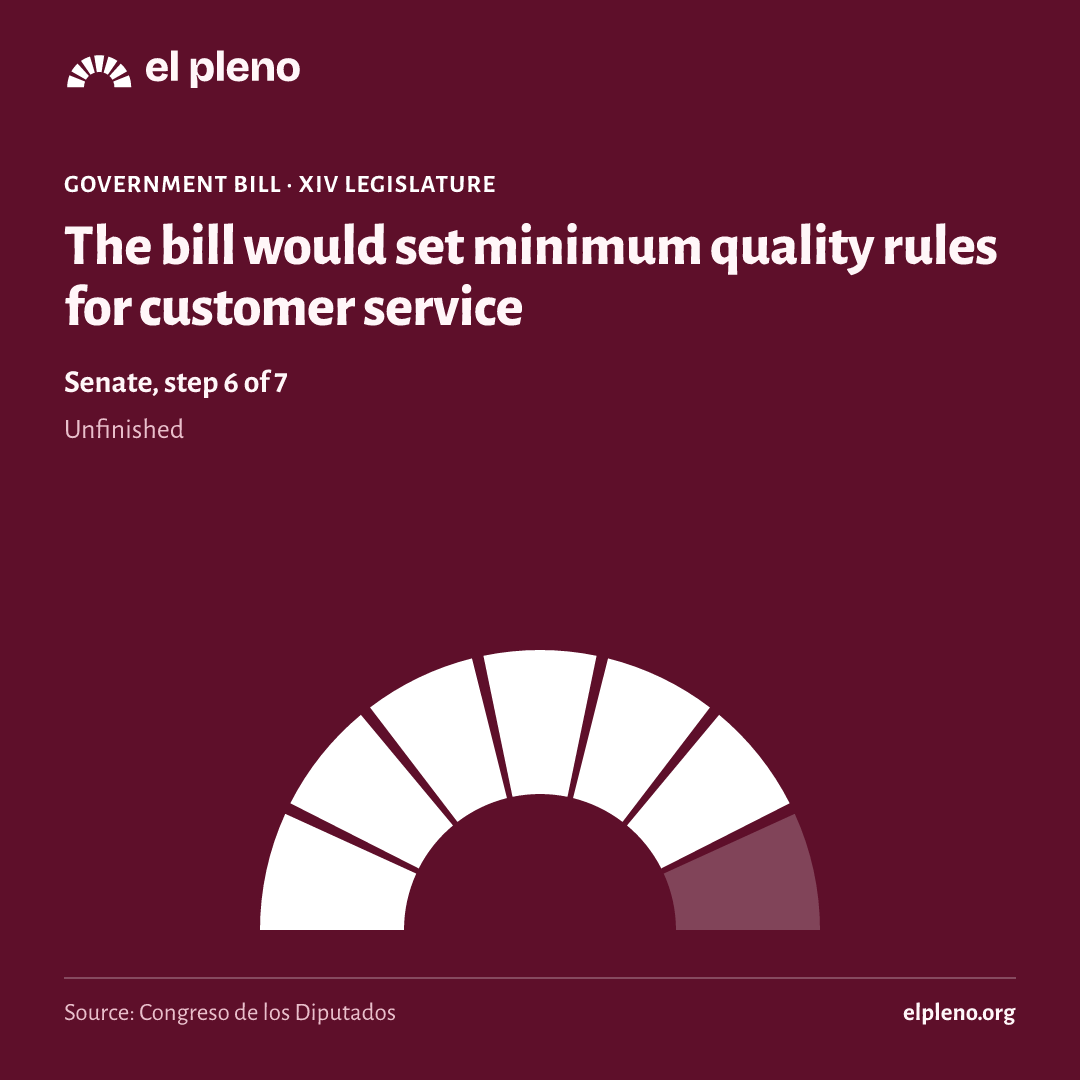
It took 6 of 7 steps. It reached Senate, and today it is unfinished.
- Introduced1 June 2022Someone registers the text in the Congreso.
- Admitted7 June 2022The Bureau of the Congreso accepts it and, for a members’ bill, the plenary decides whether to consider it.
- Amendments10 June 2022Groups propose changes.
- Committee20 October 2022A committee goes through the text in detail.
- Plenary17 April 2023All 350 deputies vote.
- Senate27 April 2023The Senate can pass it, amend it or veto it.
- BOEnot reachedIt is published in the Official State Gazette (BOE) and comes into force.
See the 9 official steps on a timeline
27 April 2023
How did the plenary vote?
Voted on: Vote on the report on the Government bill regulating customer service.
This law had 62 votes; this is the latest with every deputy’s vote. See them all
Source: Congreso de los Diputados, vote 172 of sitting 256· updated 10 Nov
Each dot is a seat. Tap one, or use the arrow keys, to see who it is.
Your province
How did the deputies from your province vote?
And your senators: the Senate does not link its votes to this law in its open data, so we cannot put them side by side here.
Or see how most of each province voted
- A Coruña More votes in favour 8 yes · 0 no
- Albacete More votes in favour 3 yes · 0 no · 1 abst.
- Alicante/Alacant More votes in favour 9 yes · 0 no · 3 abst.
- Almería More votes in favour 4 yes · 0 no · 2 abst.
- Araba/Álava More votes in favour 4 yes · 0 no
- Asturias More votes in favour 6 yes · 0 no · 1 abst.
- Ávila More votes in favour 2 yes · 0 no · 1 abst.
- Badajoz More votes in favour 5 yes · 0 no
- Barcelona More votes in favour 27 yes · 0 no · 5 abst.
- Bizkaia More votes in favour 8 yes · 0 no
- Burgos More votes in favour 4 yes · 0 no
- Cáceres More votes in favour 3 yes · 0 no · 1 abst.
- Cádiz More votes in favour 7 yes · 0 no · 1 abst.
- Cantabria More votes in favour 4 yes · 0 no · 1 abst.
- Castellón/Castelló More votes in favour 4 yes · 0 no · 1 abst.
- Ceuta Tie 0 yes · 0 no · 1 abst.
- Ciudad Real More votes in favour 4 yes · 0 no · 1 abst.
- Córdoba More votes in favour 5 yes · 0 no · 1 abst.
- Cuenca More votes in favour 3 yes · 0 no
- Gipuzkoa More votes in favour 6 yes · 0 no
- Girona More votes in favour 4 yes · 0 no · 1 abst.
- Granada More votes in favour 6 yes · 0 no · 1 abst.
- Guadalajara More votes in favour 2 yes · 0 no · 1 abst.
- Huelva More votes in favour 4 yes · 0 no · 1 abst.
- Huesca More votes in favour 3 yes · 0 no
- Illes Balears More votes in favour 6 yes · 0 no · 2 abst.
- Jaén More votes in favour 4 yes · 0 no · 1 abst.
- La Rioja More votes in favour 4 yes · 0 no
- Las Palmas More votes in favour 6 yes · 0 no · 1 abst.
- León More votes in favour 3 yes · 0 no · 1 abst.
- Lleida More votes in favour 4 yes · 0 no
- Lugo More votes in favour 4 yes · 0 no
- Madrid More votes in favour 29 yes · 1 no · 7 abst.
- Málaga More votes in favour 9 yes · 0 no · 2 abst.
- Melilla More votes in favour 1 yes · 0 no
- Murcia More votes in favour 7 yes · 0 no · 3 abst.
- Navarra More votes in favour 5 yes · 0 no
- Ourense More votes in favour 4 yes · 0 no
- Palencia More votes in favour 3 yes · 0 no
- Pontevedra More votes in favour 7 yes · 0 no
- Salamanca More votes in favour 3 yes · 0 no · 1 abst.
- Santa Cruz de Tenerife More votes in favour 5 yes · 0 no · 1 abst.
- Segovia More votes in favour 2 yes · 0 no · 1 abst.
- Sevilla More votes in favour 10 yes · 0 no · 2 abst.
- Soria More votes in favour 2 yes · 0 no
- Tarragona More votes in favour 6 yes · 0 no
- Teruel More votes in favour 3 yes · 0 no
- Toledo More votes in favour 4 yes · 0 no · 2 abst.
- Valencia/València More votes in favour 11 yes · 0 no · 3 abst.
- Valladolid More votes in favour 4 yes · 0 no · 1 abst.
- Zamora More votes in favour 2 yes · 0 no · 1 abst.
- Zaragoza More votes in favour 6 yes · 0 no · 1 abst.
More details: how each group and each province voted
The groups
Who voted in favour and who against?
In favour, most of Euskal Herria Bildu, Republicano, Socialista, Vasco (EAJ-PNV), Mixto, Ciudadanos, Gcup-ec-gc, GPlu and Popular en el Congreso. 5 deputies voted differently from their group.
By province: in 51 most voted in favour; in 0, against.
Coloured by how most of each province’s deputies voted.
- In favour: 51
- Against: 0
- Abstained: 1
| Group | Seats | How it voted |
|---|---|---|
| Euskal Herria Bildu | 5 | 5 in favour |
| Republicano | 13 | 13 in favour |
| Socialista | 120 | 120 in favour |
| Vasco (EAJ-PNV) | 6 | 6 in favour |
| Mixto | 11 | 10 in favour · 1 did not vote |
| Ciudadanos | 9 | 9 in favour |
| Gcup-ec-gc | 33 | 33 in favour |
| GPlu | 12 | 7 in favour · 4 abst. · 1 did not vote |
| Popular en el Congreso | 88 | 86 in favour · 1 against · 1 did not vote |
| VOX | 52 | 50 abst. · 2 did not vote |
What happens next
What happens now?
The legislature ended before it finished. To go on, someone would have to introduce it again in the new Cortes.
It was presented again:
- XV Legislature, Congreso de los Diputados· Passed New quality rules for customer service departments
The same initiative in the other chamber:
- XIV Legislature, Senate Government bill regulating customer service.
Sources
Where does all this come from?
- Congreso de los Diputados, file 121/000104
Official title, type, author, dates and stage.
Retrieved 11 November 2026
- Congreso de los Diputados, vote 172 of sitting 256
The count and every seat’s vote.
Retrieved 10 November 2026
- The data comes from the open files of the Congreso, the Senate and the BOE, unaltered.
- Each deputy’s province is the one of their seat on the day of the vote.
- We only say “passed” or “rejected” when the majority needed is certain; otherwise we say which side had more votes.