What it is
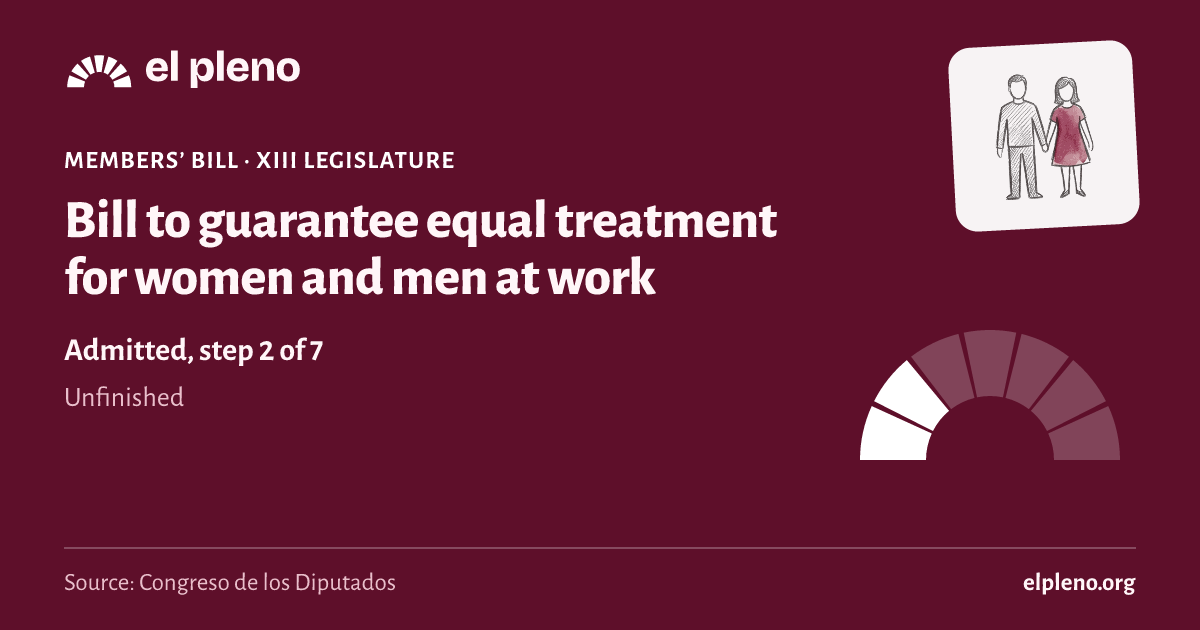
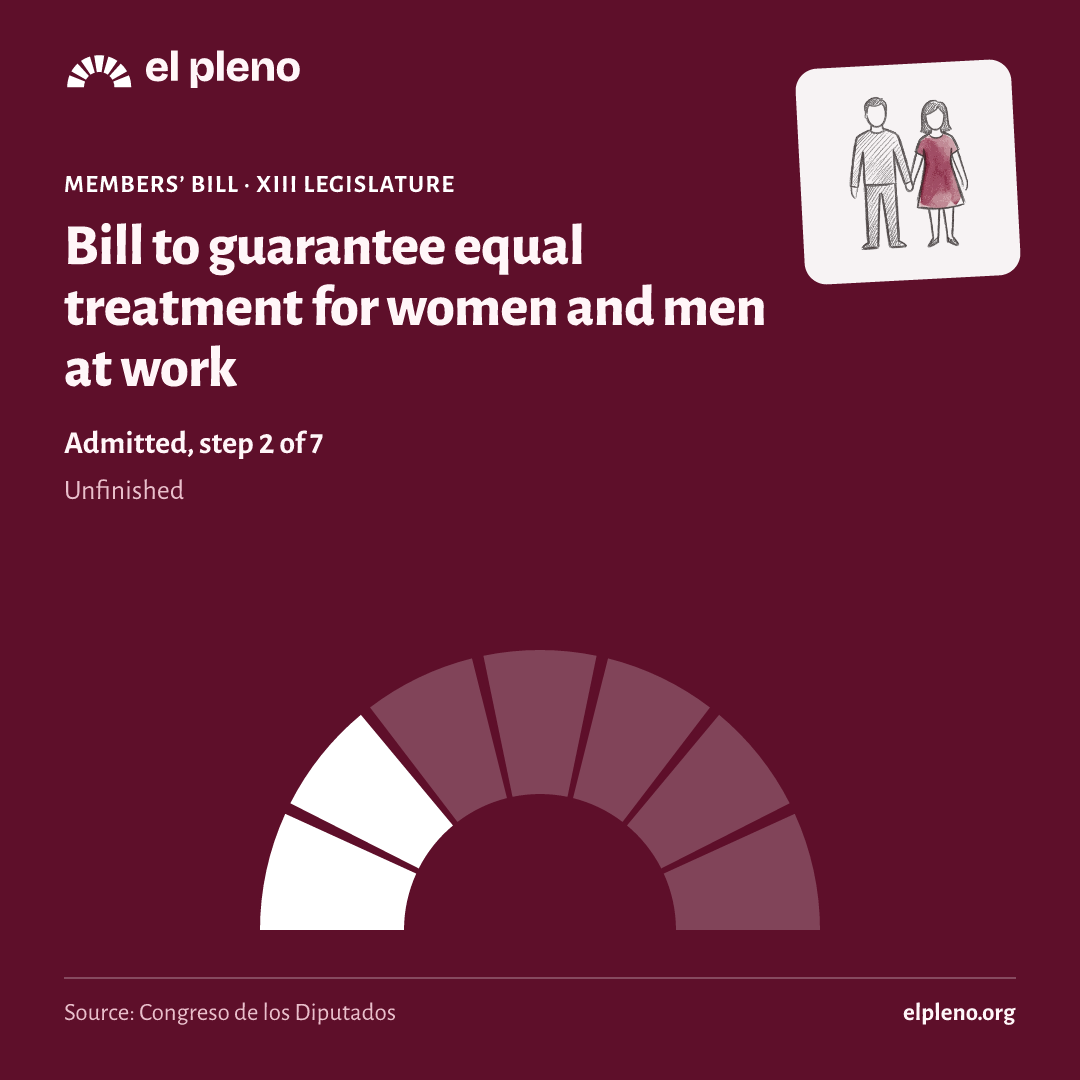
Bill to guarantee equal treatment for women and men at work
Admitted step 2 of 7 · UnfinishedIt is a members’ bill. Introduced by parliamentary groups, the Senate, regional governments or citizens. It was introduced on 23 July 2019. Introduced by: Grupo Parlamentario Socialista.
Official title: Private member's bill to guarantee equal treatment and opportunities between women and men in employment and occupation.
Source: Congreso de los Diputados, file 122/000038· updated 11 Nov
Automatic summary, not yet reviewed
- The bill seeks to guarantee the right to equal treatment and opportunities for women and men in employment and occupation, eliminating discrimination based on sex. It covers employees, self-employed workers, public employees and cooperative members.
- It defines equal treatment and opportunities and bans direct and indirect discrimination, sexual harassment and harassment based on sex, and discrimination for pregnancy, motherhood or exercising work-life balance rights. It also bans retaliation for reporting discriminatory acts.
- It requires negotiating positive action measures in favor of women when clear situations of de facto inequality exist, in collective bargaining, public employment and self-employment. Public authorities would also be required to adopt them.
- It recognizes work-life balance as an individual, non-transferable right of workers, and recognizes the right to adapt working hours for work-life balance reasons, with a procedure to resolve disagreements with the employer.
- It equalizes birth, adoption and foster care leave at 16 weeks for each parent, six of which are mandatory and uninterrupted. Equalization would be gradual: eight weeks for the other parent in 2019, twelve in 2020 and sixteen in 2021.
- It strengthens pay transparency: employers must pay the same for work of equal value, keep a pay register broken down by sex, and justify differences of 25% or more between sexes in companies with at least fifty workers. Companies with fifty or more workers must have an equality plan registered in an official register.
- It creates the State Office for the Fight against Discrimination in Employment and Occupation, part of the Labor Inspectorate, to coordinate actions against workplace discrimination, with special attention to discrimination based on sex.
- It adds measures for victims of gender-based violence, such as interrupting training contracts, nullifying dismissals for exercising their right to effective judicial protection, remote work on request, and specific leave and unpaid leave arrangements.
Who it affects
- Employees and public sector workers: They gain work-life balance rights, equal leave for both parents, schedule adaptation and protection against discriminatory dismissal.
- Companies and self-employed workers: They must comply with equality plans, pay registers, positive action and new penalties if they discriminate.
- Women: The bill aims to close the pay and employment gaps and correct de facto inequality through positive action.
- Victims of gender-based violence: They would get leave, unpaid leave arrangements, protection against dismissal and the option of remote work.
Words worth knowing
- Acción positiva (positive action)
- A measure favoring a disadvantaged group, here women, to correct situations of de facto inequality.
- Discriminación indirecta (indirect discrimination)
- A seemingly neutral rule or practice that in fact disadvantages women.
- Plan de igualdad (equality plan)
- A set of company measures to achieve real equality between women and men at work.
- Registro salarial (pay register)
- A document with the average wages of the workforce, broken down by sex and job.
- Presencia equilibrada (balanced presence)
- Composition of a body with women and men in reasonable proportion.
It summarizes the text as it was introduced. It is written by artificial intelligence and may contain mistakes: the official text is what counts. Read the official text · How we make summaries
Where it stands
How far did it get?
It took 2 of 7 steps. It reached Admitted, and today it is unfinished.
- Introduced23 July 2019Someone registers the text in the Congreso.
- Admitted25 July 2019The Bureau of the Congreso accepts it and, for a members’ bill, the plenary decides whether to consider it.
- Amendmentsnot reachedGroups propose changes.
- Committeenot reachedA committee goes through the text in detail.
- Plenarynot reachedAll 350 deputies vote.
- Senatenot reachedThe Senate can pass it, amend it or veto it.
- BOEnot reachedIt is published in the Official State Gazette (BOE) and comes into force.
See the 6 official steps on a timeline
Was there a plenary vote?
We have no plenary vote linked to this law in the Congreso’s data.
What happens next
What happens now?
The legislature ended before it finished. To go on, someone would have to introduce it again in the new Cortes.
It has not been presented again yet.
Presented before in:
- XII Legislature, Congreso de los Diputados· Unfinished Proposal to strengthen equality between women and men at work
- XII Legislature, Congreso de los Diputados· Unfinished Bill to guarantee equal treatment for women and men at work
Sources
Where does all this come from?
- Congreso de los Diputados, file 122/000038
Official title, type, author, dates and stage.
Retrieved 11 November 2026
- The data comes from the open files of the Congreso, the Senate and the BOE, unaltered.
- Each deputy’s province is the one of their seat on the day of the vote.
- We only say “passed” or “rejected” when the majority needed is certain; otherwise we say which side had more votes.