What it is
Rights and guarantees for a dignified death at the end of life
It is a members’ bill. Introduced by parliamentary groups, the Senate, regional governments or citizens. It was introduced on 2 December 2016. Introduced by: Grupo Parlamentario Ciudadanos.
Official title: Private member's bill on the rights and guarantees of the dignity of the person in the final process of their life.
Source: Congreso de los Diputados, file 122/000051· updated 11 Nov
Automatic summary, not yet reviewed
- The bill would recognize rights for people in the final process of life, understood as a terminal or agony situation caused by illness or accident, and would set duties for health professionals and guarantees for institutions.
- It would guarantee the right to clear information about one's health and to decide on treatments, including the right to refuse them even if this endangers life, without any reduction in care.
- It would allow any adult to leave prior instructions (living will) about the care they wish to receive, appoint a representative, and change or revoke them at any time.
- It would recognize the right to quality palliative care, including palliative sedation even if it shortens life, the right to receive it at home if desired, the company of relatives, and spiritual assistance.
- Professionals would have to respect the patient's wishes and adjust therapeutic effort to avoid therapeutic obstinacy. Hospitals would have to guarantee single rooms, with one year to provide them.
- The law would be basic legislation for the whole country, with penalties referred to regional rules or, failing that, the General Health Act, and the Government would be empowered to issue its implementing regulations.
Who it affects
- People in a terminal or agony situation: They would gain new rights to decide, receive palliative care, and be accompanied.
- Families and caregivers: They could accompany the patient and receive support and bereavement care.
- Health professionals: They would have a duty to respect the patient's wishes and adjust therapeutic effort.
- Public and private health and social centers: They would have to guarantee these rights, including single rooms.
- Minors: They would have the right to age-appropriate information and to be accompanied by their parents.
Words worth knowing
- Instrucciones previas (living will)
- A document in which an adult states in advance their wishes about care and treatments for when they can no longer express them.
- Cuidados paliativos (palliative care)
- Care aimed at controlling pain and other symptoms when the illness no longer responds to curative treatment.
- Sedación paliativa (palliative sedation)
- Giving drugs to reduce the patient's consciousness to relieve symptoms that do not respond to treatment.
- Obstinación terapéutica (therapeutic obstinacy)
- Keeping useless treatments that only prolong biological life with no chance of improvement.
- Adecuación del esfuerzo terapéutico (adjustment of therapeutic effort)
- Withdrawing, adjusting, or not starting treatments when a limited life prognosis makes it advisable.
It summarizes the text passed by the committee. It is written by artificial intelligence and may contain mistakes: the official text is what counts. Read the official text · How we make summaries
Where it stands
How far did it get?
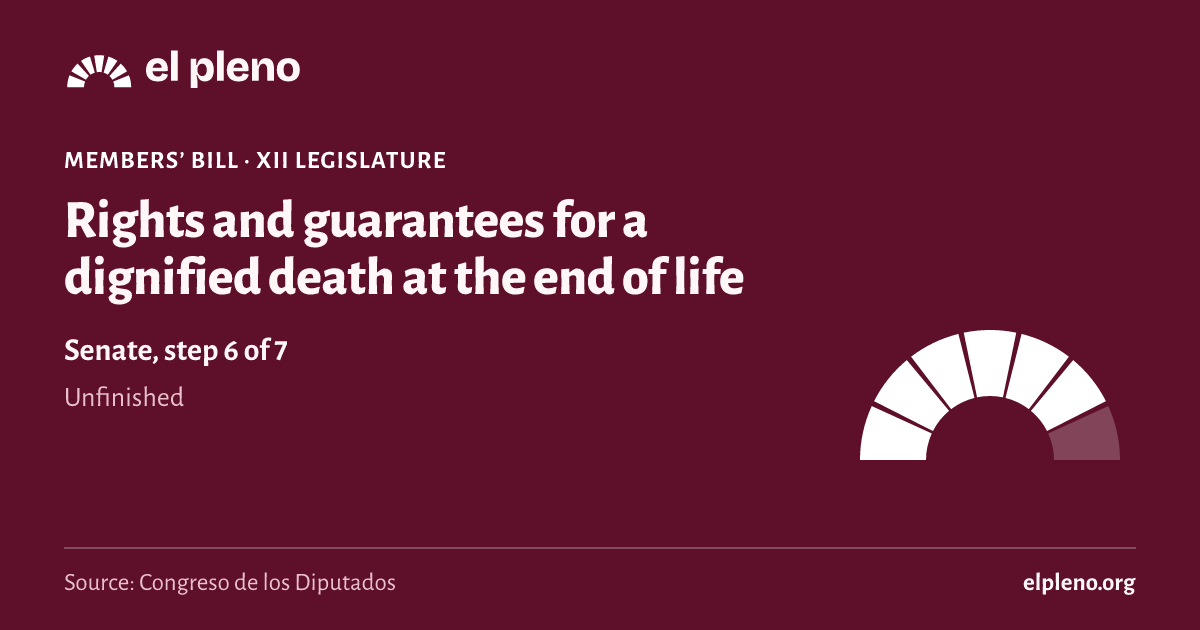
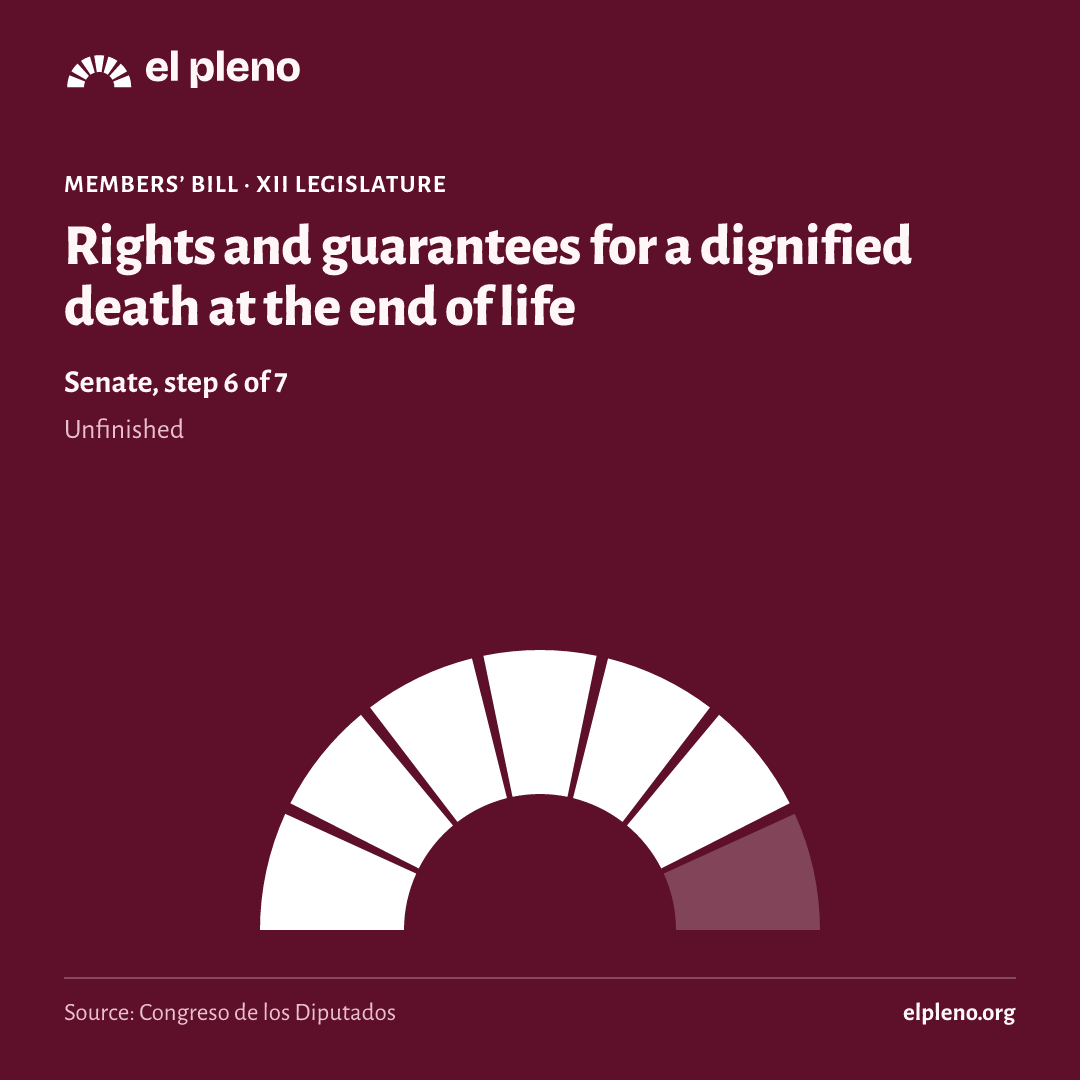
It took 6 of 7 steps. It reached Senate, and today it is unfinished.
- Introduced2 December 2016Someone registers the text in the Congreso.
- Admitted13 December 2016The Bureau of the Congreso accepts it and, for a members’ bill, the plenary decides whether to consider it.
- Amendments10 April 2017Groups propose changes.
- Committee22 June 2017A committee goes through the text in detail.
- Plenary11 December 2018All 350 deputies vote.
- Senate20 December 2018The Senate can pass it, amend it or veto it.
- BOEnot reachedIt is published in the Official State Gazette (BOE) and comes into force.
See the 16 official steps on a timeline
20 December 2018
How did the plenary vote?
Voted on: Vote on the report.
This law had 12 votes; this is the latest with every deputy’s vote. See them all
Source: Congreso de los Diputados, vote 53 of sitting 167· updated 10 Nov
Each dot is a seat. Tap one, or use the arrow keys, to see who it is.
Your province
How did the deputies from your province vote?
And your senators: the Senate does not link its votes to this law in its open data, so we cannot put them side by side here.
Or see how most of each province voted
- A Coruña More votes in favour 8 yes · 0 no
- Albacete More votes in favour 3 yes · 0 no
- Alicante/Alacant More votes in favour 11 yes · 0 no
- Almería More votes in favour 6 yes · 0 no
- Araba/Álava More votes in favour 3 yes · 1 no
- Asturias More votes in favour 8 yes · 0 no
- Ávila More votes in favour 3 yes · 0 no
- Badajoz More votes in favour 6 yes · 0 no
- Barcelona More votes in favour 20 yes · 9 no
- Bizkaia More votes in favour 6 yes · 2 no
- Burgos More votes in favour 4 yes · 0 no
- Cáceres More votes in favour 4 yes · 0 no
- Cádiz More votes in favour 9 yes · 0 no
- Cantabria More votes in favour 5 yes · 0 no
- Castellón/Castelló More votes in favour 5 yes · 0 no
- Ceuta More votes in favour 1 yes · 0 no
- Ciudad Real More votes in favour 5 yes · 0 no
- Córdoba More votes in favour 6 yes · 0 no
- Cuenca More votes in favour 3 yes · 0 no
- Gipuzkoa More votes in favour 4 yes · 2 no
- Girona More votes against 2 yes · 4 no
- Granada More votes in favour 6 yes · 0 no
- Guadalajara More votes in favour 3 yes · 0 no
- Huelva More votes in favour 5 yes · 0 no
- Huesca More votes in favour 3 yes · 0 no
- Illes Balears More votes in favour 7 yes · 0 no
- Jaén More votes in favour 5 yes · 0 no
- La Rioja More votes in favour 4 yes · 0 no
- Las Palmas More votes in favour 7 yes · 0 no
- León More votes in favour 4 yes · 0 no
- Lleida Tie 2 yes · 2 no
- Lugo More votes in favour 4 yes · 0 no
- Madrid More votes in favour 35 yes · 0 no
- Málaga More votes in favour 10 yes · 0 no
- Melilla More votes in favour 1 yes · 0 no
- Murcia More votes in favour 10 yes · 0 no
- Navarra More votes in favour 3 yes · 1 no
- Ourense More votes in favour 4 yes · 0 no
- Palencia More votes in favour 3 yes · 0 no
- Pontevedra More votes in favour 7 yes · 0 no
- Salamanca More votes in favour 4 yes · 0 no
- Santa Cruz de Tenerife More votes in favour 7 yes · 0 no
- Segovia More votes in favour 3 yes · 0 no
- Sevilla More votes in favour 12 yes · 0 no
- Soria More votes in favour 2 yes · 0 no
- Tarragona More votes in favour 4 yes · 2 no
- Teruel More votes in favour 3 yes · 0 no
- Toledo More votes in favour 6 yes · 0 no
- Valencia/València More votes in favour 16 yes · 0 no
- Valladolid More votes in favour 5 yes · 0 no
- Zamora More votes in favour 2 yes · 0 no
- Zaragoza More votes in favour 7 yes · 0 no
More details: how each group and each province voted
The groups
Who voted in favour and who against?
In favour, most of Socialista, Ciudadanos, Gcup-ec-em and Popular en el Congreso. Against, most of Vasco (EAJ-PNV), Mixto and GER. 8 deputies voted differently from their group.
By province: in 50 most voted in favour; in 1, against.
Coloured by how most of each province’s deputies voted.
- In favour: 50
- Against: 1
- Tie: 1
| Group | Seats | How it voted |
|---|---|---|
| Socialista | 84 | 83 in favour · 1 did not vote |
| Vasco (EAJ-PNV) | 5 | 5 against |
| Mixto | 19 | 8 in favour · 9 against · 2 did not vote |
| Ciudadanos | 32 | 31 in favour · 1 did not vote |
| Gcup-ec-em | 67 | 64 in favour · 3 did not vote |
| GER | 9 | 9 against |
| Popular en el Congreso | 134 | 130 in favour · 4 did not vote |
What happens next
What happens now?
The legislature ended before it finished. To go on, someone would have to introduce it again in the new Cortes.
It was presented again:
- XIII Legislature, Congreso de los Diputados· Unfinished Bill proposes rights to a dignified death and respect for patient wishes
- XIV Legislature, Congreso de los Diputados· Unfinished Bill to guarantee a dignified death and respect patient wishes
- XIV Legislature, Congreso de los Diputados· Withdrawn Bill proposes guaranteeing a dignified death and respecting patient wishes
The same initiative in the other chamber:
Sources
Where does all this come from?
- Congreso de los Diputados, file 122/000051
Official title, type, author, dates and stage.
Retrieved 11 November 2026
- Congreso de los Diputados, vote 53 of sitting 167
The count and every seat’s vote.
Retrieved 10 November 2026
- The data comes from the open files of the Congreso, the Senate and the BOE, unaltered.
- Each deputy’s province is the one of their seat on the day of the vote.
- We only say “passed” or “rejected” when the majority needed is certain; otherwise we say which side had more votes.