26 September 2018, in the Senate
Motion calling on the Government to develop the necessary actions in the school environment to defend comprehensive education in the Autonomous Communities where there are two official languages.
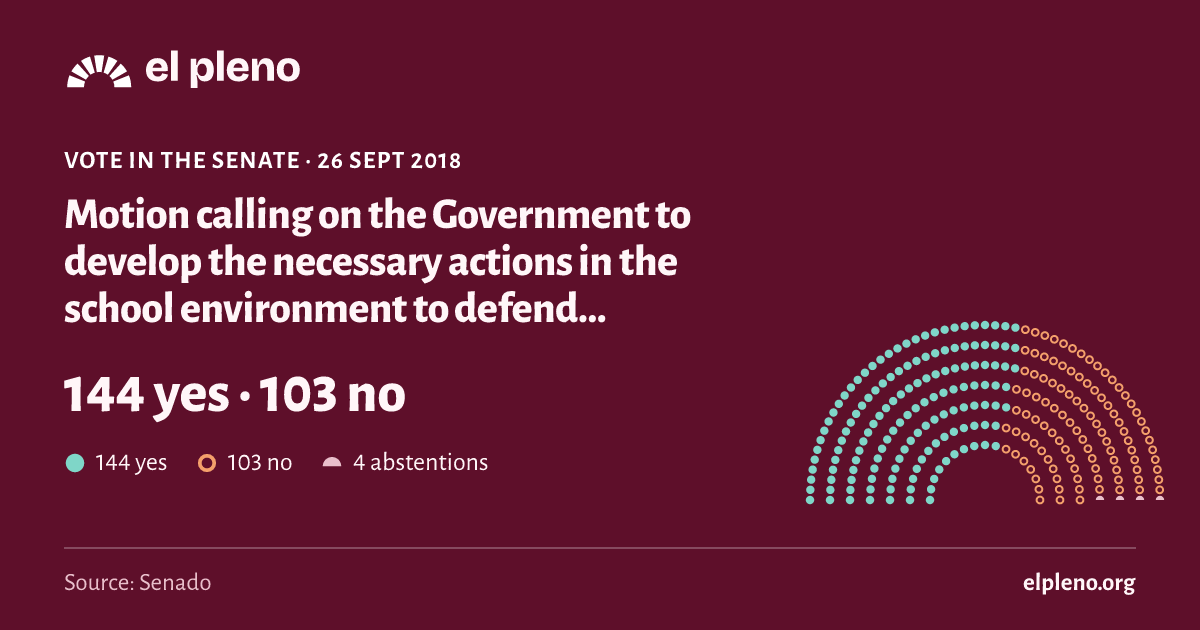
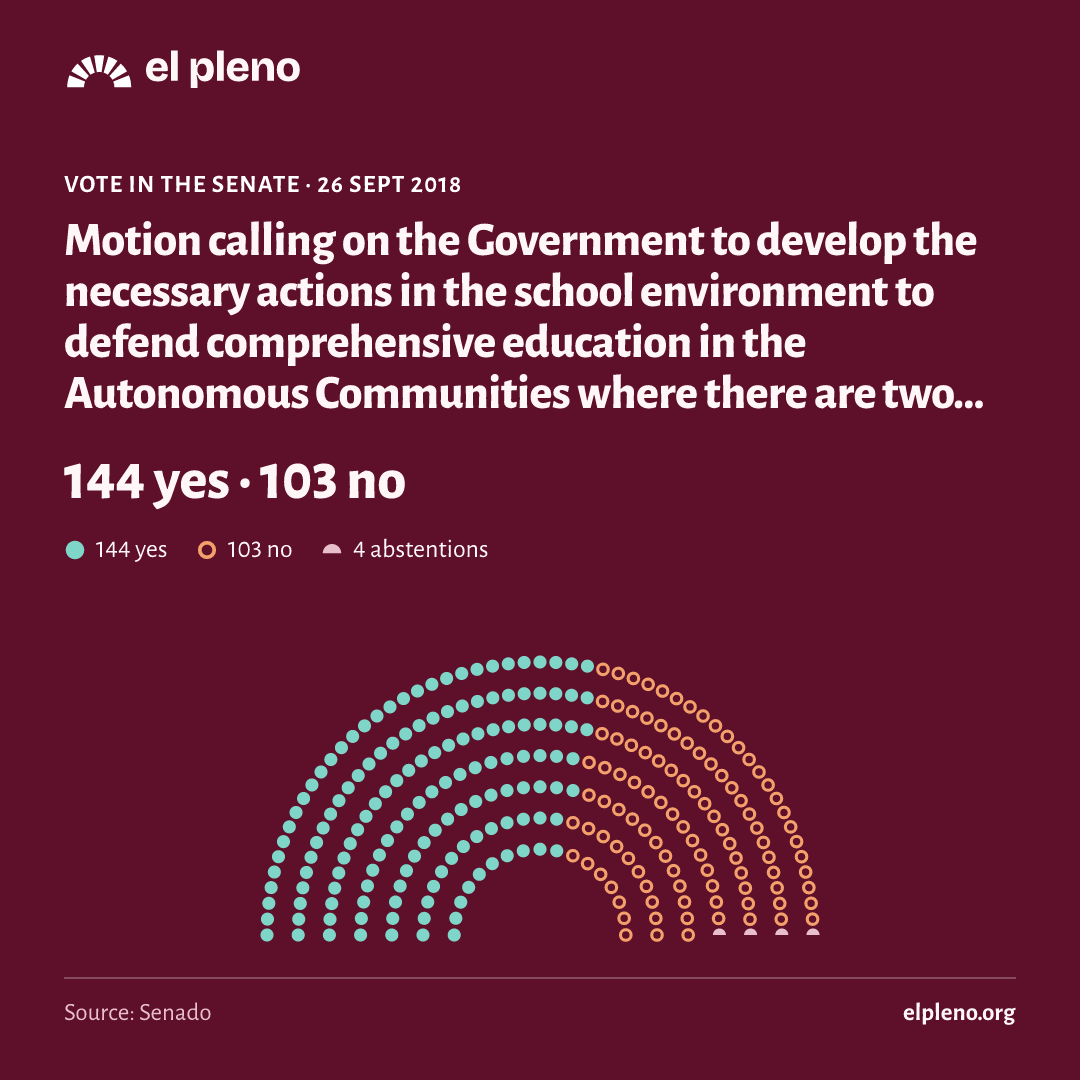
More votes in favour 144 yes · 103 no · 4 abst.More votes in favour: 144 yes and 103 no, a margin of 41. 4 abstentions.
When we cannot be sure which majority was needed, we do not say whether this means it “passed”: the official file does not say.
Source: Senate, vote 1004 of sitting 44· updated 10 Nov
The chamber
Who voted how?
144 in favour, 103 against. 4 abstentions. 8 voted differently from their group.
Each dot is a seat. Tap one, or use the arrow keys, to see who it is.
Your province
How did the senators from your province vote?
Only senators elected in a province or island appear. Senators appointed by regional parliaments have no province.
Or see how most of each province voted
- A Coruña More votes in favour 3 yes · 1 no
- Albacete More votes in favour 2 yes · 0 no
- Alicante/Alacant Tie 1 yes · 1 no
- Almería More votes in favour 2 yes · 0 no
- Araba/Álava More votes against 1 yes · 2 no
- Asturias More votes in favour 3 yes · 1 no
- Ávila More votes in favour 2 yes · 1 no
- Badajoz More votes in favour 3 yes · 1 no
- Barcelona More votes against 0 yes · 3 no
- Bizkaia More votes against 0 yes · 2 no
- Burgos More votes in favour 2 yes · 0 no
- Cáceres More votes in favour 2 yes · 0 no
- Cádiz More votes in favour 2 yes · 1 no
- Cantabria More votes in favour 3 yes · 1 no
- Castellón/Castelló More votes in favour 2 yes · 1 no
- Ceuta More votes in favour 2 yes · 0 no
- Ciudad Real More votes in favour 3 yes · 0 no
- Córdoba Tie 1 yes · 1 no
- Cuenca More votes in favour 3 yes · 1 no
- Gipuzkoa More votes against 0 yes · 4 no
- Girona More votes against 0 yes · 1 no
- Granada More votes in favour 3 yes · 1 no
- Guadalajara More votes in favour 3 yes · 0 no
- Huelva More votes against 1 yes · 2 no
- Huesca More votes in favour 3 yes · 1 no
- Illes Balears More votes in favour 3 yes · 1 no
- Jaén More votes against 1 yes · 2 no
- La Rioja More votes in favour 3 yes · 1 no
- Las Palmas More votes in favour 4 yes · 1 no
- León More votes in favour 3 yes · 0 no
- Lleida More votes against 0 yes · 2 no
- Lugo More votes in favour 2 yes · 1 no
- Madrid More votes in favour 2 yes · 1 no
- Málaga More votes in favour 2 yes · 1 no
- Melilla No data
- Murcia More votes in favour 3 yes · 1 no
- Navarra More votes in favour 3 yes · 1 no
- Ourense Tie 1 yes · 1 no
- Palencia More votes in favour 3 yes · 0 no
- Pontevedra Tie 1 yes · 1 no
- Salamanca More votes against 0 yes · 1 no
- Santa Cruz de Tenerife More votes in favour 2 yes · 1 no
- Segovia More votes in favour 2 yes · 1 no
- Sevilla More votes against 0 yes · 3 no
- Soria More votes in favour 1 yes · 0 no
- Tarragona More votes against 0 yes · 1 no
- Teruel More votes in favour 2 yes · 0 no
- Toledo More votes in favour 2 yes · 0 no
- Valencia/València More votes in favour 3 yes · 1 no
- Valladolid More votes in favour 2 yes · 1 no
- Zamora More votes in favour 2 yes · 0 no
- Zaragoza More votes in favour 3 yes · 1 no
The groups
How did each group vote?
In favour, most of Popular. Against, most of Esquerra, Socialista, Vasco, Mixto, GPN and Podemos.
| Group | Seats | How it voted |
|---|---|---|
| Esquerra | 12 | 12 against |
| Socialista | 54 | 54 against |
| Vasco | 6 | 6 against |
| Mixto | 12 | 3 in favour · 5 against · 4 abst. |
| GPN | 6 | 6 against |
| Podemos | 19 | 19 against |
| Popular | 142 | 141 in favour · 1 against |
Sources
Where does all this come from?
Official wording of what was voted on: Moción por la que se insta al Gobierno a desarrollar las acciones necesarias en el ámbito escolar para defender la educación integral en las Comunidades Autónomas donde hay dos lenguas oficiales.
- Senate, vote 1004 of sitting 44
The count and every seat’s vote.
Retrieved 10 November 2026
- The data comes from the open files of the Congreso, the Senate and the BOE, unaltered.
- Each deputy’s province is the one of their seat on the day of the vote.
- We only say “passed” or “rejected” when the majority needed is certain; otherwise we say which side had more votes.