What it is
New rules on rentals, evictions, taxes and affordable housing
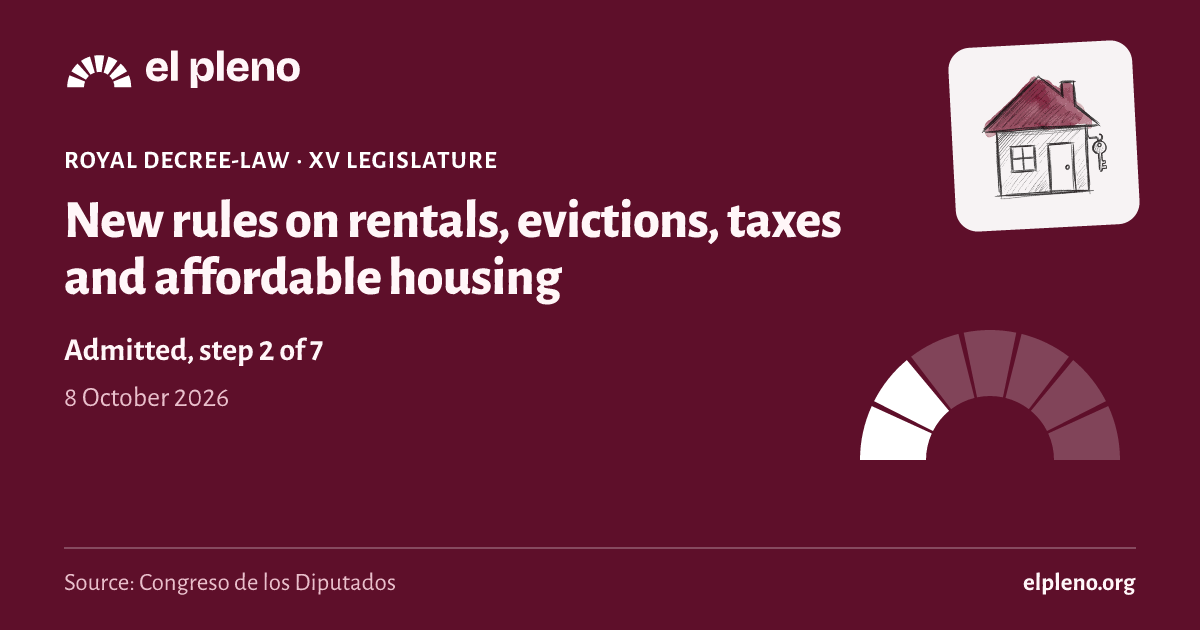
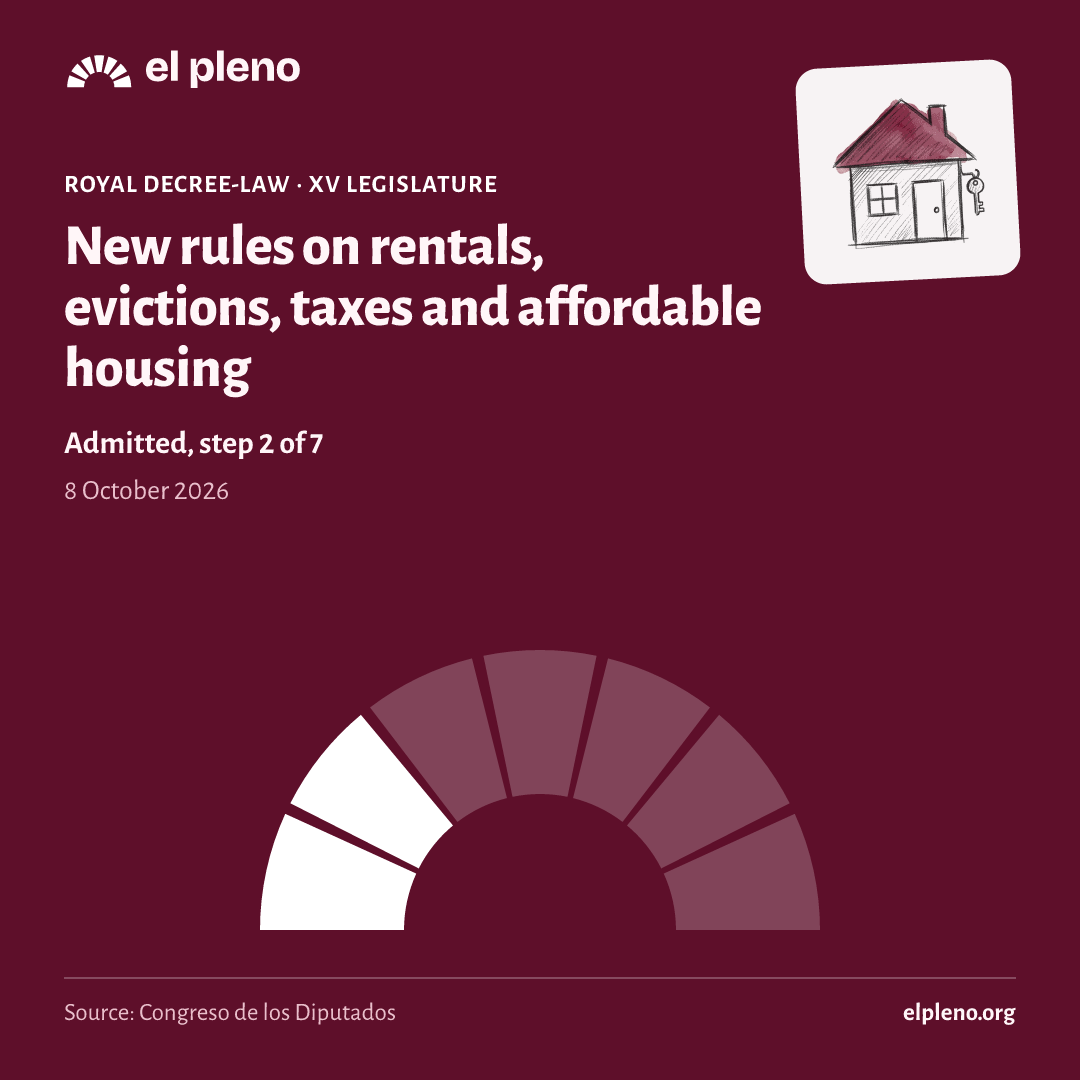
Admitted step 2 of 7It is a royal decree-law. It was introduced on 8 October 2026. Introduced by: Gobierno.
Official title: Royal Decree-Law 29/2026, of October 6, adopting urgent measures to protect the social function of housing and to expand the supply of affordable housing.
Source: Congreso de los Diputados, file 130/000060· updated 11 Nov
Automatic summary, not yet reviewed
- Until December 31, 2030, certain entities are barred from buying homes below 70% of their market value. This applies to companies that buy properties or unpaid loan portfolios at very low prices, and to large housing holders.
- Evictions of vulnerable people with no housing alternative are suspended until December 31, 2030. If the government does not offer alternative housing within two months, it must pay the tenant's debt or take over the debt, and no eviction takes place.
- The urban lease law is reformed: seasonal and room rentals are only valid if there is a real, provable reason for temporary relocation. Otherwise, the contract becomes a regular residential lease. The total of room rentals cannot exceed the rent for the whole home, and tenants cannot be charged property management fees or property taxes.
- Tenants can request an extraordinary extension of up to two additional years on their residential lease, if they are up to date on payments. Until December 31, 2027, annual rent updates cannot exceed 2%, and there is no increase at all if the rent already exceeds the reference limit.
- Under personal income tax, new reductions are created for landlords who rent at affordable prices, up to 100% of the income, plus a 10% deduction on the rent of a primary residence for low-income tenants.
- City councils may apply property tax surcharges to tourist apartments and permanently vacant homes in stressed areas, up to 150% in some cases. SOCIMI real estate companies face a special 25% levy on undistributed residential rental profits, with reductions if they allocate their portfolio to affordable rentals.
- Affordable housing is defined as housing costing at most 30% of the median income of the municipality. The TU CASA mechanism is created: loans of up to €50,000, interest-free and with no fees, for the down payment on a first primary residence.
- The Cuenta de Ahorro e Inversion Financia Europa is created, a savings and investment product with tax advantages, with a contribution limit of €150,000, plus a reinvestment modality linked to home sales.
Who it affects
- Tenants: Tenants of primary residences: more protection against eviction, limits on rent increases, and an income tax deduction.
- Large housing holders and companies buying properties or unpaid loan portfolios: They cannot buy homes below 70% of market value until 2030 and face more obligations.
- Landlords renting seasonally or by rooms: They must prove a real reason for the temporary nature and respect price and fee limits.
- Young people and first-time home buyers: They can apply for interest-free TU CASA loans and benefit from the new tax-advantaged savings account.
- City councils and public administrations: They will receive more public housing and can apply tax surcharges to tourist and vacant apartments.
Words worth knowing
- Gran tenedor (large housing holder)
- A person or company that owns more than ten residential properties or more than 1,500 square meters of residential space.
- Enervacion (enervation)
- A legal option that lets a tenant pay what they owe during an eviction case, stopping the process and keeping the lease.
- Zona de mercado residencial tensionado (stressed residential market area)
- An area officially declared where rents are capped by law.
- SOCIMI
- Listed real estate investment companies, that is, firms that invest in property and trade on the stock market.
- IRPF
- Impuesto sobre la Renta de las Personas Fisicas, Spain's personal income tax.
It summarizes the law as published in the BOE. It is written by artificial intelligence and may contain mistakes: the official text is what counts. Read the official text · How we make summaries
Where it stands
How far did it get?
It took 1 of 7 steps. It reached Admitted.
- Introduced8 October 2026Someone registers the text in the Congreso.
- Admitted13 October 2026The Bureau of the Congreso accepts it and, for a members’ bill, the plenary decides whether to consider it.
- Amendmentsnot reachedGroups propose changes.
- Committeenot reachedA committee goes through the text in detail.
- Plenarynot reachedAll 350 deputies vote.
- Senatenot reachedThe Senate can pass it, amend it or veto it.
- BOEnot reachedIt is published in the Official State Gazette (BOE) and comes into force.
See the 3 official steps on a timeline
Was there a plenary vote?
We have no plenary vote linked to this law in the Congreso’s data.
What happens next
What happens now?
Groups can now table amendments: proposed changes to the text.
Published in the BOE: Royal Decree-Law 29/2026, of October 6, adopting urgent measures to protect the social function of housing and to expand the supply of affordable housing.
Sources
Where does all this come from?
- Congreso de los Diputados, file 130/000060
Official title, type, author, dates and stage.
Retrieved 11 November 2026
- BOE, BOE-A-2026-20823
The law as published.
Retrieved 11 November 2026
- The data comes from the open files of the Congreso, the Senate and the BOE, unaltered.
- Each deputy’s province is the one of their seat on the day of the vote.
- We never say “passed” because of a vote: the files do not say which majority was needed.