What it is
Rental contracts for primary homes renew automatically, and non-renewal now costs compensation
Plenary step 5 of 7· RejectedIt is a royal decree-law. It was introduced on 30 September 2026. Introduced by: Gobierno.
Official title: Royal Decree-Law 27/2026, of September 29, adopting urgent measures to reinforce the stability of residential lease contracts.
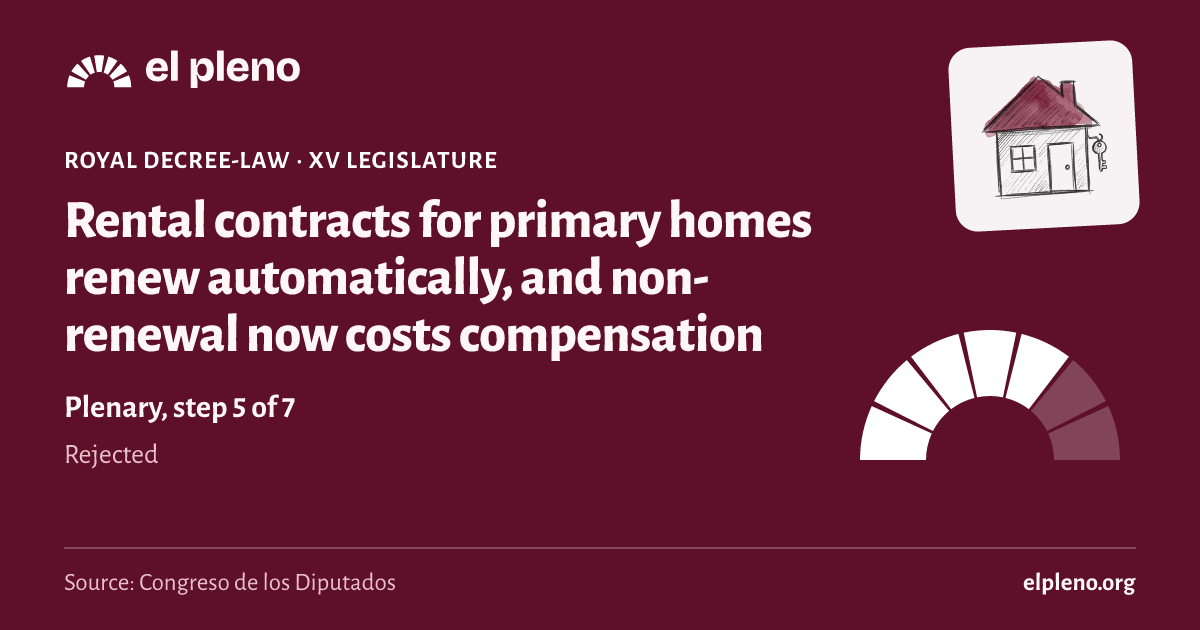
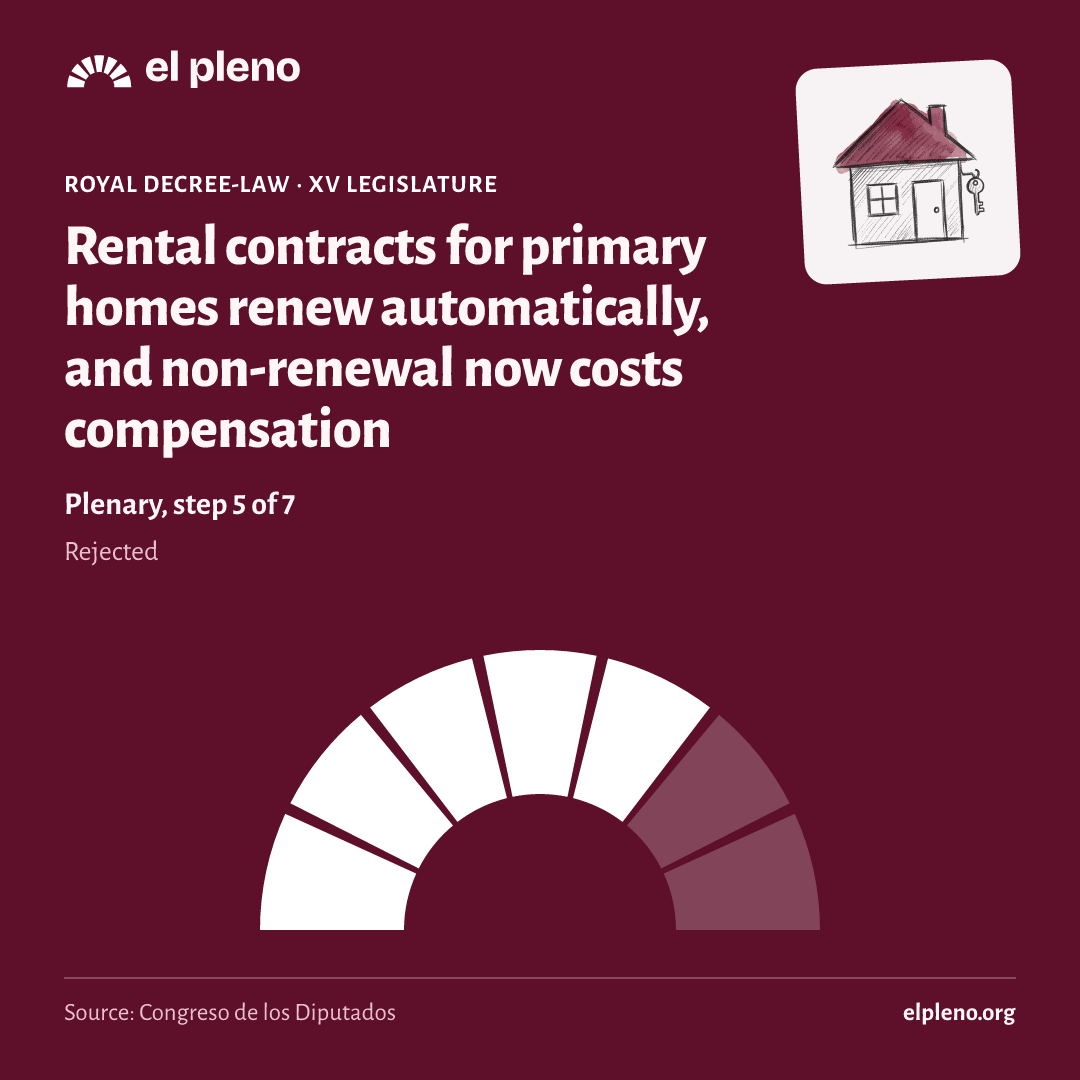
Source: Congreso de los Diputados, file 130/000056· updated 11 Nov
Automatic summary, not yet reviewed
- When a rental contract for a primary home reaches its minimum term (five years, or seven if the landlord is a company), it automatically renews for successive terms of the same length, unless either party gives notice that it does not want to renew. The landlord must give six months' notice and the tenant two months'.
- If the landlord does not renew the contract, they must pay the tenant compensation of at least twelve monthly payments of the rent for a similar home, calculated using the state reference price system. It is paid when the home is handed over and can never be less than one monthly payment per year of residence.
- No compensation is due if the landlord needs the home for themselves or close relatives (and if they do not move in within three months, the tenant still gets paid), if the tenant does not actually live in the apartment, if the tenant has another suitable home in the same municipality, if the parties sign a new contract, or if the tenant rejects a reasonable offer of a new contract of at least five years.
- Extraordinary extensions remain in place: up to one more year for tenants in a proven situation of vulnerability, and up to three more years (in annual terms) in areas declared as tight residential markets. They cannot be combined with each other or with other legal extensions, and the tight-market extension takes priority.
- The new rule applies to existing contracts only for expirations after it takes effect. Contracts already in their tacit renewal period keep the old rules until that period ends, and non-renewal notices already given remain valid and do not trigger compensation.
- The rule takes effect the day after its publication in the Official State Gazette (Boletín Oficial del Estado).
Who it affects
- Landlords of primary homes: They must give six months' notice if they do not want to renew and, in that case, pay compensation of at least twelve monthly payments.
- Tenants in primary homes: They gain continuity in their rental and, if the landlord does not renew without a justified reason, they receive compensation when handing over the apartment.
- Vulnerable tenants or those in tight-market areas: They can request extraordinary extensions of one or three years if they prove vulnerability or live in a tight-market area.
- Contracts signed before the reform: Contracts already in their tacit renewal period keep the old rules until they expire.
Words worth knowing
- Prórroga tácita
- Automatic continuation of the contract when its term ends, without anyone having to do anything.
- Arrendatario y arrendador
- Arrendatario is the tenant; arrendador is the landlord.
- Persona jurídica
- A company or organization, as opposed to a natural person.
- Tácita reconducción
- A situation where the tenant keeps living in the apartment and paying rent after the contract ends, and a new rental contract is understood to exist.
- Zona de mercado residencial tensionado
- An area officially declared where rents are especially high or have risen sharply.
It summarizes the law as published in the BOE. It is written by artificial intelligence and may contain mistakes: the official text is what counts. Read the official text · How we make summaries
Where it stands
How far did it get?
It took 5 of 7 steps. It reached Plenary, and today it is rejected.
- Introduced30 September 2026Someone registers the text in the Congreso.
- Admitted13 October 2026The Bureau of the Congreso accepts it and, for a members’ bill, the plenary decides whether to consider it.
- Amendmentsno dateGroups propose changes.
- Committeeno dateA committee goes through the text in detail.
- Plenary30 September 2026All 350 deputies vote.
- Senatenot reachedThe Senate can pass it, amend it or veto it.
- BOEnot reachedIt is published in the Official State Gazette (BOE) and comes into force.
See the 4 official steps on a timeline
2 October 2026
How did the plenary vote?
Voted on: Royal Decree-Law 27/2026, of September 29, adopting urgent measures to reinforce the stability of habitual residence rental contracts. (Public by call)
This vote did not publish each deputy’s vote.
Source: Congreso de los Diputados, vote 3 of sitting 203· updated 11 Nov
This vote does not publish each seat’s vote: the dots are drawn from the totals.
Your province
How did the deputies from your province vote?
And your senators: the Senate does not link its votes to this law in its open data, so we cannot put them side by side here.
What happens next
What happens now?
It goes no further. A similar one could be introduced later.
Published in the BOE: Royal Decree-Law 27/2026, of September 29, adopting urgent measures to reinforce the stability of residential lease contracts.
Sources
Where does all this come from?
- Congreso de los Diputados, file 130/000056
Official title, type, author, dates and stage.
Retrieved 11 November 2026
- Congreso de los Diputados, vote 3 of sitting 203
The count and every seat’s vote.
Retrieved 11 November 2026
- BOE, BOE-A-2026-20385
The law as published.
Retrieved 11 November 2026
- The data comes from the open files of the Congreso, the Senate and the BOE, unaltered.
- Each deputy’s province is the one of their seat on the day of the vote.
- We never say “passed” because of a vote: the files do not say which majority was needed.