
What it is
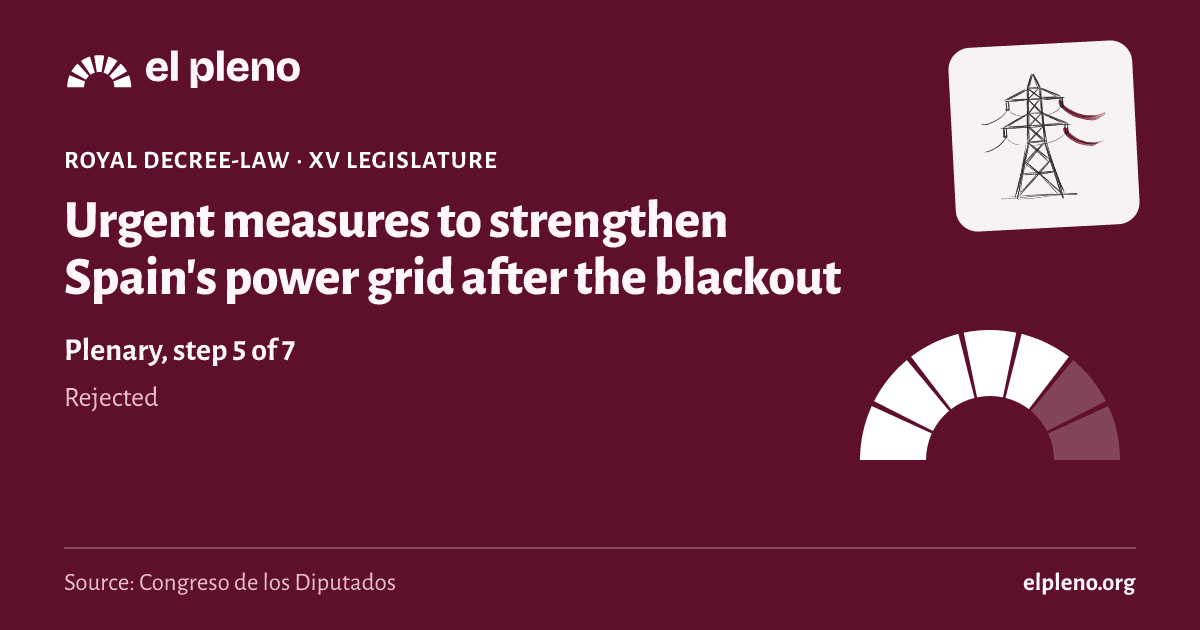
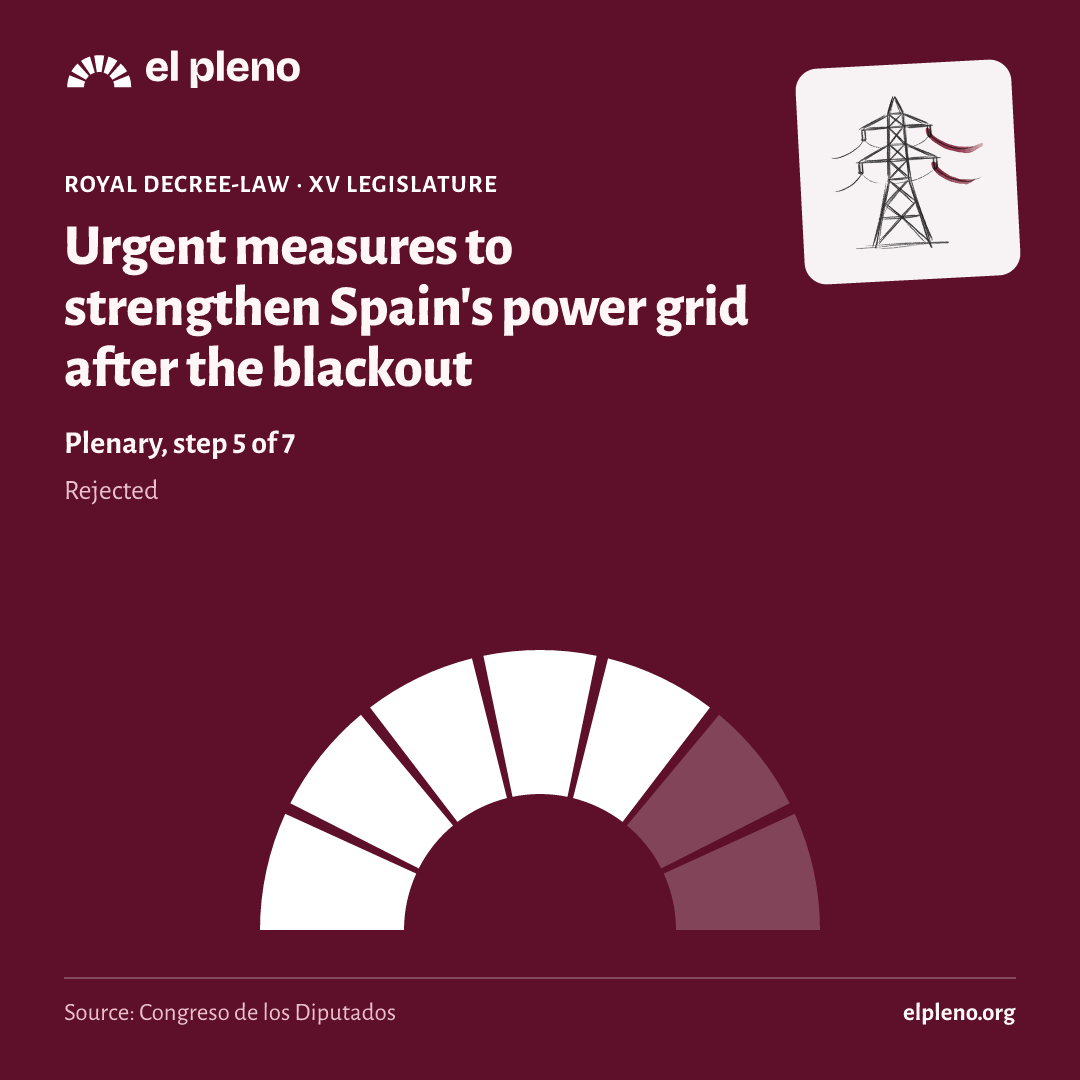
Urgent measures to strengthen Spain's power grid after the blackout
It is a royal decree-law. It was introduced on 26 June 2025. Introduced by: Gobierno.
Official title: Royal Decree-Law 7/2025, of June 24, approving urgent measures for the reinforcement of the electrical system.
Source: Congreso de los Diputados, file 130/000021· updated 11 Nov
Automatic summary, not yet reviewed
- The CNMC (Spain's competition and markets regulator) must produce a report on compliance with voltage control obligations (within six months, updated quarterly) and an extraordinary inspection plan on grid restoration capacity (within twelve months, then every three years). The system operator will have between three and fifteen months to analyze and propose regulatory changes on oscillations, voltage change speed, power injection, balancing services, grid coordination and incident monitoring.
- The system operator becomes the single access point for consumption data of all final customers, although this role will only start once the Government approves the implementing order.
- Companies sharing evacuation infrastructure (the lines that carry power from a plant to the grid) must sign an agreement allocating responsibilities among them. If they do not submit it, responsibility is shared in proportion to each one's access capacity.
- Energy storage gets a boost: storage facilities that feed power into the grid are declared of public utility, permitting for storage hybridized with renewable plants is streamlined (with deadlines cut in half and, in some cases, exemption from environmental assessment), they will get flexible access permits, and it is clarified that they do not count as consumers for connection purposes.
- Demand response is strengthened: independent aggregators, companies that pool the consumption of several customers to sell flexibility in the markets, are regulated, and the figure of the self-consumption manager is created, representing consumers in a shared self-consumption setup. Consumers will be able to sign aggregation contracts without their supplier's consent.
- The discount for energy-intensive industry is reinstated: from January 23 to December 31, 2025, companies holding an energy-intensive consumer certificate will get an 80% reduction on electricity transmission and distribution tolls. A 250 million euro credit is approved to compensate the CNMC.
- Electrification is made easier: electrical infrastructure for charging stations above 3,000 kW is exempt from permits in certain cases, homeowners' associations will be able to approve heat pumps and geothermal systems with one third of owners, and local governments may grant rebates of up to 50% on property tax (IBI) and up to 95% on construction tax (ICIO) for installing these systems.
- Renewable project deadlines are adjusted: if a court or administrative precautionary measure suspends the permits, the clock on the administrative milestones stops. In addition, an exceptional window opens for many projects to request an extension of the fifth milestone (the provisional operating permit for testing) up to a maximum of 8 years, and pumped hydro projects can reach 12 years.
Who it affects
- Power companies, generators and the system operator: Will face CNMC reports and inspections and new penalties if they fail to meet voltage control obligations.
- Electricity consumers: Will be able to access their consumption data through a single point, hire independent aggregators and use a self-consumption manager.
- Certified energy-intensive industry: Will receive an 80% discount on transmission and distribution tolls until December 31, 2025.
- Renewable and storage developers: Permitting for storage, repowering and new renewable projects is streamlined, with shorter deadlines and new windows to meet milestones.
- Homeowners' associations and local governments: Will be able to approve heat pumps and geothermal systems with one third of owners and benefit from IBI and ICIO tax rebates.
Words worth knowing
- Cero de tensión
- Blackout: total loss of voltage in the power system, as on April 28, 2025.
- Peaje de acceso
- Access toll: the part of the electricity bill that pays for using the transmission and distribution grids.
- Agregador independiente
- Independent aggregator: a company that pools several consumers to sell their flexibility (for example, cutting usage when needed) in the electricity markets.
- Autoconsumo
- Self-consumption: an installation, usually solar, that produces energy for a home's or business's own use.
- Hito administrativo
- Administrative milestone: a deadline renewable projects must meet to complete specific steps (such as obtaining the operating permit); missing it means the permits expire.
It summarizes the law as published in the BOE. It is written by artificial intelligence and may contain mistakes: the official text is what counts. Read the official text · How we make summaries
Where it stands
How far did it get?
It took 5 of 7 steps. It reached Plenary, and today it is rejected.
- Introduced26 June 2025Someone registers the text in the Congreso.
- Admitted8 July 2025The Bureau of the Congreso accepts it and, for a members’ bill, the plenary decides whether to consider it.
- Amendmentsno dateGroups propose changes.
- Committeeno dateA committee goes through the text in detail.
- Plenary8 July 2025All 350 deputies vote.
- Senatenot reachedThe Senate can pass it, amend it or veto it.
- BOEnot reachedIt is published in the Official State Gazette (BOE) and comes into force.
See the 4 official steps on a timeline
22 July 2025
How did the plenary vote?
Voted on: Royal Decree-Law 7/2025, of June 24, approving urgent measures for the reinforcement of the electrical system.
Source: Congreso de los Diputados, vote 17 of sitting 128· updated 10 Nov
Each dot is a seat. Tap one, or use the arrow keys, to see who it is.
Your province
How did the deputies from your province vote?
And your senators: the Senate does not link its votes to this law in its open data, so we cannot put them side by side here.
Or see how most of each province voted
- A Coruña More votes against 3 yes · 5 no
- Albacete Tie 2 yes · 2 no
- Alicante/Alacant More votes against 5 yes · 7 no
- Almería More votes against 2 yes · 4 no
- Araba/Álava More votes in favour 3 yes · 1 no
- Asturias More votes against 3 yes · 4 no
- Ávila More votes against 1 yes · 2 no
- Badajoz More votes against 2 yes · 3 no
- Barcelona More votes in favour 22 yes · 10 no
- Bizkaia More votes in favour 7 yes · 1 no
- Burgos Tie 2 yes · 2 no
- Cáceres Tie 2 yes · 2 no
- Cádiz More votes against 4 yes · 5 no
- Cantabria More votes against 2 yes · 3 no
- Castellón/Castelló More votes against 2 yes · 3 no
- Ceuta More votes against 0 yes · 1 no
- Ciudad Real More votes against 2 yes · 3 no
- Córdoba Tie 3 yes · 3 no
- Cuenca More votes against 1 yes · 2 no
- Gipuzkoa More votes in favour 6 yes · 0 no
- Girona More votes in favour 4 yes · 2 no
- Granada More votes against 2 yes · 5 no
- Guadalajara More votes against 1 yes · 2 no
- Huelva More votes against 2 yes · 3 no
- Huesca More votes against 1 yes · 2 no
- Illes Balears Tie 4 yes · 4 no
- Jaén More votes against 2 yes · 3 no
- La Rioja Tie 2 yes · 2 no
- Las Palmas More votes against 3 yes · 5 no
- León Tie 2 yes · 2 no
- Lleida More votes in favour 3 yes · 1 no
- Lugo More votes against 1 yes · 3 no
- Madrid More votes against 15 yes · 22 no
- Málaga More votes against 4 yes · 7 no
- Melilla More votes against 0 yes · 1 no
- Murcia More votes against 3 yes · 7 no
- Navarra Tie 2 yes · 2 no
- Ourense More votes against 1 yes · 3 no
- Palencia More votes against 1 yes · 2 no
- Pontevedra More votes in favour 4 yes · 3 no
- Salamanca More votes against 1 yes · 3 no
- Santa Cruz de Tenerife More votes in favour 4 yes · 3 no
- Segovia More votes against 1 yes · 2 no
- Sevilla More votes in favour 7 yes · 5 no
- Soria Tie 1 yes · 1 no
- Tarragona More votes in favour 4 yes · 1 no
- Teruel More votes against 1 yes · 2 no
- Toledo More votes against 2 yes · 4 no
- Valencia/València Tie 8 yes · 8 no
- Valladolid More votes against 2 yes · 3 no
- Zamora More votes against 1 yes · 2 no
- Zaragoza More votes against 2 yes · 5 no
More details: how each group and each province voted
The groups
Who voted in favour and who against?
In favour, most of Euskal Herria Bildu, Plurinacional SUMAR, Republicano, Socialista and Vasco (EAJ-PNV). Against, most of Junts per Catalunya, Mixto, Popular en el Congreso and VOX. 4 deputies voted differently from their group.
By province: in 10 most voted in favour; in 32, against.
Coloured by how most of each province’s deputies voted.
- In favour: 10
- Against: 32
- Tie: 10
| Group | Seats | How it voted |
|---|---|---|
| Euskal Herria Bildu | 6 | 5 in favour · 1 did not vote |
| Plurinacional SUMAR | 26 | 25 in favour · 1 against |
| Republicano | 7 | 7 in favour |
| Socialista | 120 | 120 in favour |
| Vasco (EAJ-PNV) | 5 | 5 in favour |
| Junts per Catalunya | 7 | 6 against · 1 did not vote |
| Mixto | 9 | 3 in favour · 6 against |
| Popular en el Congreso | 137 | 137 against |
| VOX | 33 | 33 against |
What happens next
What happens now?
It goes no further. A similar one could be introduced later.
Published in the BOE: Royal Decree-Law 7/2025, of June 24, approving urgent measures for the reinforcement of the electrical system.
Sources
Where does all this come from?
- Congreso de los Diputados, file 130/000021
Official title, type, author, dates and stage.
Retrieved 11 November 2026
- Congreso de los Diputados, vote 17 of sitting 128
The count and every seat’s vote.
Retrieved 10 November 2026
- BOE, BOE-A-2025-12857
The law as published.
Retrieved 13 November 2026
- The data comes from the open files of the Congreso, the Senate and the BOE, unaltered.
- Each deputy’s province is the one of their seat on the day of the vote.
- We only say “passed” or “rejected” when the majority needed is certain; otherwise we say which side had more votes.