What it is
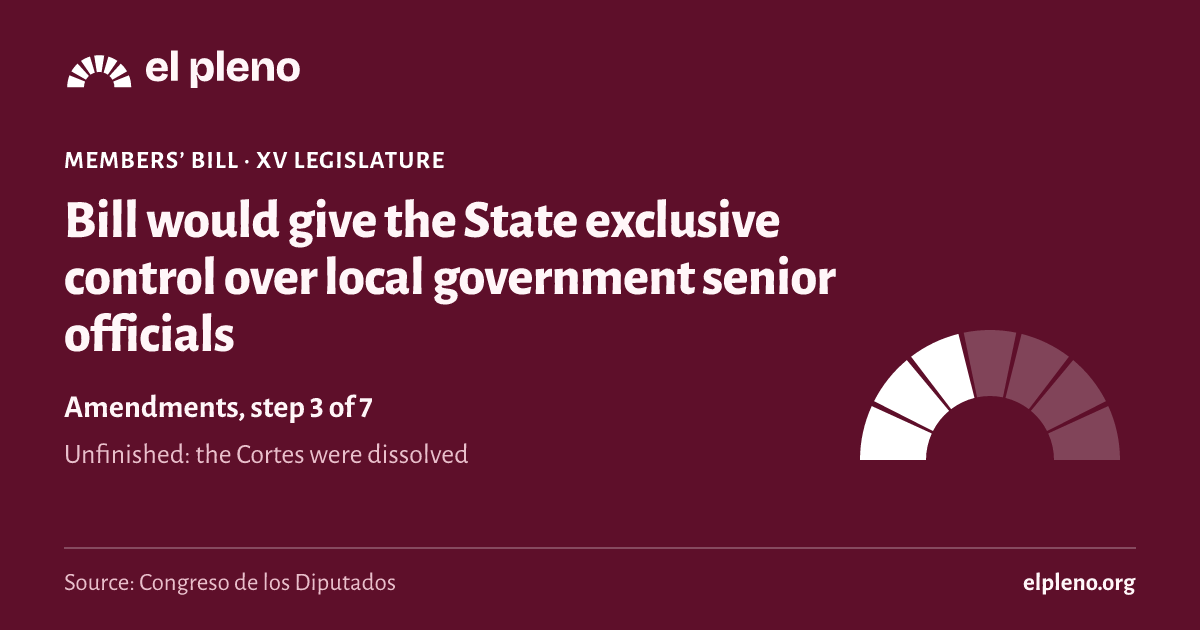
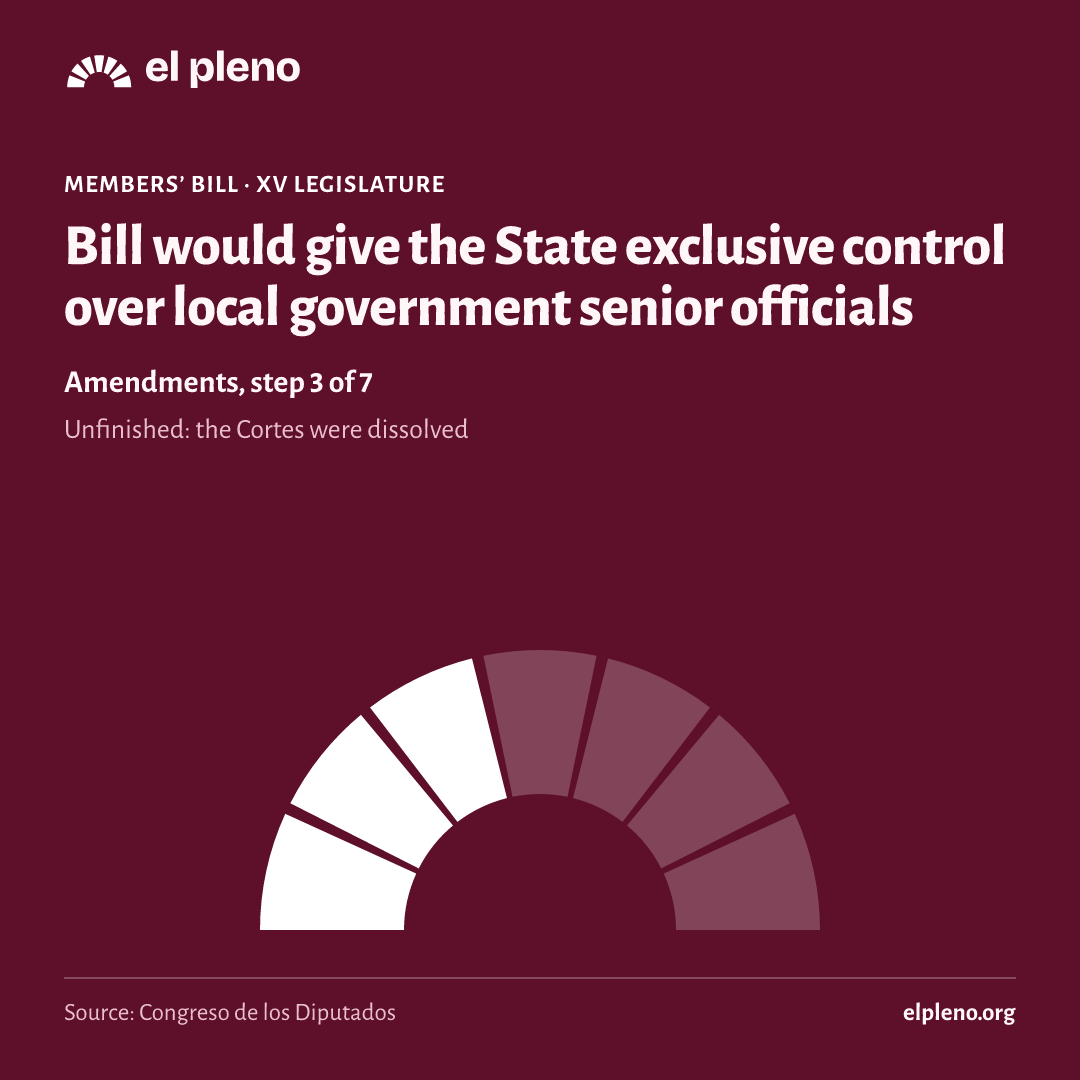
Bill would give the State exclusive control over local government senior officials
Amendments step 3 of 7 · UnfinishedIt is a members’ bill. Introduced by parliamentary groups, the Senate, regional governments or citizens. It was introduced on 2 October 2025. Introduced by: Senado.
Official title: Private member's bill for the amendment of Article 92 bis of Law 7/1985, of April 2, Regulating the Bases of the Local Regime.
Source: Congreso de los Diputados, file 124/000035· updated 11 Nov
Automatic summary, not yet reviewed
- The bill, sent by the Senate, would amend Article 92 bis of Law 7/1985, which sets the bases of local government. It is not an approved law: the Congress has referred it to the Budget and Public Service Committee, and amendments may be filed until October 28, 2025.
- The text keeps the functions of secretary, comptroller and treasurer in town councils reserved for officials with a national qualification, and keeps the corps split into the Secretaría, Intervención-tesorería and Secretaría-intervención subgrades, with two categories: entry and superior.
- The bill would make the State, through the Ministry for Digital Transformation and Public Service, solely responsible for the legal regime of these officials and for approving job offers, their selection, training and qualification. Regional governments could only collaborate in the processes and take part in selection panels.
- The proposal sets the contest system as the normal way to assign positions, with a single annual contest called by the State and nationwide in scope. General merits would count for at least 80% of the score, regional merits up to 15% and municipal merits up to 5%.
- It repeals paragraphs seven and eight of the second additional provision of Law 7/1985 and the fourteenth transitional provision of organic law A law on fundamental rights, the electoral system or other matters the Constitution reserves. It needs an absolute majority in the Congreso: 176 votes. 1/2025, which had allowed transferring the selection and assignment of these officials to the Basque Country.
- The law would be enacted under Article 149.1.18 of the Constitution, would take effect the day after its publication in the Official State Gazette, and the Ministry would have six months to approve the necessary regulatory changes.
Who it affects
- Local government officials with a national qualification (secretaries, comptrollers and treasurers): Their selection, training, assignment and disciplinary regime would remain under State control, with a single annual nationwide contest.
- Town councils and other local entities: They could set up to 5% of the contest merits and would need State authorization for certain discretionary appointments.
- Regional governments (comunidades autónomas): They would lose the power to select these officials; they could only collaborate in the processes, sit on panels and make provisional appointments.
- People applying for these positions: They would take common nationwide exams; in regions with a co-official language, knowing it would be a merit but not a requirement.
Words worth knowing
- Habilitación de carácter nacional
- An official qualification that allows certain civil servants to hold reserved positions in any Spanish town council, regardless of where they passed the entrance exam.
- Provisión de puestos
- The system used to assign each civil servant the job position they will hold.
- Concurso
- A selection process based on assessing merits such as experience or training, not only an exam.
- Libre designación
- A system in which the administration directly chooses a person for a position, without a merit contest.
- Subsidiariedad
- The principle that each matter should be handled by the government level closest to citizens that is able to solve it.
- organic law
- A law on fundamental rights, the electoral system or other matters the Constitution reserves. It needs an absolute majority in the Congreso: 176 votes.
It summarizes the text as it was introduced. It is written by artificial intelligence and may contain mistakes: the official text is what counts. Read the official text · How we make summaries
Where it stands
How far did it get?
It took 3 of 7 steps. It reached Amendments, and today it is unfinished.
- Introduced2 October 2025Someone registers the text in the Congreso.
- Admitted7 October 2025The Bureau of the Congreso accepts it and, for a members’ bill, the plenary decides whether to consider it.
- Amendments10 October 2025Groups propose changes.
- Committeenot reachedA committee goes through the text in detail.
- Plenarynot reachedAll 350 deputies vote.
- Senatenot reachedThe Senate can pass it, amend it or veto it.
- BOEnot reachedIt is published in the Official State Gazette (BOE) and comes into force.
See the 5 official steps on a timeline
Was there a plenary vote?
We have no plenary vote linked to this law in the Congreso’s data.
What happens next
What happens now?
The legislature ended before it finished. To go on, someone would have to introduce it again in the new Cortes.
It has not been presented again yet.
The same initiative in the other chamber:
Sources
Where does all this come from?
- Congreso de los Diputados, file 124/000035
Official title, type, author, dates and stage.
Retrieved 11 November 2026
- Congreso de los Diputados, procedure
The date of each step, with its official wording.
Retrieved 12 November 2026
- The data comes from the open files of the Congreso, the Senate and the BOE, unaltered.
- Each deputy’s province is the one of their seat on the day of the vote.
- We only say “passed” or “rejected” when the majority needed is certain; otherwise we say which side had more votes.