What it is
Bill to manage and clarify ownership of 'montes de socios' shared forests
It is a members’ bill. Introduced by parliamentary groups, the Senate, regional governments or citizens. It was introduced on 21 March 2024. Introduced by: Senado.
Official title: Private Member's Bill on partner-owned forests.
Source: Congreso de los Diputados, file 124/000007· updated 11 Nov
Automatic summary, not yet reviewed
- The bill would define a Monte de socios A private forest owned by several people in common, some of them unknown, usually heirs of villagers who bought it in the 19th century. as a functional and permanent community, meaning a co-ownership that cannot be divided, and would subject it to a special co-ownership regime with the rules of this law.
- It would have the regional forestry authority declare a monte de socios, at the request of at least three participants, of the entity that has run the forest, or of the Administration on public interest grounds, with a procedure allowing objections and a decision within six months.
- It would create a Junta gestora The board that governs and represents the group of co-owners of the forest. (management board) as the governing and representative body of the forest, formed by at least five participants, with a General Assembly and a Governing Board, able to manage the forest, distribute profits and invest shares with no identified owner in improvements to the forest or its area.
- It would create two special procedures to update the ownership of shares: an administrative one similar to land consolidation, and a notarial one to resume the chain of title, allowing the forest and its shares to be registered in the Property Registry.
- It would set rules for vacant shares and abandoned forests: participants would have a right of first refusal on ownerless shares after thirty years, and fully vacant forests could pass to the State and be transferred free of charge to the Regional Government or the municipality if they qualify as public utility land.
- It would repeal the current Article 27 bis of the Forestry Law and create a registry of montes de socios in each Regional Government, and would extend to these forests the corporate tax regime that applies to common-use village forests.
Who it affects
- Co-owners of montes de socios, including heirs of the original buyers from the 19th century disentailment: They could have the forest declared a monte de socios, set up a management board and update the ownership of their shares.
- Municipalities and rural areas where the forests are located: Profits from shares with no identified owner could go to public works or services in the area.
- Regional Governments (Comunidades Autónomas): They would declare montes de socios, create their own registries and develop the rules.
- Notaries and Property Registrars: They would take part in the new procedures to update ownership and resume the chain of title.
- The Spanish State: It would investigate ownership of fully vacant forests and could transfer them to Regional Governments or municipalities.
Words worth knowing
- Monte de socios
- A private forest owned by several people in common, some of them unknown, usually heirs of villagers who bought it in the 19th century.
- Junta gestora
- The board that governs and represents the group of co-owners of the forest.
- Cuota no esclarecida
- A share of the property whose owners have not yet been identified.
- Reanudación de tracto
- A procedure to register in the Property Registry the transfers missing between an old entry and the current owner.
- Desamortización
- A 19th century process in which the State sold at public auction property that had belonged to municipalities or the Church.
It summarizes the text as it was introduced. It is written by artificial intelligence and may contain mistakes: the official text is what counts. Read the official text · How we make summaries
Where it stands
How far did it get?
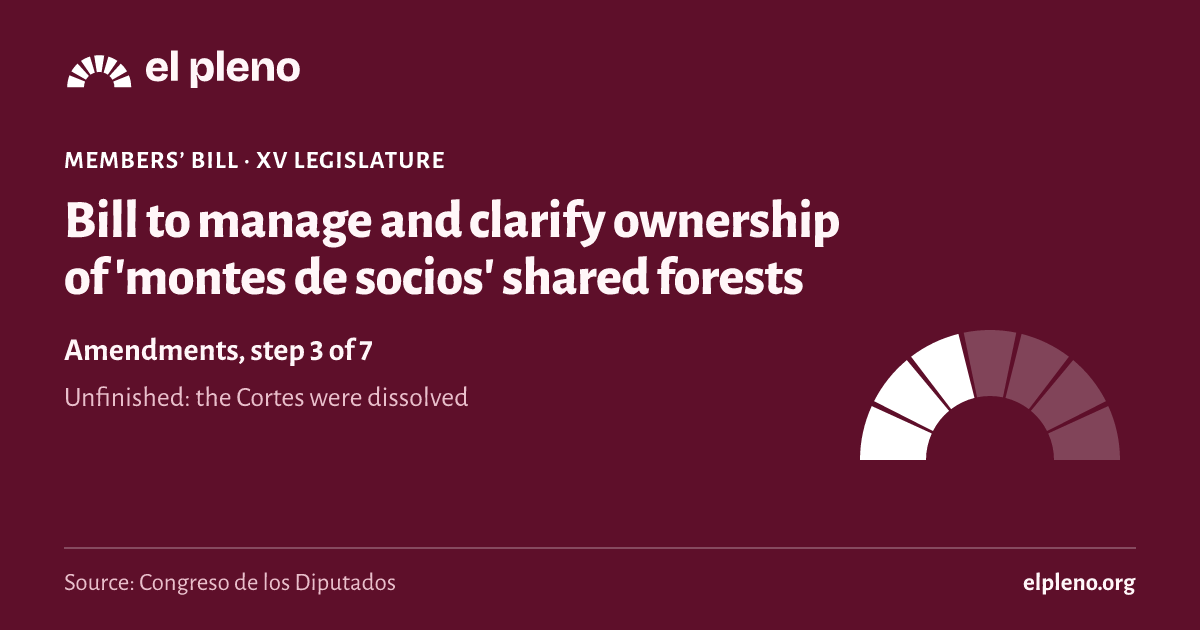
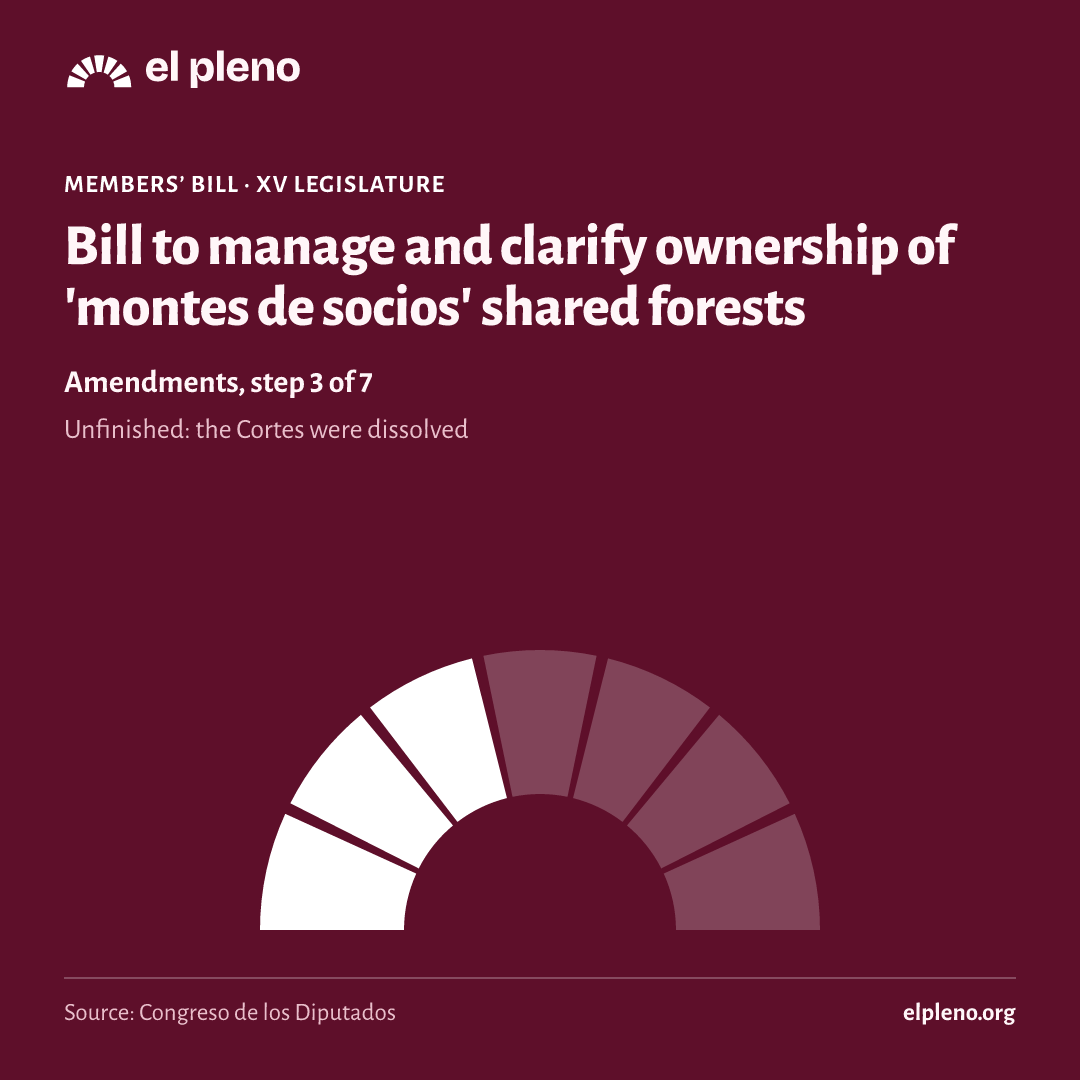
It took 3 of 7 steps. It reached Amendments, and today it is unfinished.
- Introduced21 March 2024Someone registers the text in the Congreso.
- Admitted2 April 2024The Bureau of the Congreso accepts it and, for a members’ bill, the plenary decides whether to consider it.
- Amendments5 April 2024Groups propose changes.
- Committeenot reachedA committee goes through the text in detail.
- Plenarynot reachedAll 350 deputies vote.
- Senatenot reachedThe Senate can pass it, amend it or veto it.
- BOEnot reachedIt is published in the Official State Gazette (BOE) and comes into force.
See the 5 official steps on a timeline
Was there a plenary vote?
We have no plenary vote linked to this law in the Congreso’s data.
What happens next
What happens now?
The legislature ended before it finished. To go on, someone would have to introduce it again in the new Cortes.
It has not been presented again yet.
Sources
Where does all this come from?
- Congreso de los Diputados, file 124/000007
Official title, type, author, dates and stage.
Retrieved 11 November 2026
- Congreso de los Diputados, procedure
The date of each step, with its official wording.
Retrieved 12 November 2026
- The data comes from the open files of the Congreso, the Senate and the BOE, unaltered.
- Each deputy’s province is the one of their seat on the day of the vote.
- We only say “passed” or “rejected” when the majority needed is certain; otherwise we say which side had more votes.