What it is
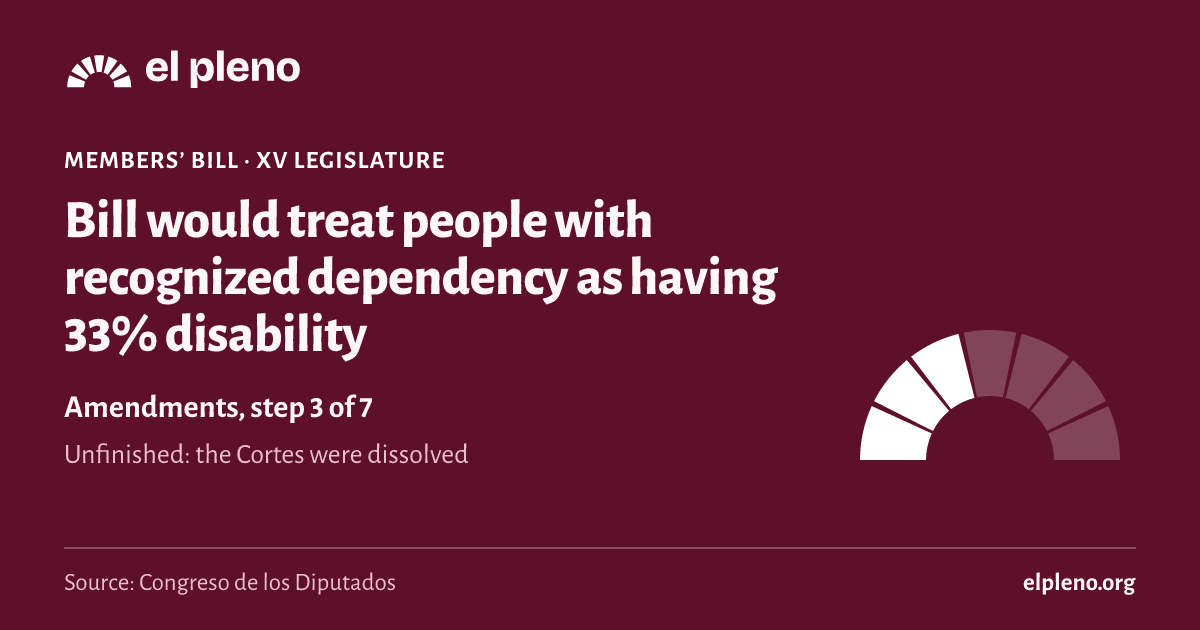
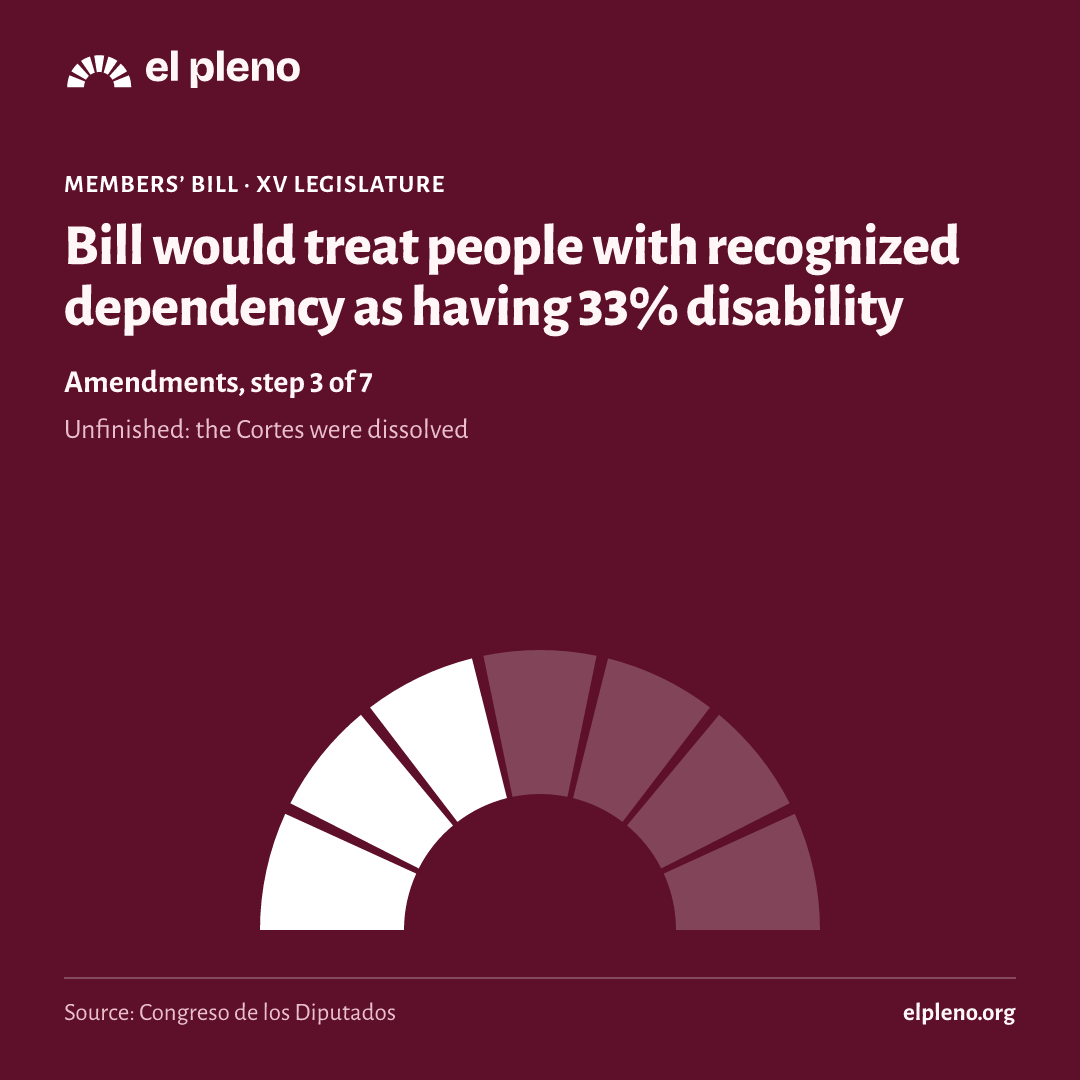
Bill would treat people with recognized dependency as having 33% disability
Amendments step 3 of 7 · UnfinishedIt is a members’ bill. Introduced by parliamentary groups, the Senate, regional governments or citizens. It was introduced on 19 December 2023. Introduced by: Senado.
Official title: Private member's bill for the modification of Royal Legislative Decree 1/2013, of November 29, by which the Consolidated Text of the General Law on the rights of persons with disabilities and their social inclusion is approved, for the legal assimilation of the assessment of dependency situations with the minimum qualification of the degree of disability.
Source: Congreso de los Diputados, file 124/000002· updated 11 Nov
Automatic summary, not yet reviewed
- The bill would amend the disability rights law so that anyone officially recognized as being in a situation of dependency, at any level, would automatically be considered a person with a disability of 33%, the minimum degree.
- Today, disability and dependency are assessed with different scales and by different bodies, so a person with dependency must go through another procedure, sometimes pay a fee, and often wait a long time to get disability recognition.
- The bill is justified by public savings, administrative simplification, and better service for vulnerable people. It would also be budget neutral, because it only grants the minimum degree and leaves each benefit rule to set its own requirements.
- The final provision says the law would enter into force on January 1, 2024.
Who it affects
- People with an officially recognized situation of dependency: Would automatically get a 33% disability degree recognized, with no extra procedure, if they have recognized dependency at any level.
- Pensioners with total, absolute, or major permanent disability, and similar civil service pensioners: Are already considered persons with a 33% disability, and the bill keeps that treatment.
- Public bodies that assess disability and dependency: Would stop processing disability recognitions already covered by the assimilation, saving resources.
Words worth knowing
- Baremo
- A scale or scoring table used to measure a person's degree of disability or dependency.
- Grado de discapacidad
- Percentage the Administration recognizes to state how much a disability affects a person. The minimum is 33%.
- Situación de dependencia
- A permanent condition in which a person needs help from others for basic daily activities.
- Prestación
- Money, service, or support the Administration gives to those entitled to it.
- Proposición de ley
- A bill introduced by the Senate or the Congress. It is not an approved law yet.
It summarizes the text as it was introduced. It is written by artificial intelligence and may contain mistakes: the official text is what counts. Read the official text · How we make summaries
Where it stands
How far did it get?
It took 3 of 7 steps. It reached Amendments, and today it is unfinished.
- Introduced19 December 2023Someone registers the text in the Congreso.
- Admitted9 January 2024The Bureau of the Congreso accepts it and, for a members’ bill, the plenary decides whether to consider it.
- Amendments12 January 2024Groups propose changes.
- Committeenot reachedA committee goes through the text in detail.
- Plenarynot reachedAll 350 deputies vote.
- Senatenot reachedThe Senate can pass it, amend it or veto it.
- BOEnot reachedIt is published in the Official State Gazette (BOE) and comes into force.
See the 5 official steps on a timeline
Was there a plenary vote?
We have no plenary vote linked to this law in the Congreso’s data.
What happens next
What happens now?
The legislature ended before it finished. To go on, someone would have to introduce it again in the new Cortes.
It has not been presented again yet.
The same initiative in the other chamber:
- XV Legislature, Senate Private member's bill for the modification of Royal Legislative Decree 1/2013, of November 29, by which the Consolidated Text of the General Law on the rights of persons with disabilities and their social inclusion is approved, for the legal assimilation of the assessment of dependency situations with the minimum qualification of the degree of disability.
- XV Legislature, Senate Private member's bill for the modification of Royal Legislative Decree 1/2013, of November 29, by which the Consolidated Text of the General Law on the rights of persons with disabilities and their social inclusion is approved, for the legal assimilation of the assessment of dependency situations with the minimum qualification of the degree of disability.
Presented before in:
- XII Legislature, Congreso de los Diputados· Unfinished Bill would treat people with recognized dependency as having a disability
- XII Legislature, Senate Private member's bill for the modification of Royal Legislative Decree 1/2013, of November 29, by which the Consolidated Text of the General Law on the rights of persons with disabilities and their social inclusion is approved, for the legal assimilation of the assessment of dependency situations with the minimum qualification of the degree of disability.
- XIV Legislature, Senate Private member's bill for the modification of Royal Legislative Decree 1/2013, of November 29, by which the Consolidated Text of the General Law on the rights of persons with disabilities and their social inclusion is approved, for the legal assimilation of the assessment of dependency situations with the minimum qualification of the degree of disability.
Sources
Where does all this come from?
- Congreso de los Diputados, file 124/000002
Official title, type, author, dates and stage.
Retrieved 11 November 2026
- Congreso de los Diputados, procedure
The date of each step, with its official wording.
Retrieved 12 November 2026
- The data comes from the open files of the Congreso, the Senate and the BOE, unaltered.
- Each deputy’s province is the one of their seat on the day of the vote.
- We only say “passed” or “rejected” when the majority needed is certain; otherwise we say which side had more votes.