What it is
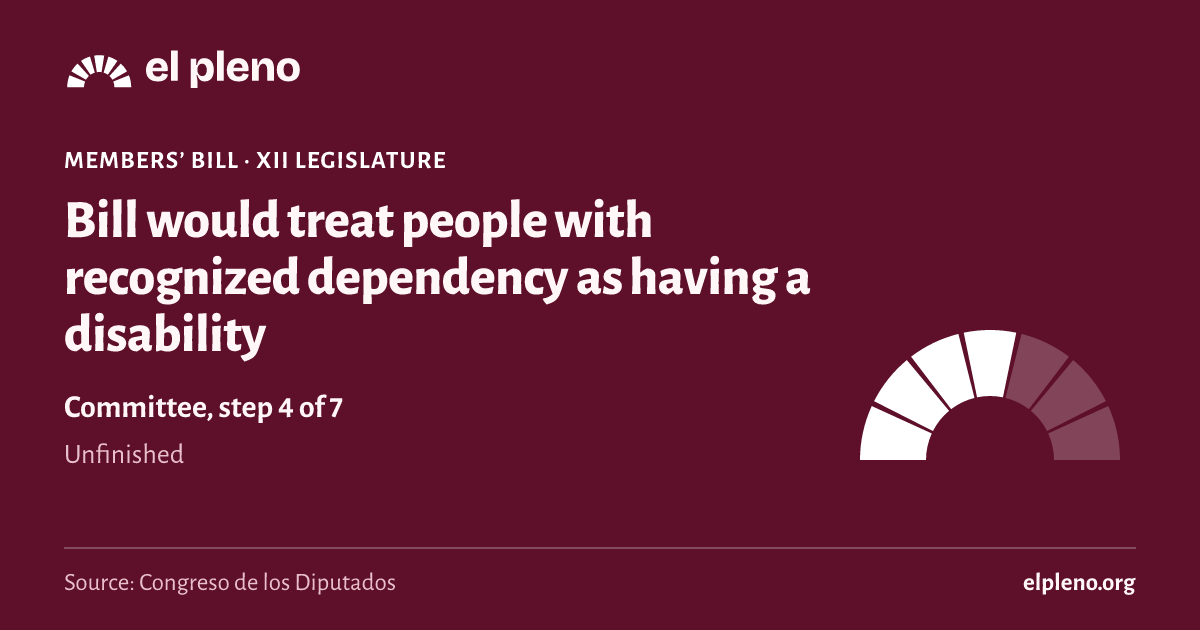
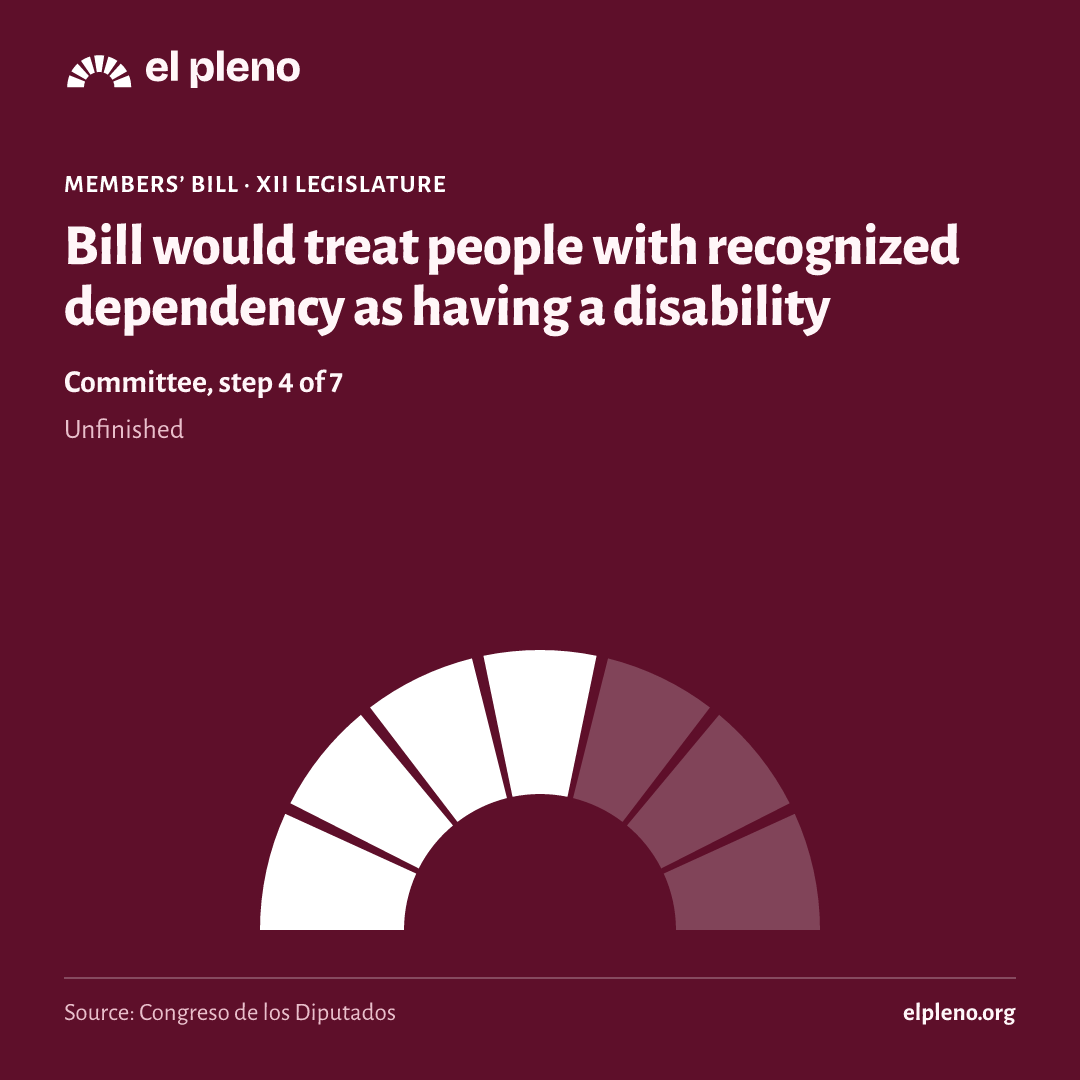
Bill would treat people with recognized dependency as having a disability
Committee step 4 of 7 · UnfinishedIt is a members’ bill. Introduced by parliamentary groups, the Senate, regional governments or citizens. It was introduced on 1 October 2018. Introduced by: Senado.
Official title: Private member's bill for the modification of Royal Legislative Decree 1/2013, of November 29, by which the Consolidated Text of the General Law on the rights of persons with disabilities and their social inclusion is approved, for the legal assimilation of the assessment of dependency situations with the minimum qualification of the degree of disability.
Source: Congreso de los Diputados, file 124/000007· updated 11 Nov
Automatic summary, not yet reviewed
- The bill would amend the General Law on the rights of persons with disabilities so that people officially recognized as being in a situation of dependency, at any level, would be considered persons with a disability of 33 percent or more, the minimum degree.
- That recognition would apply for all purposes, although the rules governing benefits or positive action measures could set specific requirements to access them. According to the explanatory statement, the bill does not extend benefits indiscriminately.
- The explanatory statement justifies the measure on grounds of social justice, administrative simplification and public savings, since people with recognized dependency would no longer need to go through another procedure to get disability recognition.
- If passed, the law would take effect the day after its publication in the Official State Gazette (Boletín Oficial del Estado).
Who it affects
- People officially recognized as being in a situation of dependency: They would be considered persons with a disability at the minimum degree (33 percent) without another procedure.
- People who already have a recognized disability degree of 33 percent or more: No change for them; the measure affects those who only have a dependency assessment.
- Bodies that certify disability: They would have fewer procedures and less workload in many cases, according to the explanatory statement.
Words worth knowing
- Situación de dependencia (situation of dependency)
- A permanent state in which a person needs help from others or significant support for basic daily activities.
- Grado de discapacidad (degree of disability)
- A percentage measuring a person's level of disability; the minimum recognized is 33 percent.
- Medidas de acción positiva (positive action measures)
- Benefits, aid or advantages the law gives to a group to offset disadvantages, such as persons with disabilities.
- Baremo (assessment scale)
- A table of criteria and scores used to assess disability or dependency.
- Proposición de ley (bill)
- A text with which the Senate or Congress proposes a law; here it is not yet passed.
It summarizes the text as it was introduced. It is written by artificial intelligence and may contain mistakes: the official text is what counts. Read the official text · How we make summaries
Where it stands
How far did it get?
It took 4 of 7 steps. It reached Committee, and today it is unfinished.
- Introduced1 October 2018Someone registers the text in the Congreso.
- Admitted9 October 2018The Bureau of the Congreso accepts it and, for a members’ bill, the plenary decides whether to consider it.
- Amendments15 October 2018Groups propose changes.
- Committee27 February 2019A committee goes through the text in detail.
- Plenarynot reachedAll 350 deputies vote.
- Senatenot reachedThe Senate can pass it, amend it or veto it.
- BOEnot reachedIt is published in the Official State Gazette (BOE) and comes into force.
See the 6 official steps on a timeline
Was there a plenary vote?
We have no plenary vote linked to this law in the Congreso’s data.
What happens next
What happens now?
The legislature ended before it finished. To go on, someone would have to introduce it again in the new Cortes.
It was presented again:
- XIV Legislature, Senate Private member's bill for the modification of Royal Legislative Decree 1/2013, of November 29, by which the Consolidated Text of the General Law on the rights of persons with disabilities and their social inclusion is approved, for the legal assimilation of the assessment of dependency situations with the minimum qualification of the degree of disability.
- XV Legislature, Congreso de los Diputados· Unfinished Bill would treat people with recognized dependency as having 33% disability
- XV Legislature, Senate Private member's bill for the modification of Royal Legislative Decree 1/2013, of November 29, by which the Consolidated Text of the General Law on the rights of persons with disabilities and their social inclusion is approved, for the legal assimilation of the assessment of dependency situations with the minimum qualification of the degree of disability.
- XV Legislature, Senate Private member's bill for the modification of Royal Legislative Decree 1/2013, of November 29, by which the Consolidated Text of the General Law on the rights of persons with disabilities and their social inclusion is approved, for the legal assimilation of the assessment of dependency situations with the minimum qualification of the degree of disability.
The same initiative in the other chamber:
Sources
Where does all this come from?
- Congreso de los Diputados, file 124/000007
Official title, type, author, dates and stage.
Retrieved 11 November 2026
- The data comes from the open files of the Congreso, the Senate and the BOE, unaltered.
- Each deputy’s province is the one of their seat on the day of the vote.
- We only say “passed” or “rejected” when the majority needed is certain; otherwise we say which side had more votes.