

What it is
Bill proposes cutting VAT on hairdressing and beauty services to 10%
It is a members’ bill. Introduced by parliamentary groups, the Senate, regional governments or citizens. It was introduced on 10 November 2023. Introduced by: Senado.
Official title: Private Member's Bill to modify Section One, point 2, of Article 91 of Law 37/1992, of December 28, on Value Added Tax.
Source: Congreso de los Diputados, file 124/000001· updated 11 Nov
Automatic summary, not yet reviewed
- The bill would amend Article 91 of the VAT Law so that hairdressing, barbering and beauty services move from the general rate to the reduced 10% rate.
- The preamble argues the sector has lost thousands of businesses and, according to the data it provides, cutting VAT to 10% would increase VAT and social security revenue and reduce unemployment spending.
- The Bureau of the Congress referred the bill to the Finance and Civil Service Committee for direct approval with full legislative power, and set a fifteen-working-day amendment period ending December 29, 2023.
- If passed, the law would enter into force on January 1, 2024, and would repeal any rules that conflict with it.
Who it affects
- Hairdressers, barbers and beauty salons: VAT on their services would drop from 21% to 10%.
- Customers of these services: They would pay less VAT on hairdressing and beauty services.
- Workers in the sector: According to the text, the measure could slow business closures and job losses.
- Tax agency and social security: The text claims the cut would increase revenue and reduce unemployment spending.
Words worth knowing
- IVA
- Value Added Tax (VAT): a percentage added to the price of almost everything you buy.
- Tipo impositivo
- The VAT percentage applied to a product or service.
- Economía sumergida
- The underground economy: business activity hidden from the tax authorities.
- Competencia legislativa plena
- Full legislative power: a parliamentary committee can pass the law directly, without a vote by the whole Congress.
- Enmiendas
- Amendments: changes that lawmakers propose to a bill before it is passed.
It summarizes the text as it was introduced. It is written by artificial intelligence and may contain mistakes: the official text is what counts. Read the official text · How we make summaries
Where it stands
How far did it get?
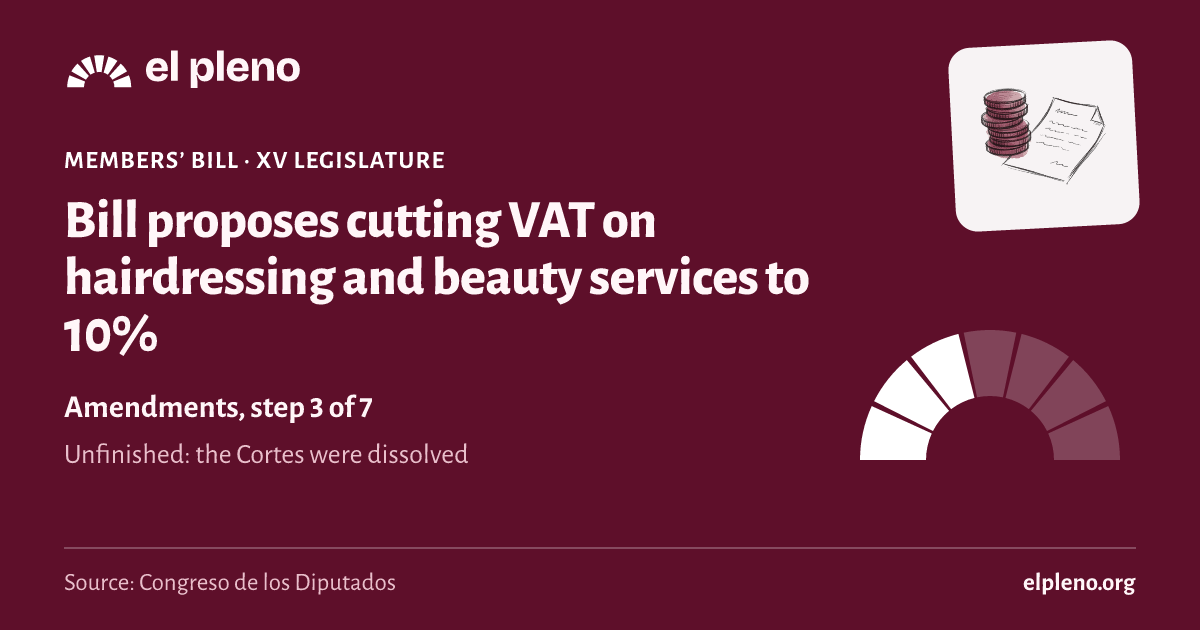
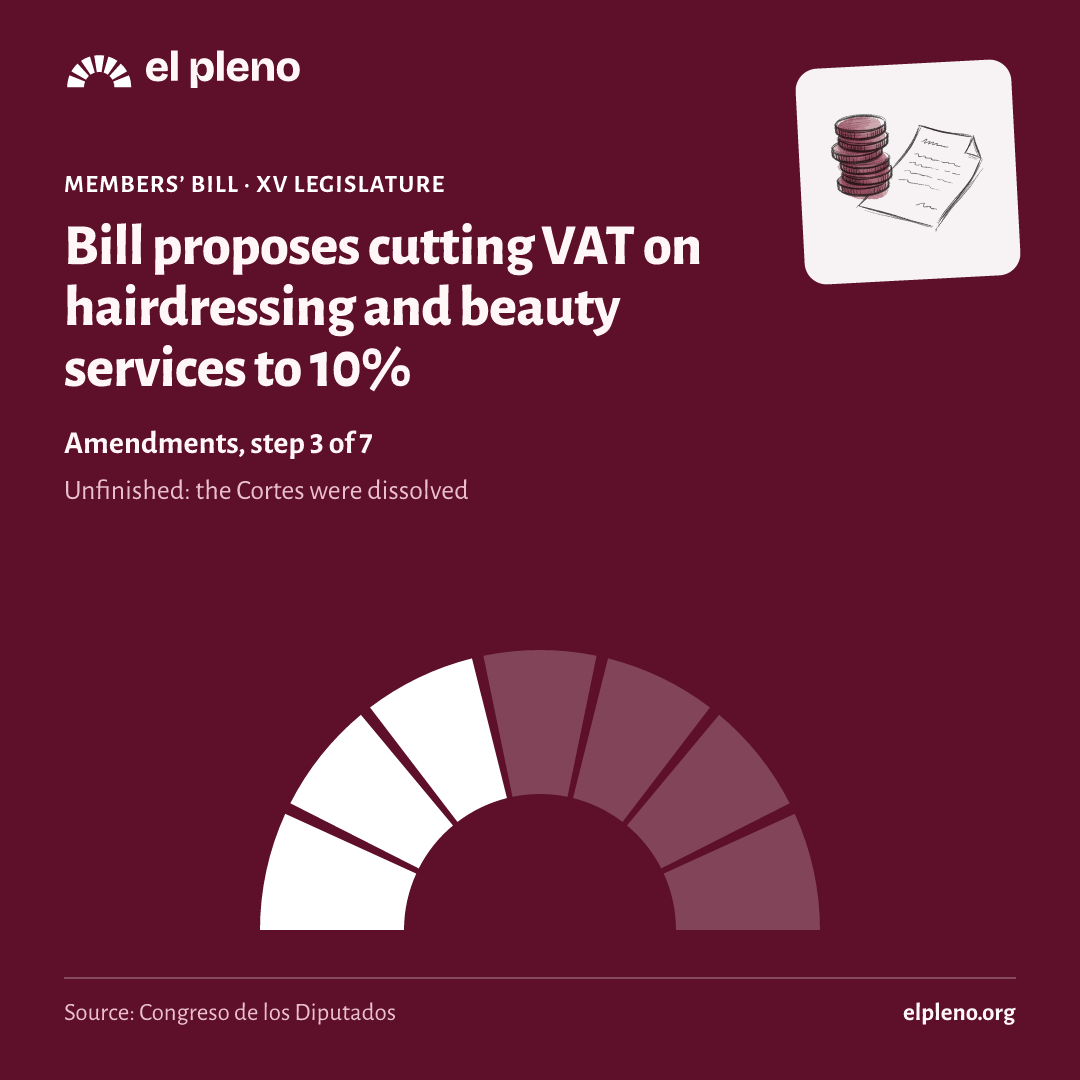
It took 3 of 7 steps. It reached Amendments, and today it is unfinished.
- Introduced10 November 2023Someone registers the text in the Congreso.
- Admitted5 December 2023The Bureau of the Congreso accepts it and, for a members’ bill, the plenary decides whether to consider it.
- Amendments11 December 2023Groups propose changes.
- Committeenot reachedA committee goes through the text in detail.
- Plenarynot reachedThe deputies vote, usually in the plenary; some laws are passed by a committee without going to it.
- Senatenot reachedThe Senate can pass it, amend it or veto it.
- BOEnot reachedThe King gives royal assent and it is published in the Official State Gazette (BOE). It comes into force on the date it sets, or after 20 days if it sets none.
See the 5 official steps on a timeline
Was there a plenary vote?
We have no plenary vote linked to this law in the Congreso’s data.
What happens next
What happens now?
The legislature ended before it finished. To go on, someone would have to introduce it again in the new Cortes.
It has not been presented again yet.
The same initiative in the other chamber:
- XV Legislature, Senate Private Member's Bill to modify Section One, point 2, of Article 91 of Law 37/1992, of December 28, on Value Added Tax.
Presented before in:
Sources
Where does all this come from?
- Congreso de los Diputados, file 124/000001
Official title, type, author, dates and stage.
Retrieved 11 November 2026
- Congreso de los Diputados, procedure
The date of each step, with its official wording.
Retrieved 13 November 2026
- The data comes from the open files of the Congreso, the Senate and the BOE, unaltered.
- Each deputy’s province is the one of their seat on the day of the vote.
- We only say “passed” or “rejected” when the majority needed is certain; otherwise we say which side had more votes.