What it is
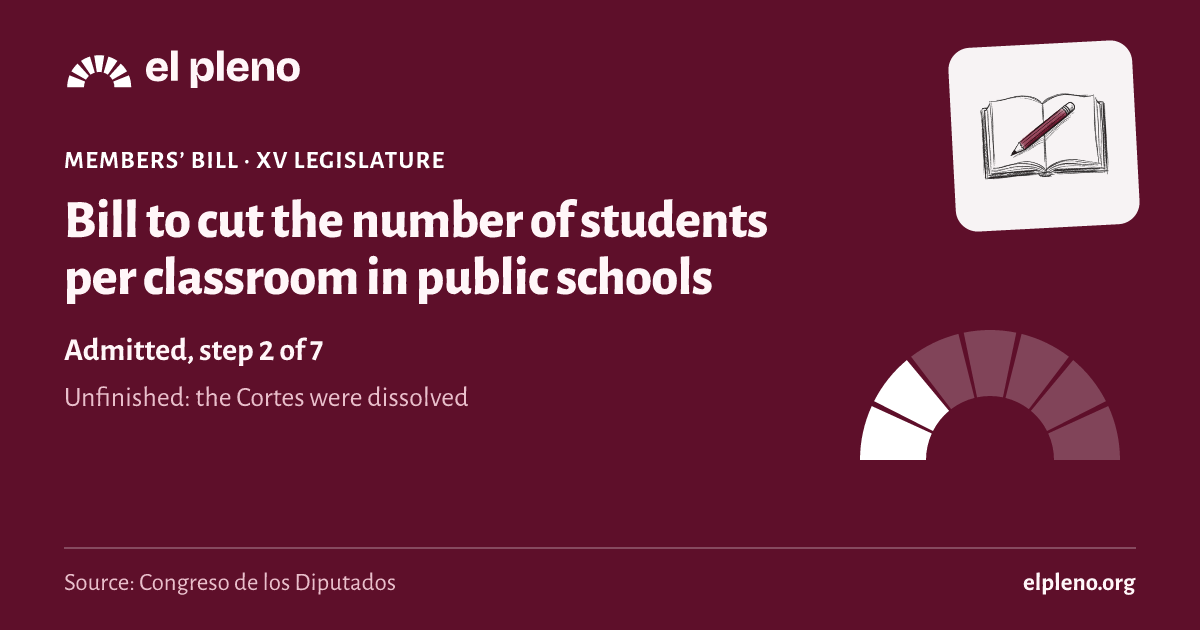
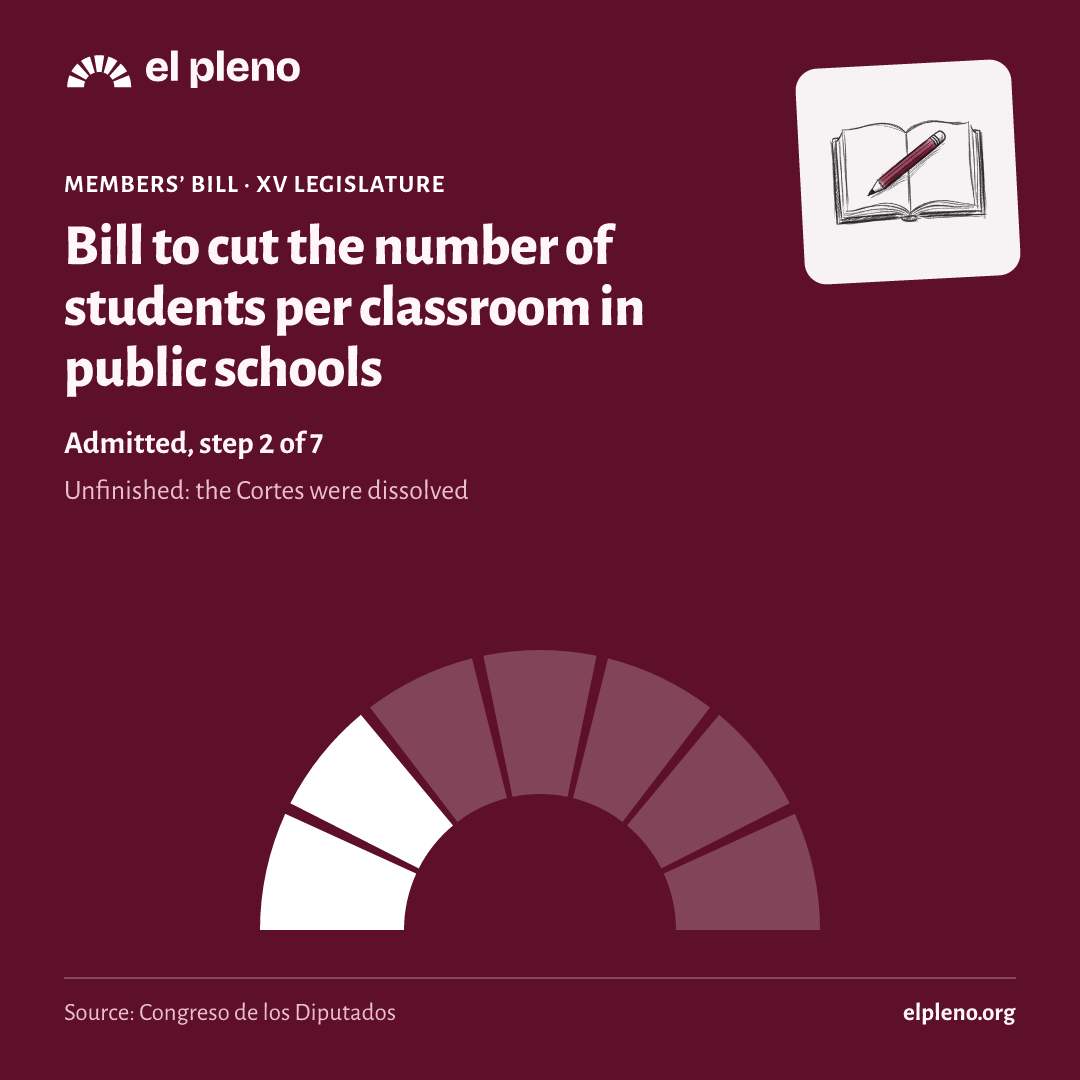
Bill to cut the number of students per classroom in public schools
It is a members’ bill. Introduced by parliamentary groups, the Senate, regional governments or citizens. It was introduced on 26 November 2025. Introduced by: Grupo Parlamentario Plurinacional SUMAR.
Official title: Private member's Organic bill on the improvement of ratios and the situation of students in Public Education.
Source: Congreso de los Diputados, file 122/000244· updated 11 Nov
Automatic summary, not yet reviewed
- The bill would make the school subsidy system for private centers (conciertos) subsidiary to public education: existing subsidies would not be expanded or renewed, and school enrollment needs would be covered by adding places in the public network.
- It sets maximum class sizes in the first cycle of early childhood education (ages 0 to 3): 5 children per unit for ages 0 to 1, 8 for ages 1 to 2, and 12 for ages 2 to 3.
- It sets a maximum of 20 students per classroom in primary education, compulsory secondary education, and Bachillerato The last two years of Spanish secondary school, before university. (the last two years of secondary school). Students repeating a grade would always count toward class size.
- The bill proposes that students with specific educational support needs and students in vulnerable situations count double for class size purposes, with more specialized support staff for schools.
- It cuts class sizes in vocational training to a maximum of 20 students per group (15 in basic grade programs) and sets a maximum of 5 students per unit in special education centers. It also includes measures for rural schools, such as qualitative criteria to prevent classroom closures and job stability for teachers.
- The changes would take effect at the start of the school year following the law's entry into force, which would be the day after its publication in the Official State Gazette.
Who it affects
- Students in public schools and their families: They would have smaller classes and more personalized attention.
- Teachers: More teachers would be needed, with more support, especially in rural areas.
- Private subsidized schools: Their subsidies would not be expanded or renewed and would become subsidiary.
- Children aged 0 to 3: Their classrooms would have much lower maximum class sizes than today.
- Students with special needs or in vulnerable situations: They would count double for class size and schools would receive more support.
Words worth knowing
- Ratios
- Number of students per classroom or school unit.
- Conciertos educativos
- Public money paid to private schools to provide free education.
- NEAE
- Necesidades Específicas de Apoyo Educativo: students who need support beyond the ordinary kind.
- Proposición de ley orgánica
- A bill introduced in the Congress of Deputies (Congreso de los Diputados); it is not yet an approved law.
- Bachillerato
- The last two years of Spanish secondary school, before university.
It summarizes the text as it was introduced. It is written by artificial intelligence and may contain mistakes: the official text is what counts. Read the official text · How we make summaries
Where it stands
How far did it get?
It took 2 of 7 steps. It reached Admitted, and today it is unfinished.
- Introduced26 November 2025Someone registers the text in the Congreso.
- Admitted9 December 2025The Bureau of the Congreso accepts it and, for a members’ bill, the plenary decides whether to consider it.
- Amendmentsnot reachedGroups propose changes.
- Committeenot reachedA committee goes through the text in detail.
- Plenarynot reachedAll 350 deputies vote.
- Senatenot reachedThe Senate can pass it, amend it or veto it.
- BOEnot reachedIt is published in the Official State Gazette (BOE) and comes into force.
See the 6 official steps on a timeline
Was there a plenary vote?
We have no plenary vote linked to this law in the Congreso’s data.
What happens next
What happens now?
The legislature ended before it finished. To go on, someone would have to introduce it again in the new Cortes.
It has not been presented again yet.
Sources
Where does all this come from?
- Congreso de los Diputados, file 122/000244
Official title, type, author, dates and stage.
Retrieved 11 November 2026
- Congreso de los Diputados, procedure
The date of each step, with its official wording.
Retrieved 12 November 2026
- The data comes from the open files of the Congreso, the Senate and the BOE, unaltered.
- Each deputy’s province is the one of their seat on the day of the vote.
- We only say “passed” or “rejected” when the majority needed is certain; otherwise we say which side had more votes.