What it is
Bill to inspect ships carrying military cargo to suspect states
It is a members’ bill. Introduced by parliamentary groups, the Senate, regional governments or citizens. It was introduced on 26 September 2025. Introduced by: Grupo Parlamentario Plurinacional SUMAR.
Official title: Private member's bill for the formalization of a Protocol for the inspection of ships with origin or destination in States subject to judicial measures, indications, or suspicion of perpetration of the crime of genocide or war crimes.
Source: Congreso de los Diputados, file 122/000219· updated 11 Nov
Automatic summary, not yet reviewed
- The bill would create a protocol to inspect civilian ships going to or coming from states suspected of genocide or war crimes, or under court rulings, when they pass through Spanish waters or ports.
- The protocol would be triggered by investigations at the International Criminal Court or Spanish courts, cases at the International Court of Justice, reports by international bodies, or facts similar to those in royal decree-law A rule with the force of law that the Government passes because it is urgent. It applies from its publication, but the Congreso must validate it within 30 days or it lapses. 10/2025 on Gaza. The Minister of Transport would decide to activate it.
- Shipping companies, agents or captains of these ships would have to give notice of arrival at a Spanish port at least 15 days in advance.
- The inspection would cover all documents and a physical check of all cargo on deck and in the holds. If military or dual-use material is found, it would be seized immediately and the ship could not leave until its cargo is free of that material.
- Hiding or falsifying information about military or dual-use material on ships going to or from these states would be a serious offense.
- Findings of defense or dual-use material would be reported to the International Criminal Court, the International Court of Justice, the Spanish courts and the Human Rights Prosecutor's Office.
Who it affects
- Shipping companies, agents and captains of ships going to or from suspect states: They would have to give 15 days' notice and submit to full cargo inspection.
- Operators carrying military or dual-use material: Their cargo could be seized and the ship held in port.
- Ministry of Transport and Maritime Captaincies: They would be responsible for activating and carrying out the inspections.
- Spanish ports: They would serve as control points to block military material bound for these states.
Words worth knowing
- Material de doble uso (dual-use material)
- Goods that can be used for both civilian and military purposes.
- Medidas cautelares (interim measures)
- Provisional court orders meant to prevent harm while a case is being decided.
- Consignatario (shipping agent)
- Person or company that handles a ship's arrival and unloading at port on behalf of its owner.
- Capitanía Marítima (Maritime Captaincy)
- Public office that oversees navigation and ships in each Spanish maritime zone.
- royal decree-law
- A rule with the force of law that the Government passes because it is urgent. It applies from its publication, but the Congreso must validate it within 30 days or it lapses.
- decree-law
- A rule with the force of law that the Government passes because it is urgent. It applies from its publication, but the Congreso must validate it within 30 days or it lapses.
It summarizes the text as it was introduced. It is written by artificial intelligence and may contain mistakes: the official text is what counts. Read the official text · How we make summaries
Where it stands
How far did it get?
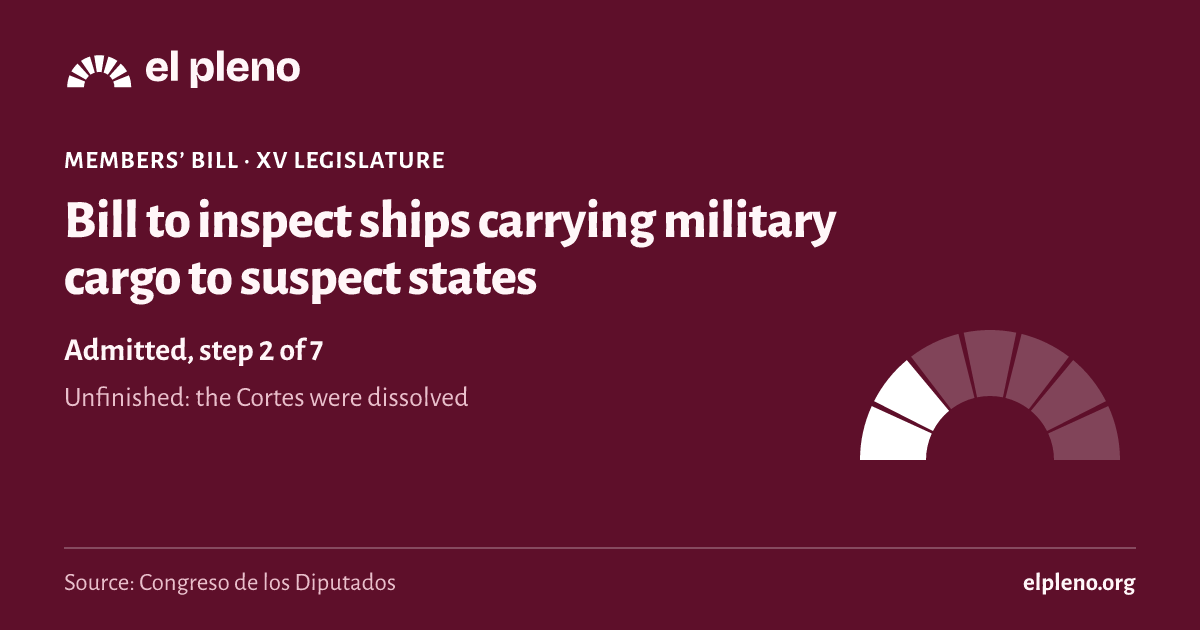
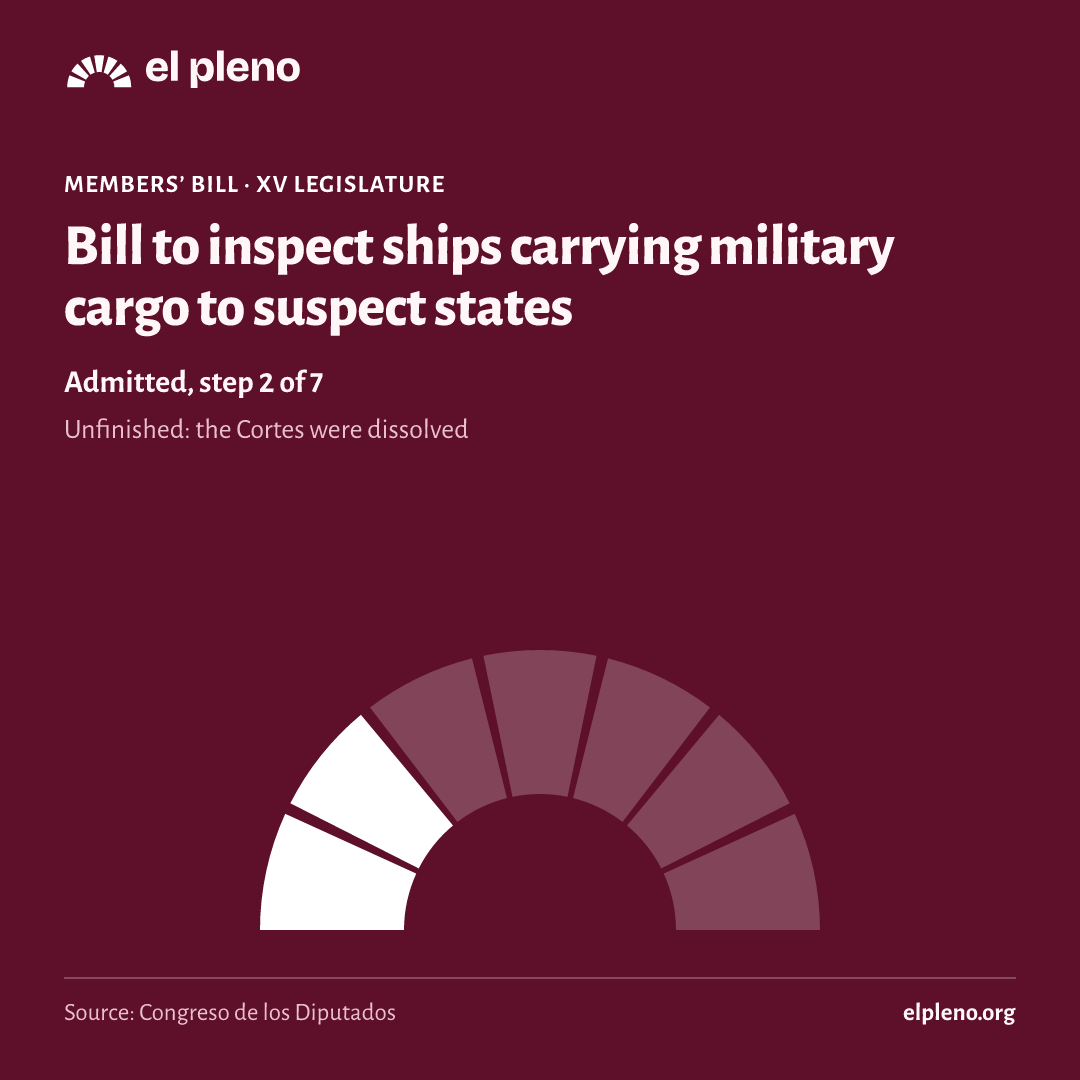
It took 2 of 7 steps. It reached Admitted, and today it is unfinished.
- Introduced26 September 2025Someone registers the text in the Congreso.
- Admitted7 October 2025The Bureau of the Congreso accepts it and, for a members’ bill, the plenary decides whether to consider it.
- Amendmentsnot reachedGroups propose changes.
- Committeenot reachedA committee goes through the text in detail.
- Plenarynot reachedAll 350 deputies vote.
- Senatenot reachedThe Senate can pass it, amend it or veto it.
- BOEnot reachedIt is published in the Official State Gazette (BOE) and comes into force.
See the 6 official steps on a timeline
Was there a plenary vote?
We have no plenary vote linked to this law in the Congreso’s data.
What happens next
What happens now?
The legislature ended before it finished. To go on, someone would have to introduce it again in the new Cortes.
It has not been presented again yet.
Sources
Where does all this come from?
- Congreso de los Diputados, file 122/000219
Official title, type, author, dates and stage.
Retrieved 11 November 2026
- Congreso de los Diputados, procedure
The date of each step, with its official wording.
Retrieved 12 November 2026
- The data comes from the open files of the Congreso, the Senate and the BOE, unaltered.
- Each deputy’s province is the one of their seat on the day of the vote.
- We only say “passed” or “rejected” when the majority needed is certain; otherwise we say which side had more votes.