What it is
Bill would let regions manage income tax The personal income tax (IRPF in Spain): what people pay on what they earn from work, business or savings. on behalf of the State
It is a members’ bill. Introduced by parliamentary groups, the Senate, regional governments or citizens. It was introduced on 19 September 2025. Introduced by: Grupo Parlamentario Republicano.
Official title: Private member's bill enabling the delegation of competences in the management of the Personal Income Tax.
Source: Congreso de los Diputados, file 122/000217· updated 11 Nov
Automatic summary, not yet reviewed
- The bill would allow autonomous communities to take on, delegated by the State, powers to apply personal income tax, impose sanctions and review decisions, something expressly excluded until now. To do this, it would amend organic law A law on fundamental rights, the electoral system or other matters the Constitution reserves. It needs an absolute majority in the Congreso: 176 votes. 8/1980 and add a ninth additional provision referring to Law 22/2009.
- A tenth additional provision would be added to Law 22/2009 setting the framework for the delegation: it would be voluntary, would require an agreement by the Mixed Commission for Economic Affairs or an equivalent bilateral commission, and would have to guarantee coordination, information sharing and the fight against fraud. In Andalusia, the delegation would not extend to Ceuta and Melilla.
- Catalonia would take on these powers from 2026, and within six months the transfer of the necessary staff, material and budgetary resources should be agreed.
- The delegation to Catalonia would be gradual: from January 1, 2027, control over regional deductions and taxpayer assistance; from 2028, management and voluntary-period collection; later, subject to an agreement, tax inspection and executive-period collection, and finally appeals and review procedures. Until the Catalan Tax Agency has its own computer systems, it would share those of the State agency.
- Article 1 of the bill would have the character of an organic law, and the law would enter into force the day after its publication in the Official State Gazette.
Who it affects
- Autonomous communities under the common regime: Could request, by delegation, powers to apply personal income tax, impose sanctions and review decisions.
- Generalitat de Catalunya (Catalonia's regional government): Would be the first to take on these powers, gradually from 2026 onward.
- Personal income taxpayers: Any communications they receive must clearly identify which tax administration is acting.
- State Tax Administration Agency (Agencia Estatal de Administración Tributaria): Would share information, procedures and computer systems with regional tax administrations.
Words worth knowing
- Delegación de competencias (delegation of powers)
- The State allows another administration, such as an autonomous community, to exercise functions that are originally its own.
- Tributos cedidos (transferred taxes)
- State taxes whose management is transferred to the autonomous communities, such as inheritance tax or wealth tax.
- Potestad sancionadora (sanctioning power)
- The ability to impose penalties, such as fines, when someone breaks a rule.
- Comprobación limitada (limited verification)
- A simple review of a tax return, without a full inspection, to check the data provided.
- Ley orgánica (organic law)
- A type of law that requires an absolute majority in Congress and is reserved for especially important matters.
- organic law
- A law on fundamental rights, the electoral system or other matters the Constitution reserves. It needs an absolute majority in the Congreso: 176 votes.
- income tax
- The personal income tax (IRPF in Spain): what people pay on what they earn from work, business or savings.
It summarizes the text as it was introduced. It is written by artificial intelligence and may contain mistakes: the official text is what counts. Read the official text · How we make summaries
Where it stands
How far did it get?
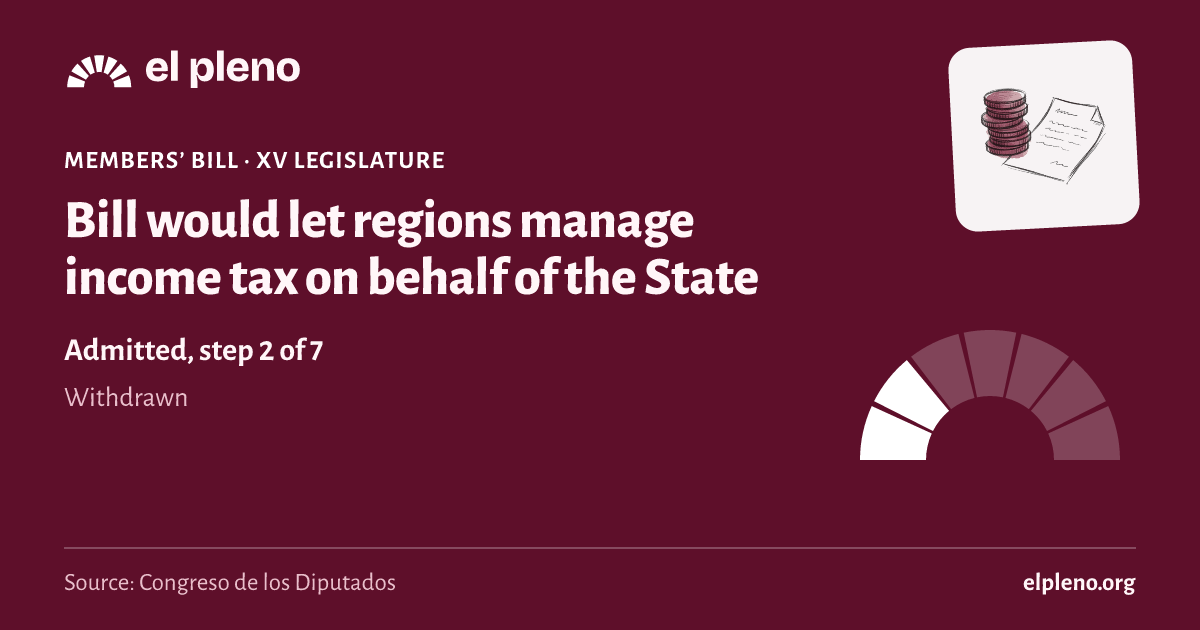
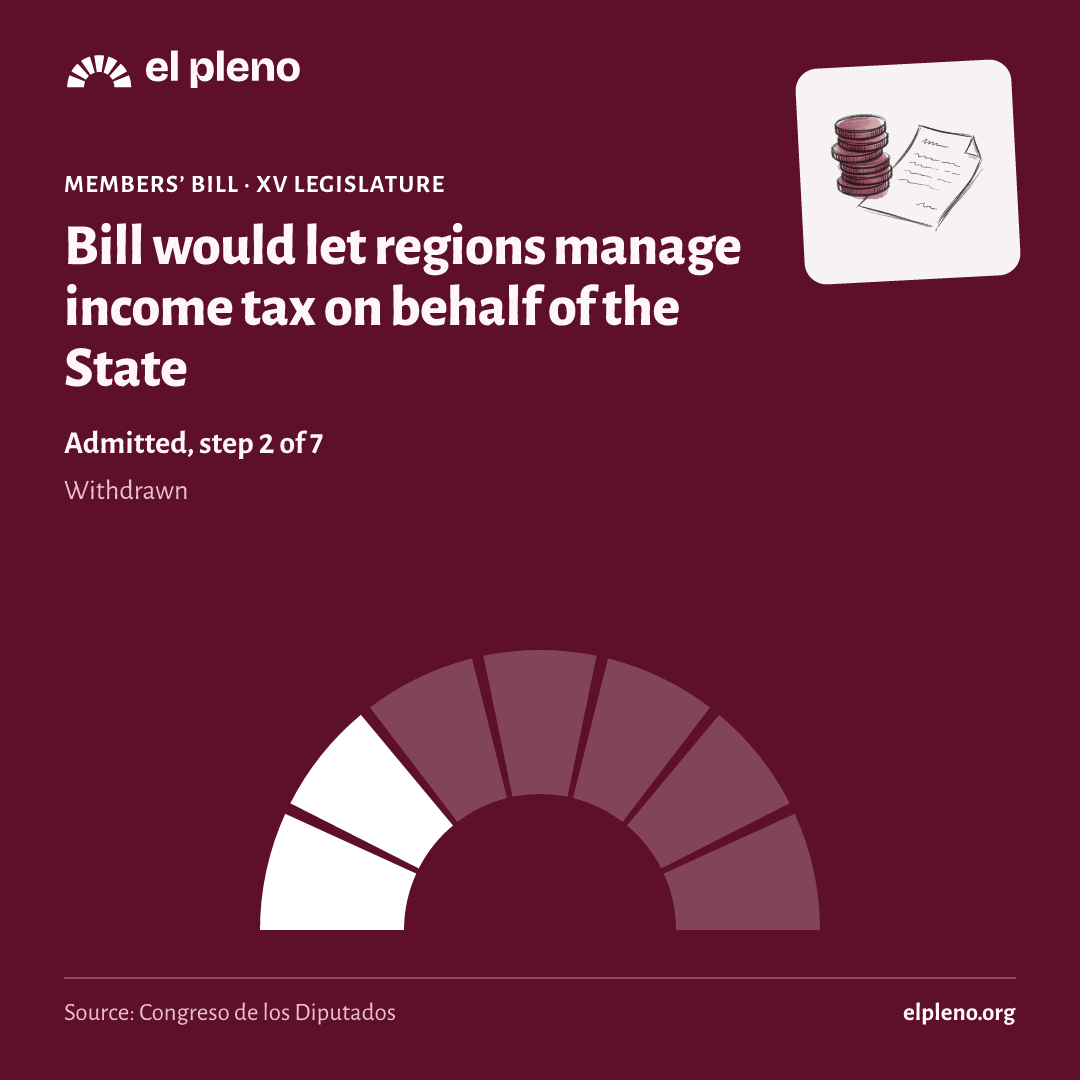
It took 2 of 7 steps. It reached Admitted, and today it is withdrawn.
- Introduced19 September 2025Someone registers the text in the Congreso.
- Admitted23 September 2025The Bureau of the Congreso accepts it and, for a members’ bill, the plenary decides whether to consider it.
- Amendmentsnot reachedGroups propose changes.
- Committeenot reachedA committee goes through the text in detail.
- Plenarynot reachedAll 350 deputies vote.
- Senatenot reachedThe Senate can pass it, amend it or veto it.
- BOEnot reachedIt is published in the Official State Gazette (BOE) and comes into force.
See the 6 official steps on a timeline
Was there a plenary vote?
We have no plenary vote linked to this law in the Congreso’s data.
What happens next
What happens now?
Whoever introduced it withdrew it, or it was merged into another one. It goes no further.
Sources
Where does all this come from?
- Congreso de los Diputados, file 122/000217
Official title, type, author, dates and stage.
Retrieved 11 November 2026
- Congreso de los Diputados, procedure
The date of each step, with its official wording.
Retrieved 12 November 2026
- The data comes from the open files of the Congreso, the Senate and the BOE, unaltered.
- Each deputy’s province is the one of their seat on the day of the vote.
- We only say “passed” or “rejected” when the majority needed is certain; otherwise we say which side had more votes.