What it is
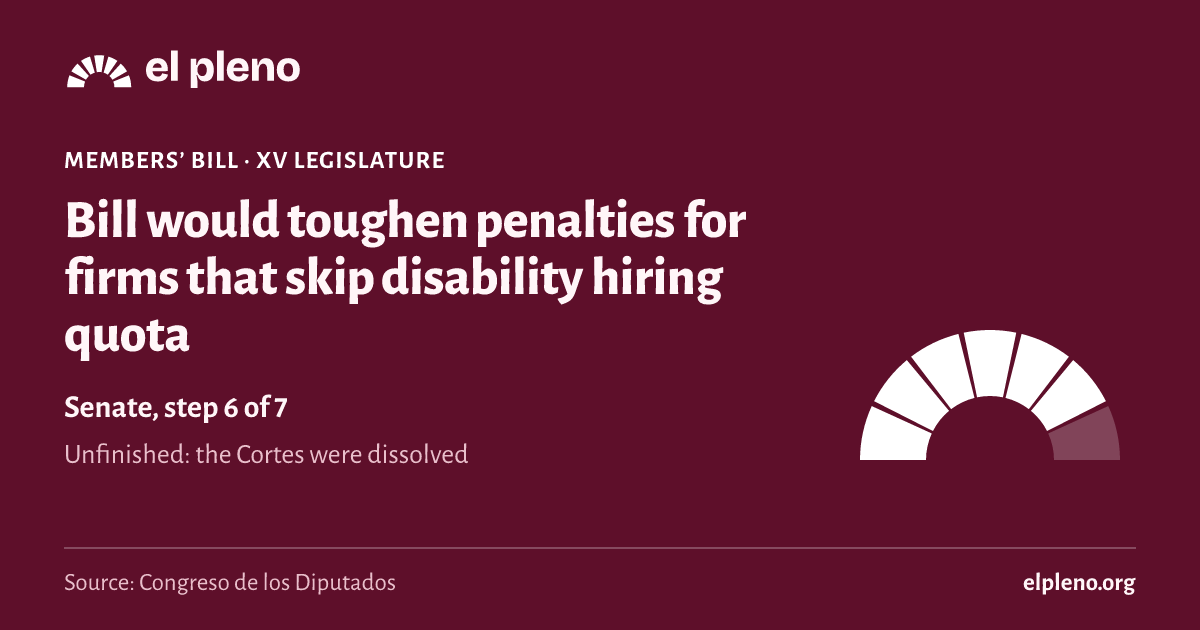
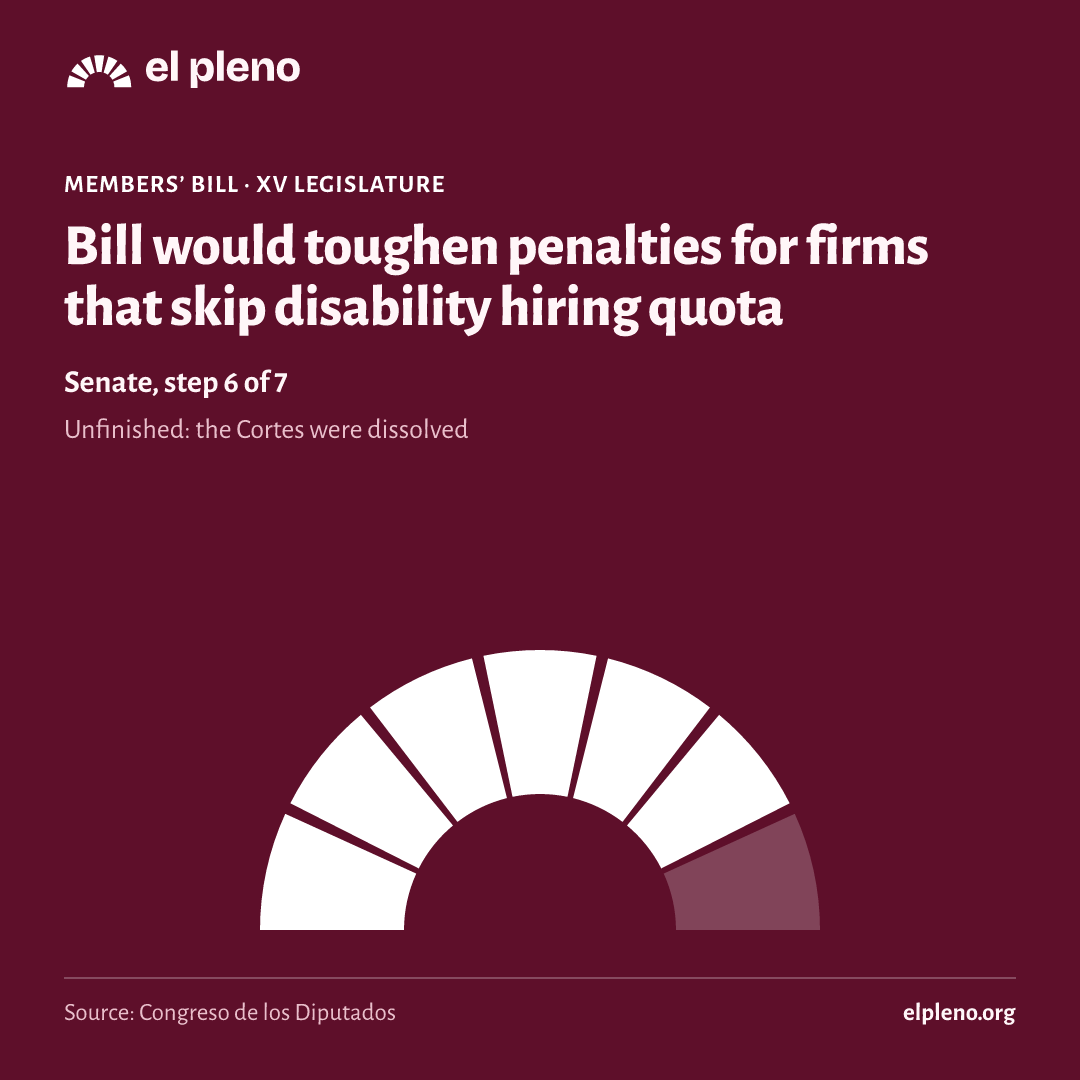
Bill would toughen penalties for firms that skip disability hiring quota
Senate step 6 of 7· LapsedIt is a members’ bill. Introduced by parliamentary groups, the Senate, regional governments or citizens. It was introduced on 23 July 2025. Introduced by: Grupo Parlamentario Socialista.
Official title: Private member's bill to promote the labor inclusion of persons with disabilities through the employment quota in companies.
Source: Congreso de los Diputados, file 122/000215· updated 11 Nov
Automatic summary, not yet reviewed
- The bill would reclassify the failure to reserve jobs for people with disabilities as a very serious offense, instead of a serious one. If the company was already firmly sanctioned for the same violation in the previous two years, the maximum fine would apply.
- Companies firmly sanctioned for that very serious offense would be automatically barred from receiving public subsidies while the sanction lasts.
- Public administrations would run awareness campaigns on the labor inclusion of people with disabilities. The Labor and Social Security Inspectorate would carry out verification campaigns for 3 years, renewable for equal periods.
- Within three years of the law taking effect, the Government would prepare a report on the impact of these measures, with indicators such as the percentage of companies meeting the quota, to be sent to the Spanish Parliament and published on the Transparency Portal.
Who it affects
- Companies with 50 or more workers, required to reserve 2% of jobs for people with disabilities.: They would face tougher fines if they fail to comply and could be excluded from subsidies.
- People with disabilities seeking regular employment.: Enforcement of the job reservation would be strengthened and support services better funded.
- Spain's autonomous communities.: They would have to distribute State resources to guarantee the measures in Article 54 of the Employment Law.
- The Labor and Social Security Inspectorate.: It would have to step up its inspection campaigns for at least 3 years.
Words worth knowing
- Cuota de reserva de empleo (employment reservation quota)
- A rule requiring companies with 50 or more workers to fill at least 2% of jobs with people with disabilities, or to apply alternative measures.
- Infracción muy grave (very serious offense)
- A category of labor violation carrying higher fines than a serious one.
- Medidas alternativas (alternative measures)
- Exceptional options that can replace directly hiring people with disabilities, such as agreements in sector collective bargaining.
- Sanción en firme (final sanction)
- An administrative sanction that can no longer be appealed and is therefore final.
It summarizes the text passed by the committee. It is written by artificial intelligence and may contain mistakes: the official text is what counts. Read the official text · How we make summaries
Where it stands
How far did it get?
It took 6 of 7 steps. It reached Senate, and today it is lapsed.
- Introduced23 July 2025Someone registers the text in the Congreso.
- Admitted26 August 2025The Bureau of the Congreso accepts it and, for a members’ bill, the plenary decides whether to consider it.
- Amendments19 September 2025Groups propose changes.
- Committee19 February 2026A committee goes through the text in detail.
- Plenaryno dateAll 350 deputies vote.
- Senate23 July 2026The Senate can pass it, amend it or veto it.
- BOEnot reachedIt is published in the Official State Gazette (BOE) and comes into force.
See the 13 official steps on a timeline
9 September 2025
How did the plenary vote?
Voted on: Private member's bill by the Socialist Parliamentary Group, for the promotion of the labor inclusion of people with disabilities through the employment quota in companies.
Source: Congreso de los Diputados, vote 2 of sitting 129· updated 10 Nov
Each dot is a seat. Tap one, or use the arrow keys, to see who it is.
Your province
How did the deputies from your province vote?
And your senators: the Senate does not link its votes to this law in its open data, so we cannot put them side by side here.
Or see how most of each province voted
- A Coruña More votes in favour 8 yes · 0 no
- Albacete More votes in favour 4 yes · 0 no
- Alicante/Alacant More votes in favour 10 yes · 2 no
- Almería More votes in favour 5 yes · 1 no
- Araba/Álava More votes in favour 4 yes · 0 no
- Asturias More votes in favour 6 yes · 1 no
- Ávila More votes in favour 3 yes · 0 no
- Badajoz More votes in favour 4 yes · 1 no
- Barcelona More votes in favour 30 yes · 2 no
- Bizkaia More votes in favour 8 yes · 0 no
- Burgos More votes in favour 3 yes · 0 no
- Cáceres More votes in favour 4 yes · 0 no
- Cádiz More votes in favour 8 yes · 1 no
- Cantabria More votes in favour 4 yes · 1 no
- Castellón/Castelló More votes in favour 4 yes · 1 no
- Ceuta More votes in favour 1 yes · 0 no
- Ciudad Real More votes in favour 4 yes · 1 no
- Córdoba More votes in favour 5 yes · 1 no
- Cuenca More votes in favour 3 yes · 0 no
- Gipuzkoa More votes in favour 6 yes · 0 no
- Girona More votes in favour 6 yes · 0 no
- Granada More votes in favour 6 yes · 1 no
- Guadalajara More votes in favour 2 yes · 1 no
- Huelva More votes in favour 4 yes · 1 no
- Huesca More votes in favour 3 yes · 0 no
- Illes Balears More votes in favour 7 yes · 1 no
- Jaén More votes in favour 4 yes · 1 no
- La Rioja More votes in favour 4 yes · 0 no
- Las Palmas More votes in favour 7 yes · 1 no
- León More votes in favour 4 yes · 0 no
- Lleida More votes in favour 4 yes · 0 no
- Lugo More votes in favour 4 yes · 0 no
- Madrid More votes in favour 30 yes · 5 no
- Málaga More votes in favour 9 yes · 2 no
- Melilla More votes in favour 1 yes · 0 no
- Murcia More votes in favour 8 yes · 2 no
- Navarra More votes in favour 5 yes · 0 no
- Ourense More votes in favour 4 yes · 0 no
- Palencia More votes in favour 3 yes · 0 no
- Pontevedra More votes in favour 7 yes · 0 no
- Salamanca More votes in favour 4 yes · 0 no
- Santa Cruz de Tenerife More votes in favour 7 yes · 0 no
- Segovia More votes in favour 3 yes · 0 no
- Sevilla More votes in favour 10 yes · 1 no
- Soria More votes in favour 2 yes · 0 no
- Tarragona More votes in favour 6 yes · 0 no
- Teruel More votes in favour 3 yes · 0 no
- Toledo More votes in favour 5 yes · 1 no
- Valencia/València More votes in favour 14 yes · 2 no
- Valladolid More votes in favour 4 yes · 1 no
- Zamora More votes in favour 3 yes · 0 no
- Zaragoza More votes in favour 6 yes · 1 no
More details: how each group and each province voted
The groups
Who voted in favour and who against?
In favour, most of Euskal Herria Bildu, Plurinacional SUMAR, Republicano, Socialista, Vasco (EAJ-PNV), Junts per Catalunya, Mixto and Popular en el Congreso. Against, most of VOX.
By province: in 52 most voted in favour; in 0, against.
Coloured by how most of each province’s deputies voted.
- In favour: 52
- Against: 0
| Group | Seats | How it voted |
|---|---|---|
| Euskal Herria Bildu | 6 | 6 in favour |
| Plurinacional SUMAR | 26 | 26 in favour |
| Republicano | 7 | 7 in favour |
| Socialista | 120 | 118 in favour · 2 did not vote |
| Vasco (EAJ-PNV) | 5 | 5 in favour |
| Junts per Catalunya | 7 | 7 in favour |
| Mixto | 9 | 9 in favour |
| Popular en el Congreso | 137 | 135 in favour · 2 did not vote |
| VOX | 33 | 33 against |
What happens next
What happens now?
The legislature ended before it finished. To go on, someone would have to introduce it again in the new Cortes.
Sources
Where does all this come from?
- Congreso de los Diputados, file 122/000215
Official title, type, author, dates and stage.
Retrieved 11 November 2026
- Congreso de los Diputados, procedure
The date of each step, with its official wording.
Retrieved 12 November 2026
- Congreso de los Diputados, vote 2 of sitting 129
The count and every seat’s vote.
Retrieved 10 November 2026
- The data comes from the open files of the Congreso, the Senate and the BOE, unaltered.
- Each deputy’s province is the one of their seat on the day of the vote.
- We never say “passed” because of a vote: the files do not say which majority was needed.