What it is
Bill would let the State appoint port authority leaders
It is a members’ bill. Introduced by parliamentary groups, the Senate, regional governments or citizens. It was introduced on 17 February 2025. Introduced by: Grupo Parlamentario VOX.
Official title: Private member's bill amending Royal Legislative Decree 2/2011, of September 5, approving the Consolidated Text of the Law on State Ports and Merchant Marine.
Source: Congreso de los Diputados, file 122/000165· updated 11 Nov
Automatic summary, not yet reviewed
- The bill, introduced by the VOX parliamentary group, would change the ports law so that the Ministry in charge of Infrastructure appoints the governing bodies of Port Authorities, instead of the Autonomous Communities.
- Articles 1, 11 and 24 of the consolidated text would be amended to confirm that the State has exclusive authority over ports of general interest, and that Port Authorities operate with autonomy but under the Ministry's powers through Puertos del Estado.
- Article 30 would be rewritten to professionalize the boards of directors of Port Authorities: the Council of Ministers would appoint the chair, the Ministry would appoint the other members based on qualifications and experience, and the bill sets their number, conflicts of interest rules and duties.
- The proposed law would rest on the State's constitutional authority over ports of general interest and would take effect the day after its publication in the Official State Gazette (Boletín Oficial del Estado).
Words worth knowing
- Texto refundido (consolidated text)
- A law that gathers and organizes in a single text all the rules on one subject.
- Autoridad Portuaria (Port Authority)
- Public body that manages each port of general interest.
- Puerto de interés general (port of general interest)
- A port under the exclusive authority of the Spanish State, not the Autonomous Communities, because of its importance to the whole country.
- Proposición de ley (bill introduced by lawmakers)
- A text in the form of a law introduced by a parliamentary group that still must be debated and passed by the Congress of Deputies (Congreso de los Diputados).
It summarizes the text as it was introduced. It is written by artificial intelligence and may contain mistakes: the official text is what counts. Read the official text · How we make summaries
Where it stands
How far did it get?
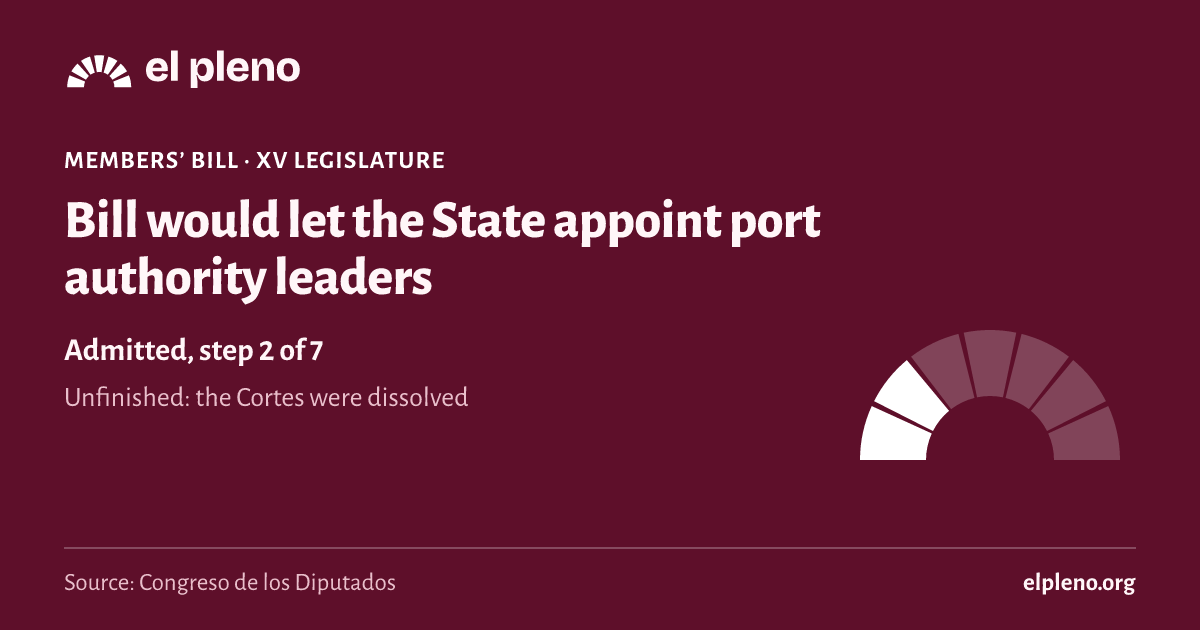
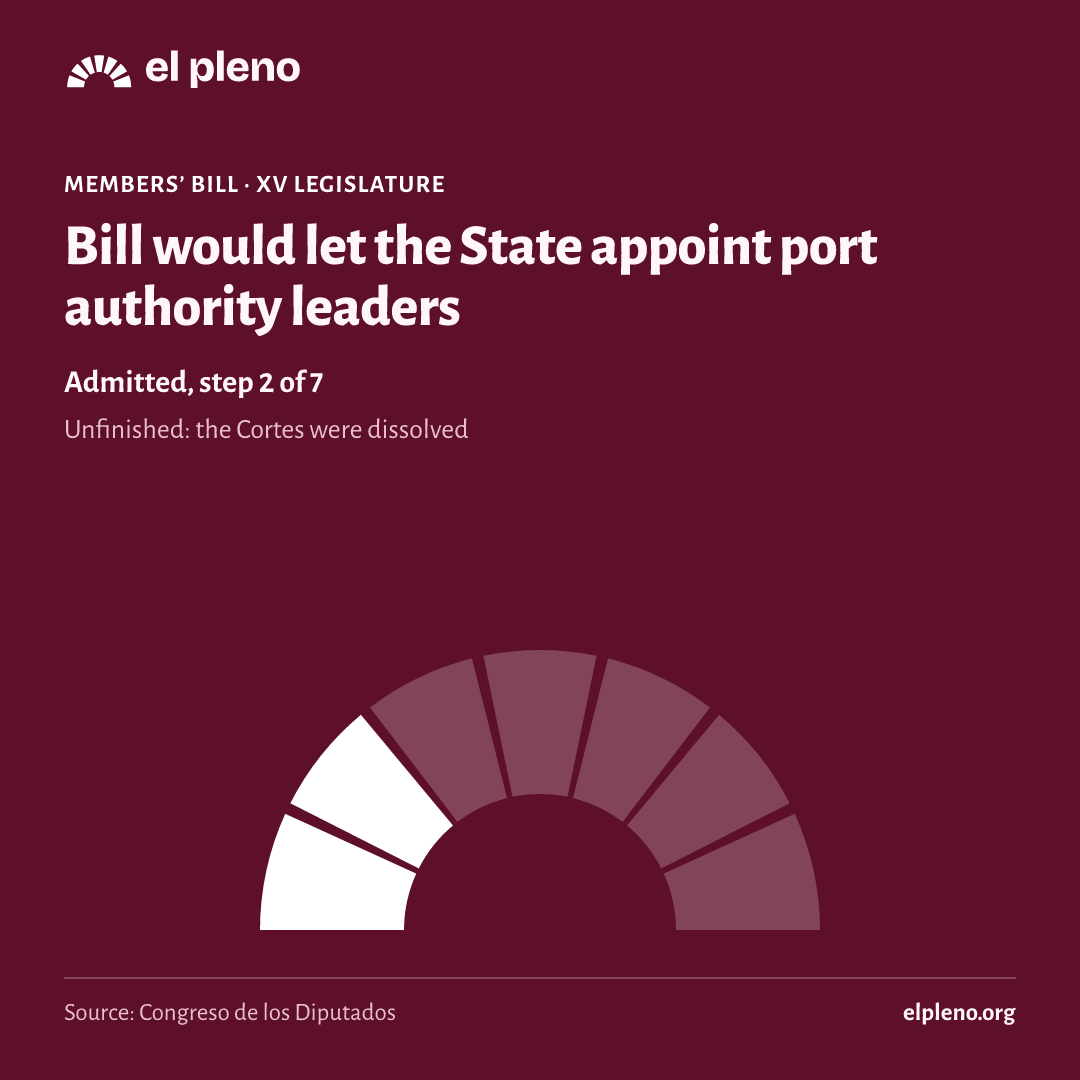
It took 2 of 7 steps. It reached Admitted, and today it is unfinished.
- Introduced17 February 2025Someone registers the text in the Congreso.
- Admitted25 February 2025The Bureau of the Congreso accepts it and, for a members’ bill, the plenary decides whether to consider it.
- Amendmentsnot reachedGroups propose changes.
- Committeenot reachedA committee goes through the text in detail.
- Plenarynot reachedThe deputies vote, usually in the plenary; some laws are passed by a committee without going to it.
- Senatenot reachedThe Senate can pass it, amend it or veto it.
- BOEnot reachedThe King gives royal assent and it is published in the Official State Gazette (BOE). It comes into force on the date it sets, or after 20 days if it sets none.
See the 6 official steps on a timeline
Was there a plenary vote?
We have no plenary vote linked to this law in the Congreso’s data.
What happens next
What happens now?
The legislature ended before it finished. To go on, someone would have to introduce it again in the new Cortes.
It has not been presented again yet.
The same initiative in the other chamber:
Sources
Where does all this come from?
- Congreso de los Diputados, file 122/000165
Official title, type, author, dates and stage.
Retrieved 11 November 2026
- Congreso de los Diputados, procedure
The date of each step, with its official wording.
Retrieved 13 November 2026
- The data comes from the open files of the Congreso, the Senate and the BOE, unaltered.
- Each deputy’s province is the one of their seat on the day of the vote.
- We only say “passed” or “rejected” when the majority needed is certain; otherwise we say which side had more votes.