What it is
Bill would reform Spain's citizen security law with more safeguards
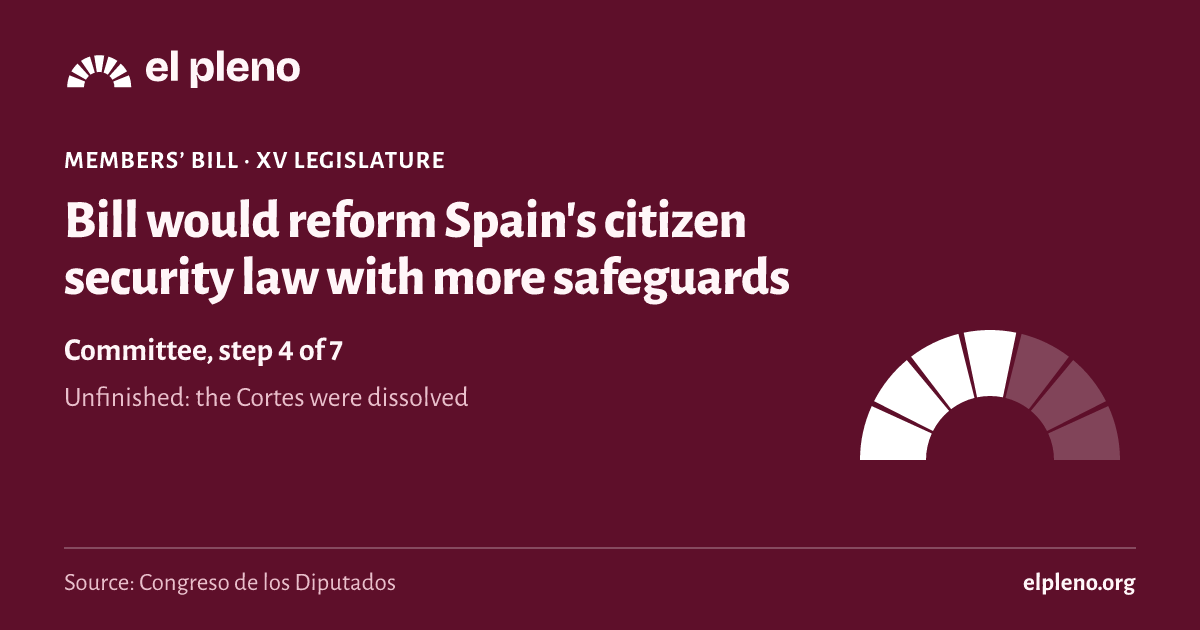
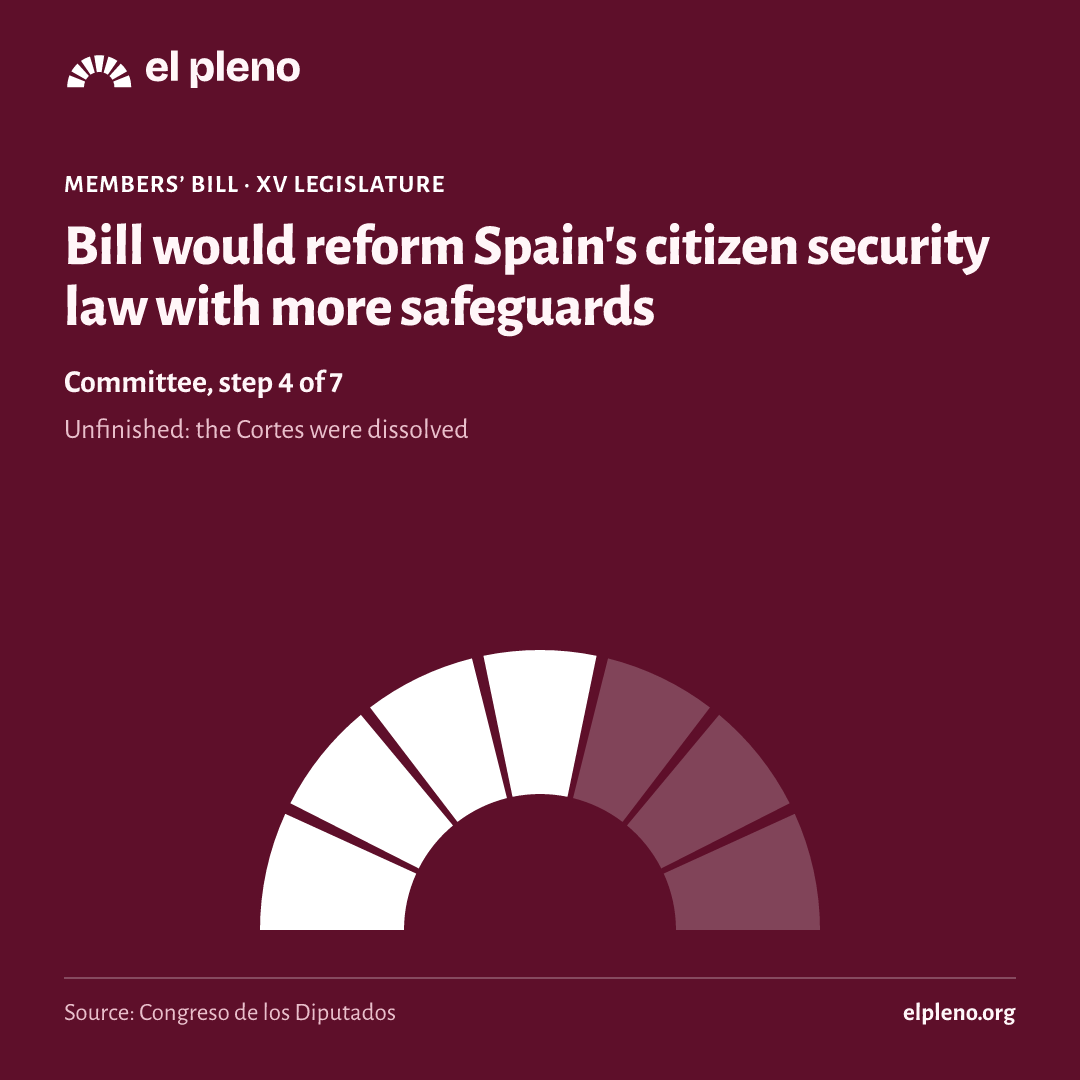
Committee step 4 of 7· LapsedIt is a members’ bill. Introduced by parliamentary groups, the Senate, regional governments or citizens. It was introduced on 4 October 2024. Introduced by: Grupo Parlamentario Socialista Grupo Parlamentario Plurinacional SUMAR Grupo Parlamentario Euskal Herria Bildu Grupo Parlamentario Vasco (EAJ-PNV).
Official title: Private member's Organic Law on the protection of freedoms and citizen security.
Source: Congreso de los Diputados, file 122/000131· updated 11 Nov
Automatic summary, not yet reviewed
- The bill would rename the law and give it a more rights-based approach: security should serve so that rights and freedoms can be freely exercised, and any restriction must be legal and proportionate.
- It would improve safeguards in police identifications and searches: identification must be based on reasonable suspicion, without discrimination based on language or gender, and transfers to police stations would be limited to 2 hours, extendable only with justified reasons up to 6. It would also allow entering a home during disasters to rescue animals.
- It would strengthen the right of assembly and demonstration: lack of prior notice alone would not be enough to stop a demonstration, police dissolution would become a last resort with prior warning, and organizers would be exempt from liability if they meet the requirements.
- It would reform the sanctions system: several offenses would be removed (such as demonstrations in front of the Congress or the Senate), drug possession would drop from serious to minor, photographing police operations would no longer be punishable, and fines would be reduced based on income (up to 50% for low incomes).
- It would lower fine amounts: minor offenses would carry fines of €100 to €500 and serious ones €501 to €25,000, and sanctions could be suspended through educational or restorative activities.
- It would add new provisions: mediation training for police, annual transparency statistics, protocols on the use of force and riot gear with a gradual replacement of rubber bullets, and a review of the special regime for Ceuta and Melilla within 6 months.
Who it affects
- The general public: More limits and controls on police identifications, searches and sanctions.
- Organizers and participants in demonstrations: More protection of the right of assembly and less liability for third-party acts.
- Sanctioned people with low incomes: Fine reductions of between 25% and 50% based on their financial capacity.
- Police and state security forces: New duties of justification, mediation and operating protocols.
- Migrants in Ceuta and Melilla: Review of the special regime of the immigration law within 6 months.
Words worth knowing
- Proposición de ley
- A bill introduced by parliamentary groups so it can become law. It is not approved yet.
- Ley orgánica
- Organic law: a type of Spanish law reserved for major matters, such as fundamental rights, requiring special majorities to pass.
- Principio de proporcionalidad
- Proportionality principle: measures and sanctions must match the seriousness of the act, without going too far.
- Infracción leve, grave y muy grave
- Categories of administrative offenses ordered from least to most serious, with different fines.
- Balas de goma
- Rubber bullets: kinetic projectiles used by police in riots; the bill proposes replacing them with less harmful means.
It summarizes the text as it was introduced. It is written by artificial intelligence and may contain mistakes: the official text is what counts. Read the official text · How we make summaries
Where it stands
How far did it get?
It took 4 of 7 steps. It reached Committee, and today it is lapsed.
- Introduced4 October 2024Someone registers the text in the Congreso.
- Admitted8 October 2024The Bureau of the Congreso accepts it and, for a members’ bill, the plenary decides whether to consider it.
- Amendments15 November 2024Groups propose changes.
- Committee10 December 2024A committee goes through the text in detail.
- Plenarynot reachedAll 350 deputies vote.
- Senatenot reachedThe Senate can pass it, amend it or veto it.
- BOEnot reachedIt is published in the Official State Gazette (BOE) and comes into force.
See the 12 official steps on a timeline
12 December 2024
How did the plenary vote?
Voted on: Amendment to the whole of alternative text submitted by the VOX Parliamentary Group.
This law had 3 votes; this is the latest with every deputy’s vote. See them all
Source: Congreso de los Diputados, vote 9 of sitting 85· updated 10 Nov
Each dot is a seat. Tap one, or use the arrow keys, to see who it is.
Your province
How did the deputies from your province vote?
And your senators: the Senate does not link its votes to this law in its open data, so we cannot put them side by side here.
Or see how most of each province voted
- A Coruña More votes against 0 yes · 4 no · 4 abst.
- Albacete More votes against 0 yes · 2 no · 2 abst.
- Alicante/Alacant More votes against 2 yes · 5 no · 5 abst.
- Almería More votes against 1 yes · 2 no · 3 abst.
- Araba/Álava More votes against 0 yes · 3 no · 1 abst.
- Asturias More votes against 1 yes · 3 no · 3 abst.
- Ávila More votes against 0 yes · 1 no · 2 abst.
- Badajoz More votes against 1 yes · 2 no · 2 abst.
- Barcelona More votes against 2 yes · 25 no · 5 abst.
- Bizkaia More votes against 0 yes · 7 no · 1 abst.
- Burgos More votes against 0 yes · 2 no · 2 abst.
- Cáceres More votes against 0 yes · 2 no · 2 abst.
- Cádiz More votes against 1 yes · 4 no · 4 abst.
- Cantabria More votes against 1 yes · 2 no · 2 abst.
- Castellón/Castelló More votes against 1 yes · 2 no · 2 abst.
- Ceuta Tie 0 yes · 0 no · 1 abst.
- Ciudad Real More votes against 1 yes · 2 no · 2 abst.
- Córdoba More votes against 1 yes · 3 no · 2 abst.
- Cuenca More votes against 0 yes · 1 no · 2 abst.
- Gipuzkoa More votes against 0 yes · 6 no
- Girona More votes against 0 yes · 6 no
- Granada More votes against 1 yes · 3 no · 3 abst.
- Guadalajara Tie 1 yes · 1 no · 1 abst.
- Huelva More votes against 1 yes · 2 no · 2 abst.
- Huesca More votes against 0 yes · 1 no · 2 abst.
- Illes Balears More votes against 1 yes · 4 no · 3 abst.
- Jaén More votes against 1 yes · 2 no · 2 abst.
- La Rioja More votes against 0 yes · 2 no · 2 abst.
- Las Palmas More votes against 1 yes · 4 no · 3 abst.
- León More votes against 0 yes · 2 no · 2 abst.
- Lleida More votes against 0 yes · 4 no
- Lugo More votes against 0 yes · 1 no · 3 abst.
- Madrid More votes against 5 yes · 14 no · 15 abst.
- Málaga More votes against 2 yes · 4 no · 5 abst.
- Melilla Tie 0 yes · 0 no · 1 abst.
- Murcia More votes against 2 yes · 4 no · 4 abst.
- Navarra More votes against 0 yes · 3 no · 2 abst.
- Ourense More votes against 0 yes · 1 no · 3 abst.
- Palencia More votes against 0 yes · 1 no · 2 abst.
- Pontevedra More votes against 0 yes · 4 no · 3 abst.
- Salamanca More votes against 0 yes · 1 no · 3 abst.
- Santa Cruz de Tenerife More votes against 0 yes · 4 no · 3 abst.
- Segovia More votes against 0 yes · 1 no · 2 abst.
- Sevilla More votes against 1 yes · 7 no · 4 abst.
- Soria More votes against 0 yes · 1 no · 1 abst.
- Tarragona More votes against 0 yes · 5 no · 1 abst.
- Teruel More votes against 0 yes · 1 no · 2 abst.
- Toledo More votes against 1 yes · 2 no · 3 abst.
- Valencia/València More votes against 2 yes · 7 no · 6 abst.
- Valladolid More votes against 1 yes · 2 no · 2 abst.
- Zamora More votes against 0 yes · 1 no · 2 abst.
- Zaragoza More votes against 1 yes · 3 no · 3 abst.
More details: how each group and each province voted
The groups
Who voted in favour and who against?
In favour, most of VOX. Against, most of Euskal Herria Bildu, Plurinacional SUMAR, Republicano, Socialista, Vasco (EAJ-PNV), Junts per Catalunya and Mixto. 1 deputy voted differently from their group.
By province: in 0 most voted in favour; in 15, against.
Coloured by how most of each province’s deputies voted.
- In favour: 0
- Against: 15
- Abstained: 16
- Tie: 21
| Group | Seats | How it voted |
|---|---|---|
| Euskal Herria Bildu | 6 | 6 against |
| Plurinacional SUMAR | 27 | 26 against · 1 did not vote |
| Republicano | 7 | 7 against |
| Socialista | 120 | 119 against · 1 did not vote |
| Vasco (EAJ-PNV) | 5 | 5 against |
| Junts per Catalunya | 7 | 7 against |
| Mixto | 8 | 6 against · 1 abst. · 1 did not vote |
| Popular en el Congreso | 137 | 136 abst. · 1 did not vote |
| VOX | 33 | 33 in favour |
What happens next
What happens now?
The legislature ended before it finished. To go on, someone would have to introduce it again in the new Cortes.
It has not been presented again yet.
Sources
Where does all this come from?
- Congreso de los Diputados, file 122/000131
Official title, type, author, dates and stage.
Retrieved 11 November 2026
- Congreso de los Diputados, procedure
The date of each step, with its official wording.
Retrieved 12 November 2026
- Congreso de los Diputados, vote 9 of sitting 85
The count and every seat’s vote.
Retrieved 10 November 2026
- The data comes from the open files of the Congreso, the Senate and the BOE, unaltered.
- Each deputy’s province is the one of their seat on the day of the vote.
- We never say “passed” because of a vote: the files do not say which majority was needed.