What it is
Bill to protect borrowers from abusive mortgage amortization clauses
Amendments step 3 of 7· LapsedIt is a members’ bill. Introduced by parliamentary groups, the Senate, regional governments or citizens. It was introduced on 16 July 2024. Introduced by: Grupo Parlamentario Plurinacional SUMAR.
Official title: Private member's bill on the regulation of Redito Ad Libitum clauses in the contracting of mortgage loans and credits.
Source: Congreso de los Diputados, file 122/000124· updated 11 Nov
Automatic summary, not yet reviewed
- The bill would create new ways to end mortgage contracts with abusive amortization clauses, such as formulas with errors or that make it impossible to calculate payments, and would set out how to fix those contracts.
- It defines which clauses are covered: the so-called REDAL clauses, those that fail to disclose payments under different interest rate scenarios, undefined financial jargon, and the interest formula errors listed in two annexes.
- Lenders would have to set up a voluntary claim system for consumers and offer a mixed payment system covering interest and amortizing capital. They could not start civil proceedings for nonpayment if the payments made exceed the monthly interest.
- If the bank rejects the claim, the consumer could appeal to the Bank of Spain (Banco de España), which would rule within two months with a binding opinion. If the bank does not respond within three months, the consumer's request would be deemed accepted.
- Keeping these clauses after a resolved claim would be a consumer offense, and filing the request would automatically suspend lawsuits arising from that contract.
Who it affects
- People with mortgages containing abusive or unclear amortization clauses, such as increasing payment loans: They could claim to replace those clauses and choose the most favorable option
- Lenders: They would have to set up claim systems, offer mixed payments, and face penalties for keeping abusive clauses
- Bank of Spain (Banco de España): It would resolve disputes with binding opinions and could add new bias mechanisms to the list
- Ministries of Economy and Consumer Affairs: They would update the error tables and oversee proper application of the rule
Words worth knowing
- Amortización (amortization)
- Paying back part of the borrowed money, on top of interest, with each payment
- Subamortización (under-amortization)
- Paying off less principal than under the French system, leaving a larger debt
- Sistema francés (French system)
- The usual method for calculating mortgages with equal payments
- Cláusula REDAL (Redito ad Libitum)
- The bill's name for amortization clauses with errors or missing information
- Dictamen vinculante (binding opinion)
- A Bank of Spain ruling that both parties must follow
It summarizes the text as it was introduced. It is written by artificial intelligence and may contain mistakes: the official text is what counts. Read the official text · How we make summaries
Where it stands
How far did it get?
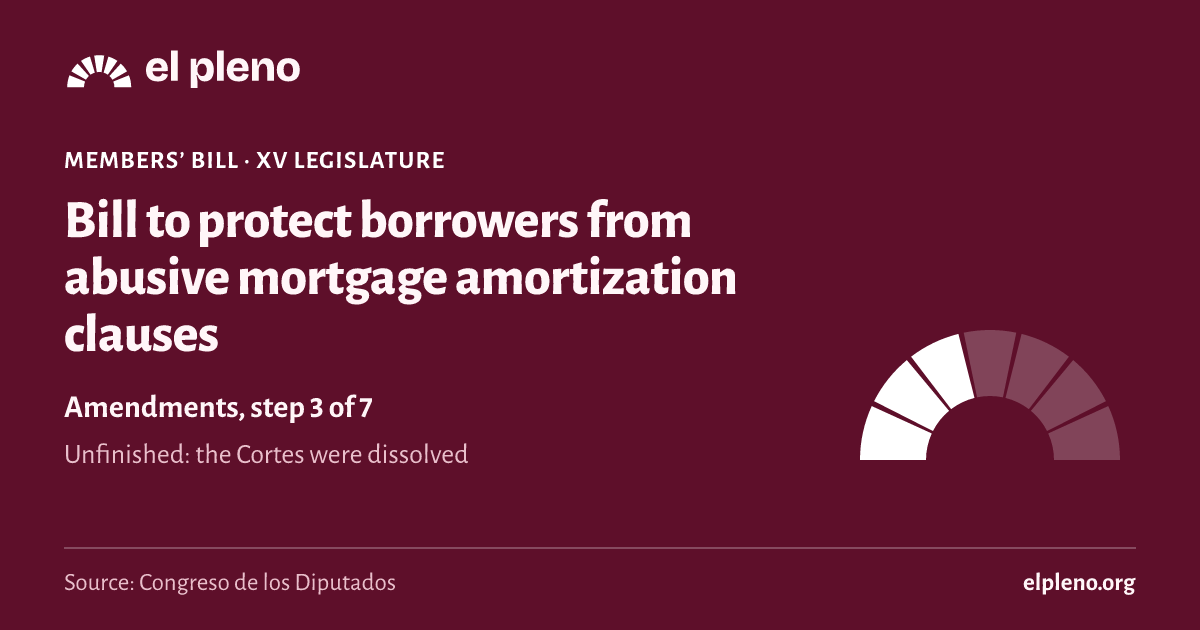
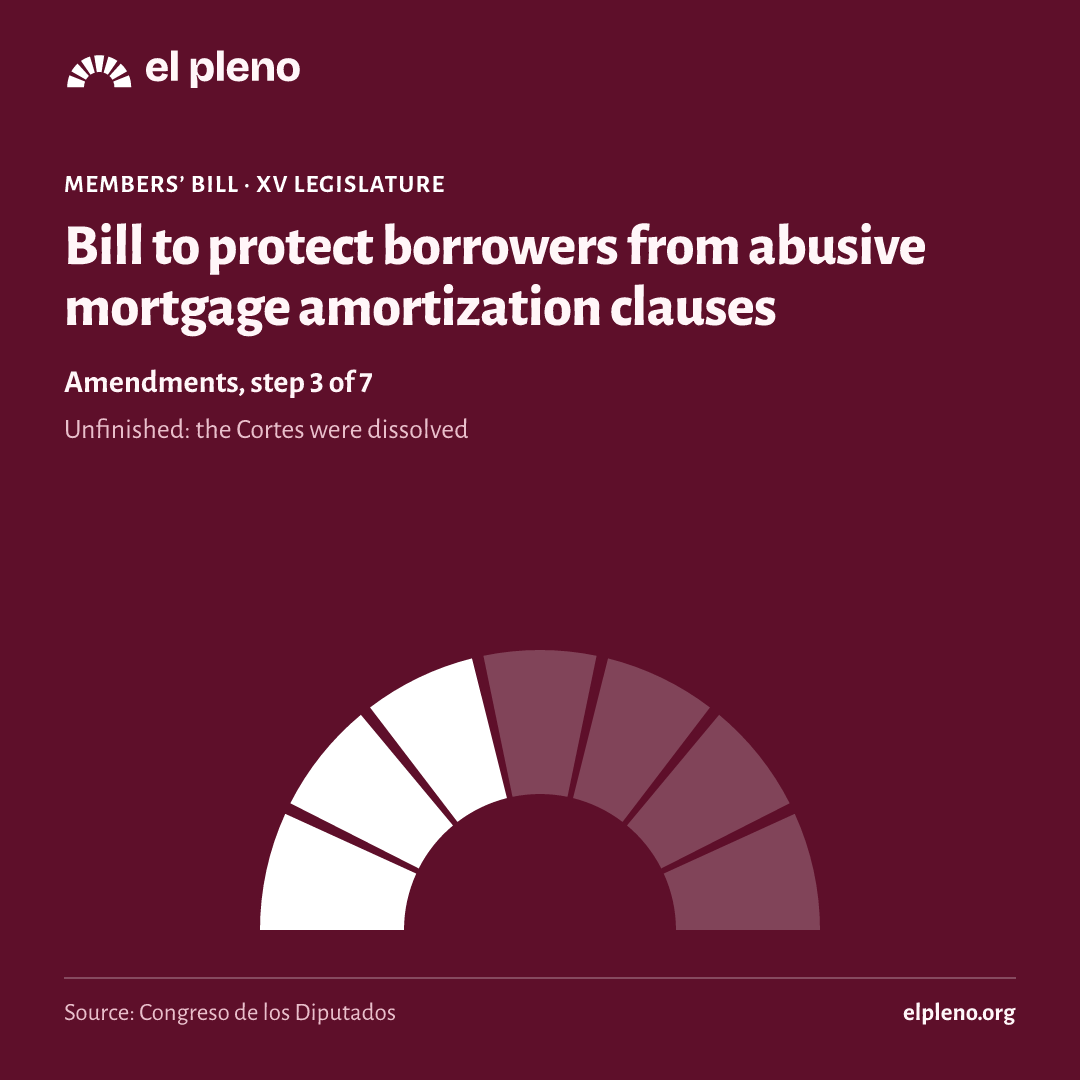
It took 3 of 7 steps. It reached Amendments, and today it is lapsed.
- Introduced16 July 2024Someone registers the text in the Congreso.
- Admitted23 July 2024The Bureau of the Congreso accepts it and, for a members’ bill, the plenary decides whether to consider it.
- Amendments31 October 2024Groups propose changes.
- Committeenot reachedA committee goes through the text in detail.
- Plenarynot reachedAll 350 deputies vote.
- Senatenot reachedThe Senate can pass it, amend it or veto it.
- BOEnot reachedIt is published in the Official State Gazette (BOE) and comes into force.
See the 9 official steps on a timeline
11 December 2025
How did the plenary vote?
Voted on: Vote on the request by the Plenary of the Chamber to take over the deliberation and final vote on the Private Member's Bill relating to the regulation of Redito Ad Libitum clauses in the contracting of loans and mortgage credits, submitted by the Popular Parliamentary Group in the Congress.
This law had 2 votes; this is the latest with every deputy’s vote. See them all
Source: Congreso de los Diputados, vote 27 of sitting 154· updated 10 Nov
Each dot is a seat. Tap one, or use the arrow keys, to see who it is.
Your province
How did the deputies from your province vote?
And your senators: the Senate does not link its votes to this law in its open data, so we cannot put them side by side here.
Or see how most of each province voted
- A Coruña More votes in favour 8 yes · 0 no
- Albacete More votes in favour 4 yes · 0 no
- Alicante/Alacant More votes in favour 12 yes · 0 no
- Almería More votes in favour 6 yes · 0 no
- Araba/Álava Tie 2 yes · 2 no
- Asturias More votes in favour 7 yes · 0 no
- Ávila More votes in favour 3 yes · 0 no
- Badajoz More votes in favour 5 yes · 0 no
- Barcelona More votes in favour 32 yes · 0 no
- Bizkaia Tie 4 yes · 4 no
- Burgos More votes in favour 4 yes · 0 no
- Cáceres More votes in favour 4 yes · 0 no
- Cádiz More votes in favour 9 yes · 0 no
- Cantabria More votes in favour 5 yes · 0 no
- Castellón/Castelló More votes in favour 5 yes · 0 no
- Ceuta More votes in favour 1 yes · 0 no
- Ciudad Real More votes in favour 5 yes · 0 no
- Córdoba More votes in favour 6 yes · 0 no
- Cuenca More votes in favour 3 yes · 0 no
- Gipuzkoa More votes against 2 yes · 4 no
- Girona More votes in favour 6 yes · 0 no
- Granada More votes in favour 7 yes · 0 no
- Guadalajara More votes in favour 3 yes · 0 no
- Huelva More votes in favour 5 yes · 0 no
- Huesca More votes in favour 3 yes · 0 no
- Illes Balears More votes in favour 8 yes · 0 no
- Jaén More votes in favour 5 yes · 0 no
- La Rioja More votes in favour 4 yes · 0 no
- Las Palmas More votes in favour 8 yes · 0 no
- León More votes in favour 4 yes · 0 no
- Lleida More votes in favour 4 yes · 0 no
- Lugo More votes in favour 4 yes · 0 no
- Madrid More votes in favour 37 yes · 0 no
- Málaga More votes in favour 10 yes · 0 no
- Melilla More votes in favour 1 yes · 0 no
- Murcia More votes in favour 10 yes · 0 no
- Navarra More votes in favour 4 yes · 1 no
- Ourense More votes in favour 4 yes · 0 no
- Palencia More votes in favour 3 yes · 0 no
- Pontevedra More votes in favour 7 yes · 0 no
- Salamanca More votes in favour 4 yes · 0 no
- Santa Cruz de Tenerife More votes in favour 7 yes · 0 no
- Segovia More votes in favour 3 yes · 0 no
- Sevilla More votes in favour 12 yes · 0 no
- Soria More votes in favour 2 yes · 0 no
- Tarragona More votes in favour 6 yes · 0 no
- Teruel More votes in favour 3 yes · 0 no
- Toledo More votes in favour 6 yes · 0 no
- Valencia/València More votes in favour 15 yes · 0 no
- Valladolid More votes in favour 5 yes · 0 no
- Zamora More votes in favour 3 yes · 0 no
- Zaragoza More votes in favour 7 yes · 0 no
More details: how each group and each province voted
The groups
Who voted in favour and who against?
In favour, most of Plurinacional SUMAR, Republicano, Socialista, Junts per Catalunya, Mixto, Popular en el Congreso and VOX. Against, most of Euskal Herria Bildu and Vasco (EAJ-PNV).
By province: in 49 most voted in favour; in 1, against.
Coloured by how most of each province’s deputies voted.
- In favour: 49
- Against: 1
- Tie: 2
| Group | Seats | How it voted |
|---|---|---|
| Euskal Herria Bildu | 6 | 6 against |
| Plurinacional SUMAR | 26 | 26 in favour |
| Republicano | 7 | 7 in favour |
| Socialista | 120 | 120 in favour |
| Vasco (EAJ-PNV) | 5 | 5 against |
| Junts per Catalunya | 7 | 7 in favour |
| Mixto | 9 | 8 in favour · 1 did not vote |
| Popular en el Congreso | 137 | 137 in favour |
| VOX | 33 | 32 in favour · 1 did not vote |
What happens next
What happens now?
The legislature ended before it finished. To go on, someone would have to introduce it again in the new Cortes.
It has not been presented again yet.
Sources
Where does all this come from?
- Congreso de los Diputados, file 122/000124
Official title, type, author, dates and stage.
Retrieved 11 November 2026
- Congreso de los Diputados, procedure
The date of each step, with its official wording.
Retrieved 12 November 2026
- Congreso de los Diputados, vote 27 of sitting 154
The count and every seat’s vote.
Retrieved 10 November 2026
- The data comes from the open files of the Congreso, the Senate and the BOE, unaltered.
- Each deputy’s province is the one of their seat on the day of the vote.
- We never say “passed” because of a vote: the files do not say which majority was needed.