What it is
Bill to guarantee truthful information and fight disinformation in the media
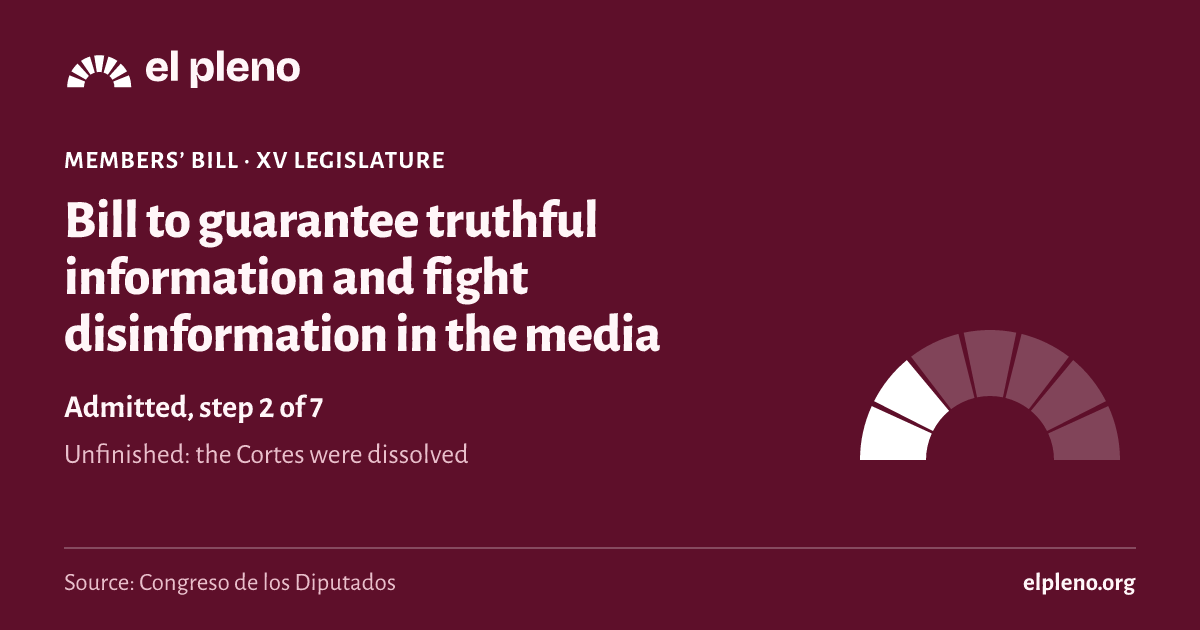
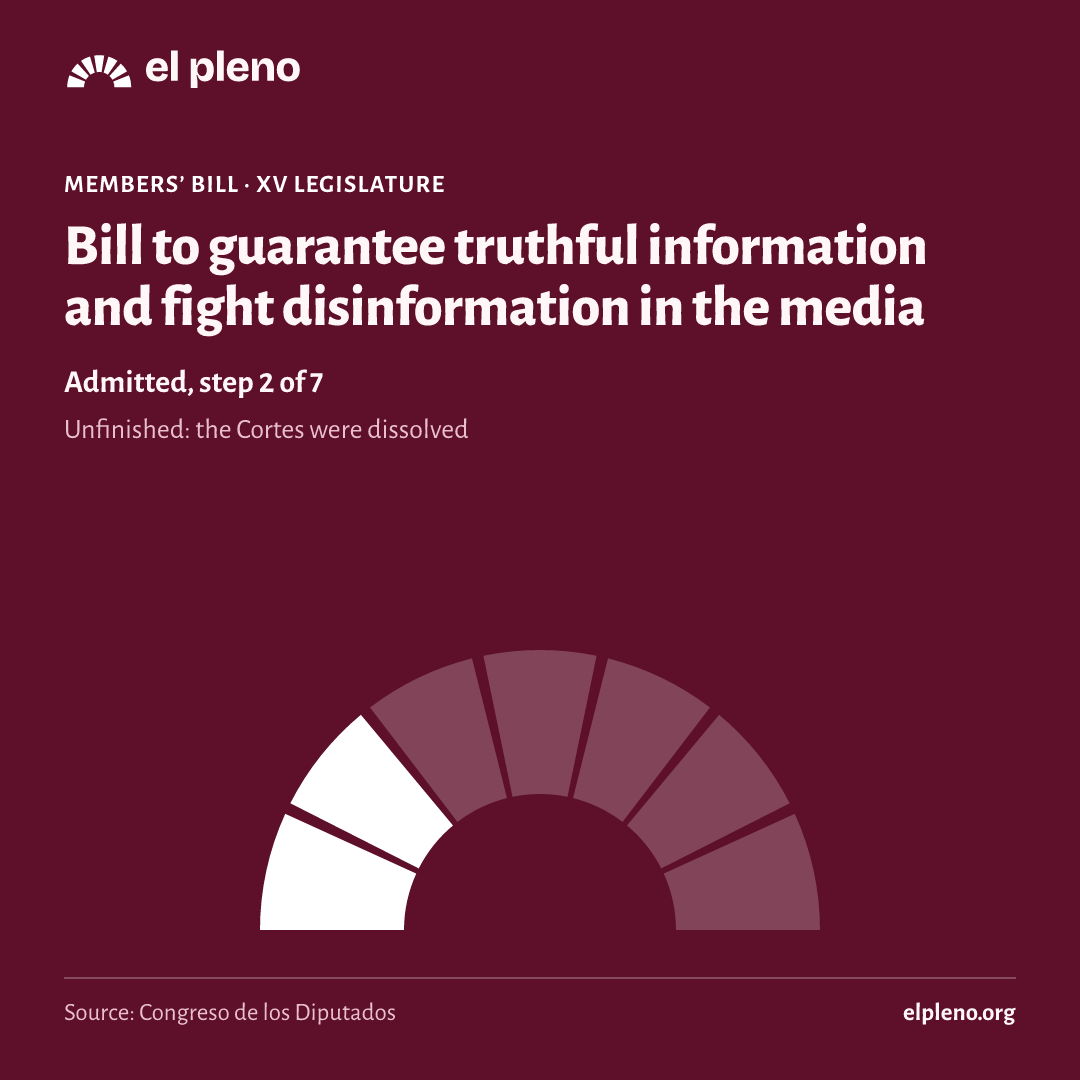
Admitted step 2 of 7· LapsedIt is a members’ bill. Introduced by parliamentary groups, the Senate, regional governments or citizens. It was introduced on 24 May 2024. Introduced by: Grupo Parlamentario Mixto.
Official title: Private member's Organic Bill guaranteeing the right to truthful information and fighting disinformation.
Source: Congreso de los Diputados, file 122/000107· updated 11 Nov
Automatic summary, not yet reviewed
- The bill would limit ownership stakes in media companies based on audience share: the more of the four fields (TV, radio, print and digital press) one person or company takes part in, the lower the combined audience cap, from 25% statewide with a stake in one field down to 10% with stakes in all four.
- It would create the Council for the Right to Information (Consejo del Derecho a la Información), a body of 50 members elected by universal suffrage that would monitor pluralism, detect fake news spread by media outlets and keep a public register of outlets and journalists sanctioned for disinformation. Decisions would need a three-fifths majority and minutes would be public.
- It sets up a sanctioning regime with fines from €1,000 to €600,000 depending on whether the offense is minor, serious or very serious. Offenses include breaking ownership concentration limits, hiding data in the interests register, deliberately spreading fake news to influence elections, or promoting discrimination and hate. Repeat cases could lead to losing the license.
- Owners, directors and news anchors of media outlets would have to declare their assets and interests to a public register, within one month of the law taking effect or of taking the post.
- Outlets with at least 15% statewide or 20% regional audience would have to guarantee newsroom independence (for example through newsroom committees) and publish on their websites, free and easy to access, their income, balance sheets, shareholders and board members.
- To fight job insecurity, the bill would make producing news content an essential activity (no outsourcing to contractors or subcontractors), treat media outlets with shared shareholders as a single group of companies, pay freelancers the same hourly rate as staff, and ban fixed-term contracts.
Who it affects
- Companies and individuals that own media outlets or hold stakes in them: Audience caps depending on how many fields they take part in, and a duty to declare assets and interests in a public register.
- Media outlets with large audiences: Must publish their income, ownership and control structure, and guarantee newsroom independence, with fines if they fail.
- Media professionals: New job protections: no contractors or subcontractors, same hourly pay as staff for freelancers, and an end to fixed-term contracts.
- Presenters and hosts of news or political affairs programs: Also required to file a declaration of assets and interests.
- The Government and public administrations: They must create a new audience measurement system, publish the cost of institutional advertising campaigns, and apply new criteria to award them.
Words worth knowing
- Proposición de ley orgánica
- A text a parliamentary group submits so it can become a law affecting fundamental rights. It is not an approved law yet; it is still being processed.
- Capital social
- The money shareholders have put into a company; it determines what share of it each one owns.
- Potestad sancionadora
- The power of a public body to impose sanctions, such as fines, on those who break the law.
- Contrata y subcontrata
- Contractor and subcontractor companies hired to do part of another company's work. The bill bans using them to produce news content.
- Publicidad institucional
- Advertising paid for by public administrations to promote their activities or campaigns.
It summarizes the text as it was introduced. It is written by artificial intelligence and may contain mistakes: the official text is what counts. Read the official text · How we make summaries
Where it stands
How far did it get?
It took 2 of 7 steps. It reached Admitted, and today it is lapsed.
- Introduced24 May 2024Someone registers the text in the Congreso.
- Admitted28 May 2024The Bureau of the Congreso accepts it and, for a members’ bill, the plenary decides whether to consider it.
- Amendmentsnot reachedGroups propose changes.
- Committeenot reachedA committee goes through the text in detail.
- Plenarynot reachedAll 350 deputies vote.
- Senatenot reachedThe Senate can pass it, amend it or veto it.
- BOEnot reachedIt is published in the Official State Gazette (BOE) and comes into force.
See the 6 official steps on a timeline
Was there a plenary vote?
We have no plenary vote linked to this law in the Congreso’s data.
What happens next
What happens now?
The legislature ended before it finished. To go on, someone would have to introduce it again in the new Cortes.
It has not been presented again yet.
Sources
Where does all this come from?
- Congreso de los Diputados, file 122/000107
Official title, type, author, dates and stage.
Retrieved 11 November 2026
- Congreso de los Diputados, procedure
The date of each step, with its official wording.
Retrieved 12 November 2026
- The data comes from the open files of the Congreso, the Senate and the BOE, unaltered.
- Each deputy’s province is the one of their seat on the day of the vote.
- We never say “passed” because of a vote: the files do not say which majority was needed.