What it is
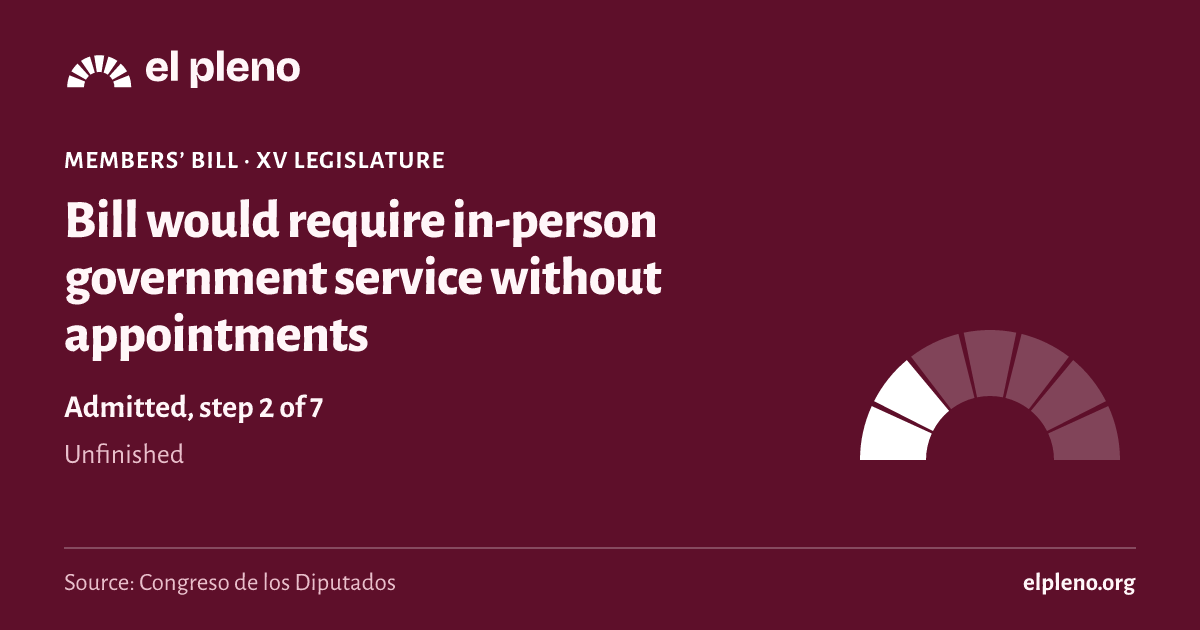
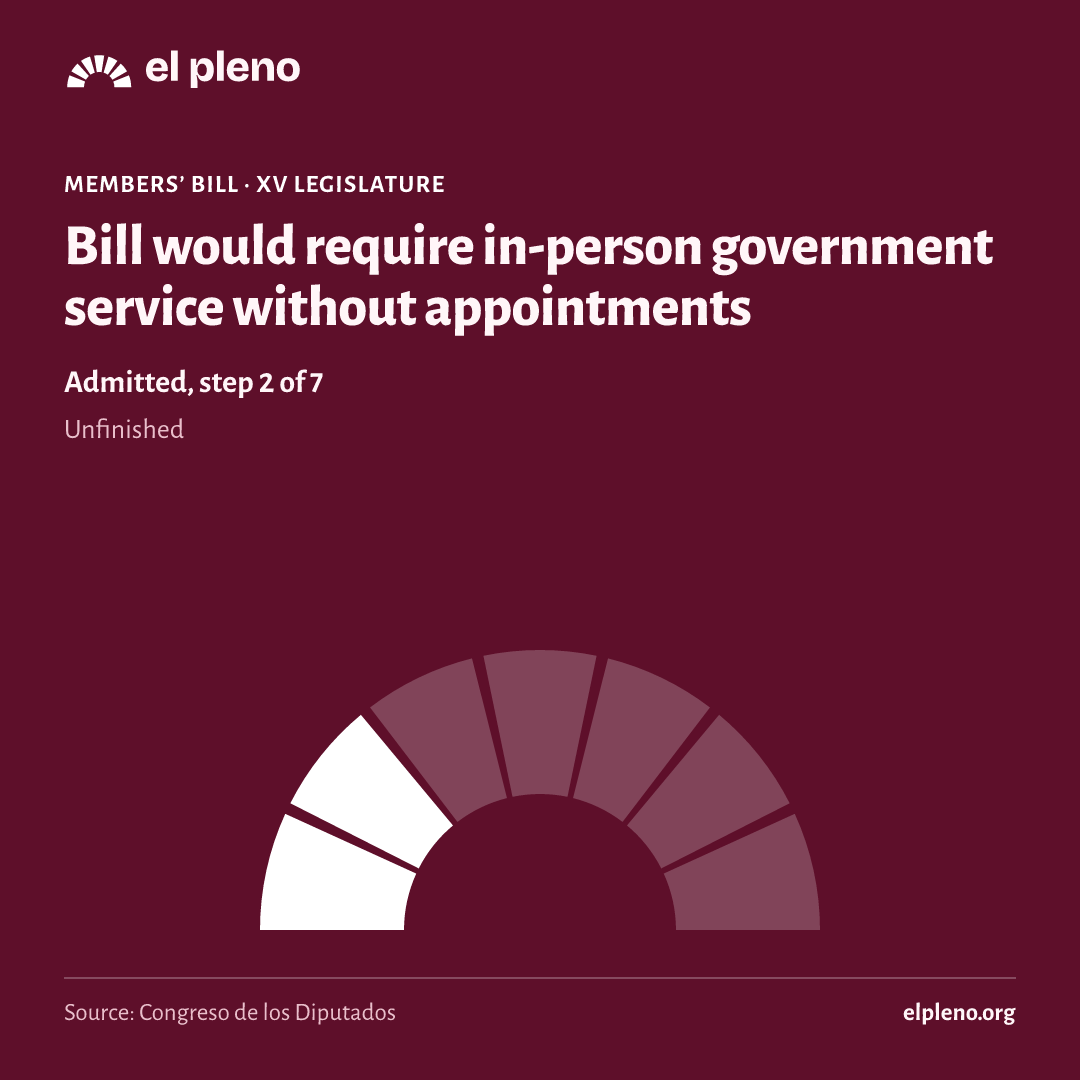
Bill would require in-person government service without appointments
It is a members’ bill. Introduced by parliamentary groups, the Senate, regional governments or citizens. It was introduced on 18 April 2024. Introduced by: Grupo Parlamentario VOX.
Official title: Private member's bill for the improvement of citizen attention by public administrations.
Source: Congreso de los Diputados, file 122/000092· updated 11 Nov
Automatic summary, not yet reviewed
- The bill would add a new right: direct, in-person and personalized service at government offices when a citizen requests it.
- It would let individuals choose at any time whether to deal with the government electronically or not, and switch channels whenever they want. Prior appointments would no longer be mandatory to interact with public authorities.
- The duty to use electronic means would remain for companies, entities without legal personality, professionals with mandatory membership (such as notaries and property registrars), representatives of those required to use electronic channels, and public employees. Authorities could extend this duty to other groups of individuals shown to have access to electronic means.
- The law would take effect on the first day of the budget year after its publication in the Official State Gazette.
Who it affects
- Older or vulnerable people with digital difficulties: They could be served in person without mandatory prior appointments.
- Any individual dealing with the government: They could choose between electronic and in-person channels and switch at any time.
- Companies and entities without legal personality: They would still have to deal with the government electronically.
- Professionals with mandatory membership, such as notaries and registrars: They would still have to use electronic means in their professional activity.
Words worth knowing
- Proposición de ley
- A bill introduced by a parliamentary group. It is not a law until Congress and the Senate approve it.
- Ley 39/2015
- The Spanish law setting common rules for all public administration procedures. This bill would amend it.
- Brecha digital
- The digital divide: some people, mostly older ones, struggle to use the internet and online procedures.
- Persona jurídica
- A legal entity, such as a company or association, as opposed to a natural person, which is an individual.
- Ejercicio presupuestario
- The budget year, the period for which public spending is approved.
It summarizes the text as it was introduced. It is written by artificial intelligence and may contain mistakes: the official text is what counts. Read the official text · How we make summaries
Where it stands
How far did it get?
It took 2 of 7 steps. It reached Admitted, and today it is unfinished.
- Introduced18 April 2024Someone registers the text in the Congreso.
- Admitted24 April 2024The Bureau of the Congreso accepts it and, for a members’ bill, the plenary decides whether to consider it.
- Amendmentsnot reachedGroups propose changes.
- Committeenot reachedA committee goes through the text in detail.
- Plenarynot reachedAll 350 deputies vote.
- Senatenot reachedThe Senate can pass it, amend it or veto it.
- BOEnot reachedIt is published in the Official State Gazette (BOE) and comes into force.
See the 5 official steps on a timeline
Was there a plenary vote?
We have no plenary vote linked to this law in the Congreso’s data.
What happens next
What happens now?
The legislature ended before it finished. To go on, someone would have to introduce it again in the new Cortes.
It has not been presented again yet.
Sources
Where does all this come from?
- Congreso de los Diputados, file 122/000092
Official title, type, author, dates and stage.
Retrieved 11 November 2026
- Congreso de los Diputados, procedure
The date of each step, with its official wording.
Retrieved 12 November 2026
- The data comes from the open files of the Congreso, the Senate and the BOE, unaltered.
- Each deputy’s province is the one of their seat on the day of the vote.
- We only say “passed” or “rejected” when the majority needed is certain; otherwise we say which side had more votes.