What it is
Proposal to make prison officers agents of the authority
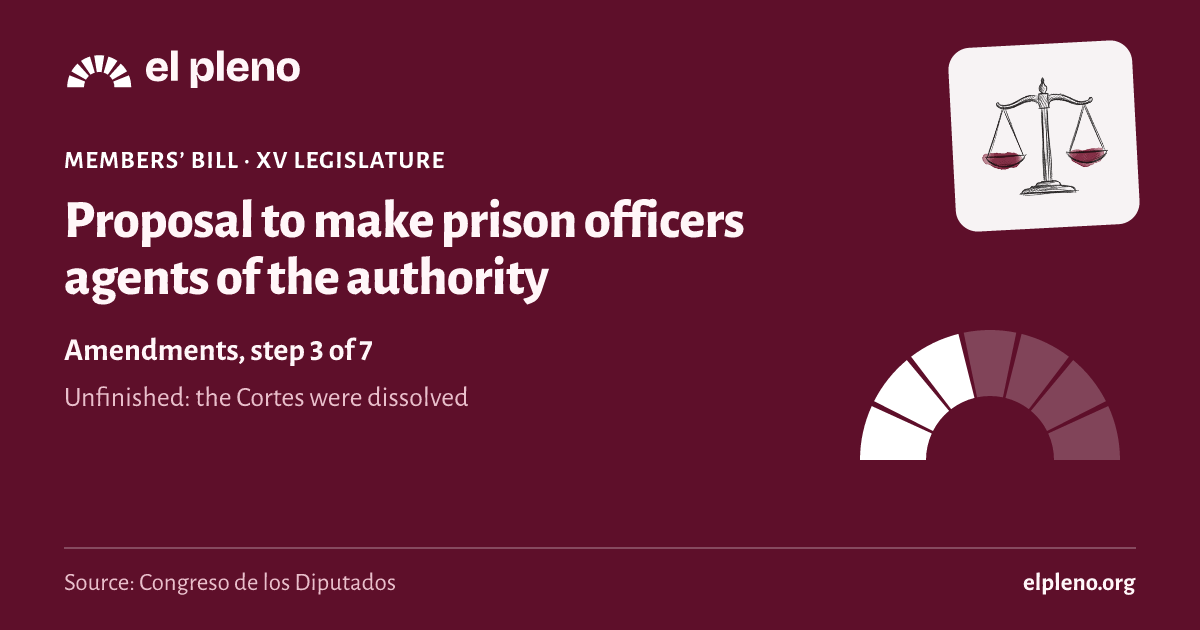
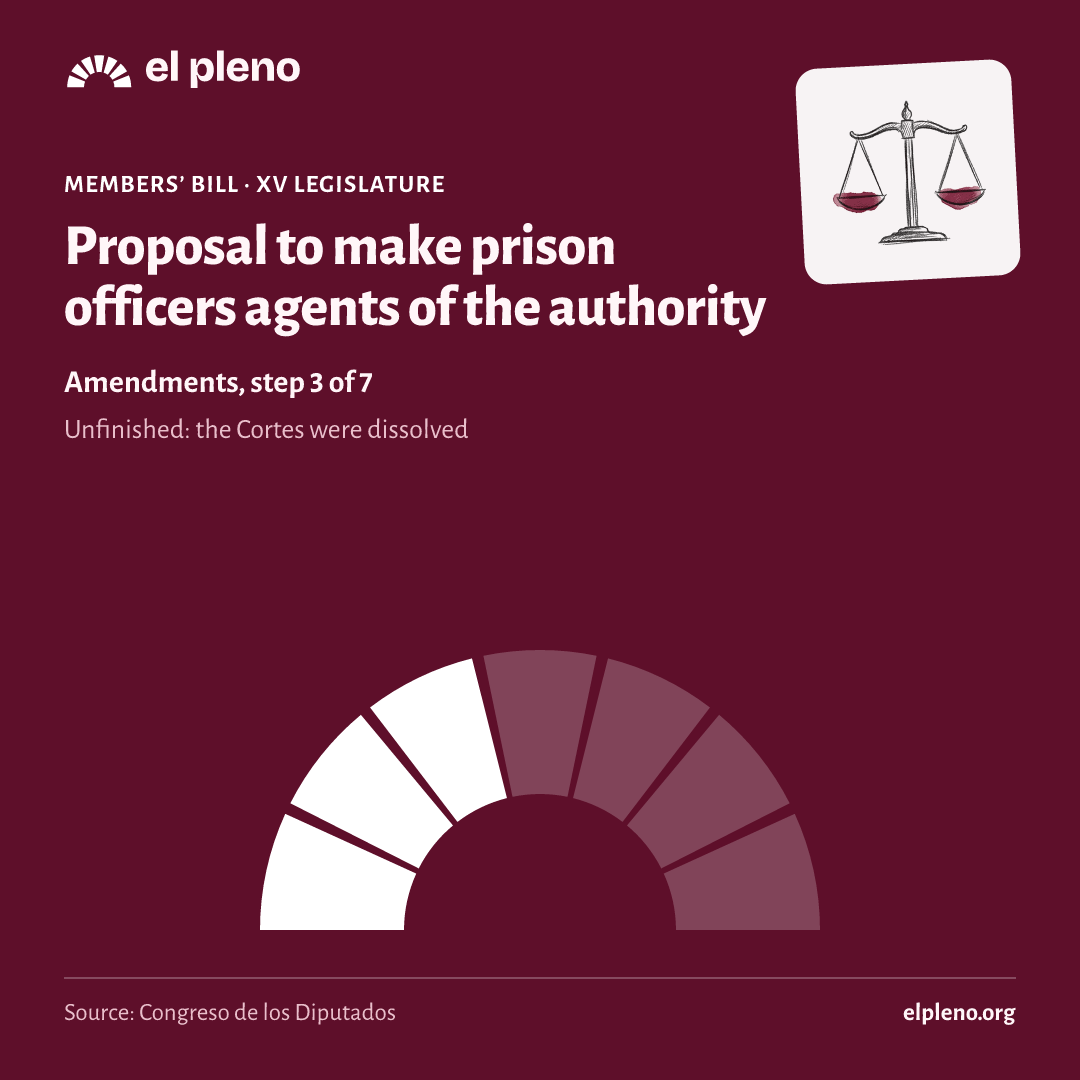
Amendments step 3 of 7· LapsedIt is a members’ bill. Introduced by parliamentary groups, the Senate, regional governments or citizens. It was introduced on 21 March 2024. Introduced by: Grupo Parlamentario Popular en el Congreso.
Official title: Private Member's Organic Bill to amend Organic Law 1/1979, of September 26, General Penitentiary, to recognize the status of agents of the authority to prison officers in the exercise of their duties.
Source: Congreso de los Diputados, file 122/000081· updated 11 Nov
Automatic summary, not yet reviewed
- The bill would amend Article 80 of the General Penitentiary Law to recognize prison officers as agents of the authority for all legal purposes. They could identify themselves with their professional registration number, and their reports would be presumed true unless proven otherwise.
- If someone commits the crime of assault endangering the physical integrity of an officer on duty, the officer would be treated as an authority for criminal protection purposes, the same as members of the state security forces.
- A new fifth paragraph would guarantee that prison officers are held separately from other detainees if they are detained, and from other inmates if they are imprisoned or transferred under custody.
- The explanatory statement justifies the reform by the assaults on prison officers, which the text puts at 508 in 2023, and because no law currently grants them the status of agents of the authority.
Who it affects
- Prison corps officers: They would be recognized as agents of the authority, with greater criminal protection and separation measures if they serve prison sentences.
- People held in prisons: They would live with officers whose authority would have stronger legal backing.
- Penitentiary administration: It would have to apply the regulatory changes affecting its staff.
Words worth knowing
- Agente de la autoridad (agent of the authority)
- A person the law allows to act on behalf of public authority, such as a police officer. Assaulting them carries stronger criminal protection.
- Presunción de veracidad (presumption of truthfulness)
- What the officer states in their reports is taken as true unless someone proves otherwise.
- Delito de atentado (crime of assault on authority)
- A crime consisting of attacking or intimidating an authority or public officer while performing their duties.
- Proposición de Ley Orgánica (Organic Law bill)
- A text submitted to the Congress of Deputies to amend a special law, not yet approved.
It summarizes the text as it was introduced. It is written by artificial intelligence and may contain mistakes: the official text is what counts. Read the official text · How we make summaries
Where it stands
How far did it get?
It took 3 of 7 steps. It reached Amendments, and today it is lapsed.
- Introduced21 March 2024Someone registers the text in the Congreso.
- Admitted2 April 2024The Bureau of the Congreso accepts it and, for a members’ bill, the plenary decides whether to consider it.
- Amendments29 November 2024Groups propose changes.
- Committeenot reachedA committee goes through the text in detail.
- Plenarynot reachedAll 350 deputies vote.
- Senatenot reachedThe Senate can pass it, amend it or veto it.
- BOEnot reachedIt is published in the Official State Gazette (BOE) and comes into force.
See the 9 official steps on a timeline
19 November 2024
How did the plenary vote?
Voted on: Private member's bill by the Popular Parliamentary Group in the Congress, Organic bill amending Organic Law 1/1979, of September 26, General Penitentiary, for the recognition of the status of law enforcement officers to prison service officials in the exercise of their functions.
Source: Congreso de los Diputados, vote 2 of sitting 77· updated 10 Nov
Each dot is a seat. Tap one, or use the arrow keys, to see who it is.
Your province
How did the deputies from your province vote?
And your senators: the Senate does not link its votes to this law in its open data, so we cannot put them side by side here.
Or see how most of each province voted
- A Coruña More votes in favour 6 yes · 2 no
- Albacete More votes in favour 4 yes · 0 no
- Alicante/Alacant More votes in favour 11 yes · 1 no
- Almería More votes in favour 6 yes · 0 no
- Araba/Álava More votes in favour 3 yes · 1 no
- Asturias More votes in favour 6 yes · 1 no
- Ávila More votes in favour 3 yes · 0 no
- Badajoz More votes in favour 5 yes · 0 no
- Barcelona More votes in favour 20 yes · 9 no · 3 abst.
- Bizkaia More votes in favour 5 yes · 3 no
- Burgos More votes in favour 4 yes · 0 no
- Cáceres More votes in favour 4 yes · 0 no
- Cádiz More votes in favour 8 yes · 1 no
- Cantabria More votes in favour 5 yes · 0 no
- Castellón/Castelló More votes in favour 5 yes · 0 no
- Ceuta More votes in favour 1 yes · 0 no
- Ciudad Real More votes in favour 5 yes · 0 no
- Córdoba More votes in favour 5 yes · 1 no
- Cuenca More votes in favour 3 yes · 0 no
- Gipuzkoa More votes in favour 4 yes · 2 no
- Girona Tie 2 yes · 2 no · 2 abst.
- Granada More votes in favour 6 yes · 0 no · 1 abst.
- Guadalajara More votes in favour 3 yes · 0 no
- Huelva More votes in favour 5 yes · 0 no
- Huesca More votes in favour 3 yes · 0 no
- Illes Balears More votes in favour 7 yes · 1 no
- Jaén More votes in favour 5 yes · 0 no
- La Rioja More votes in favour 4 yes · 0 no
- Las Palmas More votes in favour 7 yes · 0 no · 1 abst.
- León More votes in favour 4 yes · 0 no
- Lleida More votes in favour 2 yes · 1 no · 1 abst.
- Lugo More votes in favour 4 yes · 0 no
- Madrid More votes in favour 29 yes · 4 no · 1 abst.
- Málaga More votes in favour 10 yes · 1 no
- Melilla More votes in favour 1 yes · 0 no
- Murcia More votes in favour 9 yes · 0 no · 1 abst.
- Navarra More votes in favour 4 yes · 1 no
- Ourense More votes in favour 4 yes · 0 no
- Palencia More votes in favour 3 yes · 0 no
- Pontevedra More votes in favour 6 yes · 1 no
- Salamanca More votes in favour 4 yes · 0 no
- Santa Cruz de Tenerife More votes in favour 7 yes · 0 no
- Segovia More votes in favour 3 yes · 0 no
- Sevilla More votes in favour 10 yes · 2 no
- Soria More votes in favour 2 yes · 0 no
- Tarragona More votes in favour 3 yes · 2 no · 1 abst.
- Teruel More votes in favour 3 yes · 0 no
- Toledo More votes in favour 6 yes · 0 no
- Valencia/València More votes in favour 12 yes · 3 no
- Valladolid More votes in favour 5 yes · 0 no
- Zamora More votes in favour 3 yes · 0 no
- Zaragoza More votes in favour 6 yes · 1 no
More details: how each group and each province voted
The groups
Who voted in favour and who against?
In favour, most of Socialista, Vasco (EAJ-PNV), Popular en el Congreso and VOX. Against, most of Euskal Herria Bildu, Plurinacional SUMAR and Republicano. 3 deputies voted differently from their group.
By province: in 51 most voted in favour; in 0, against.
Coloured by how most of each province’s deputies voted.
- In favour: 51
- Against: 0
- Tie: 1
| Group | Seats | How it voted |
|---|---|---|
| Euskal Herria Bildu | 6 | 6 against |
| Plurinacional SUMAR | 27 | 26 against · 1 did not vote |
| Republicano | 7 | 7 against |
| Socialista | 120 | 119 in favour · 1 did not vote |
| Vasco (EAJ-PNV) | 5 | 5 in favour |
| Junts per Catalunya | 7 | 7 abst. |
| Mixto | 8 | 2 in favour · 1 against · 4 abst. · 1 did not vote |
| Popular en el Congreso | 137 | 136 in favour · 1 did not vote |
| VOX | 33 | 33 in favour |
What happens next
What happens now?
The legislature ended before it finished. To go on, someone would have to introduce it again in the new Cortes.
Sources
Where does all this come from?
- Congreso de los Diputados, file 122/000081
Official title, type, author, dates and stage.
Retrieved 11 November 2026
- Congreso de los Diputados, procedure
The date of each step, with its official wording.
Retrieved 12 November 2026
- Congreso de los Diputados, vote 2 of sitting 77
The count and every seat’s vote.
Retrieved 10 November 2026
- The data comes from the open files of the Congreso, the Senate and the BOE, unaltered.
- Each deputy’s province is the one of their seat on the day of the vote.
- We never say “passed” because of a vote: the files do not say which majority was needed.