What it is
Bill to improve life for people with ALS
It is a members’ bill. Introduced by parliamentary groups, the Senate, regional governments or citizens. It was introduced on 22 February 2024. Introduced by: Grupo Parlamentario Junts per Catalunya.
Official title: Private member's bill to improve the quality of life of people with amyotrophic lateral sclerosis.
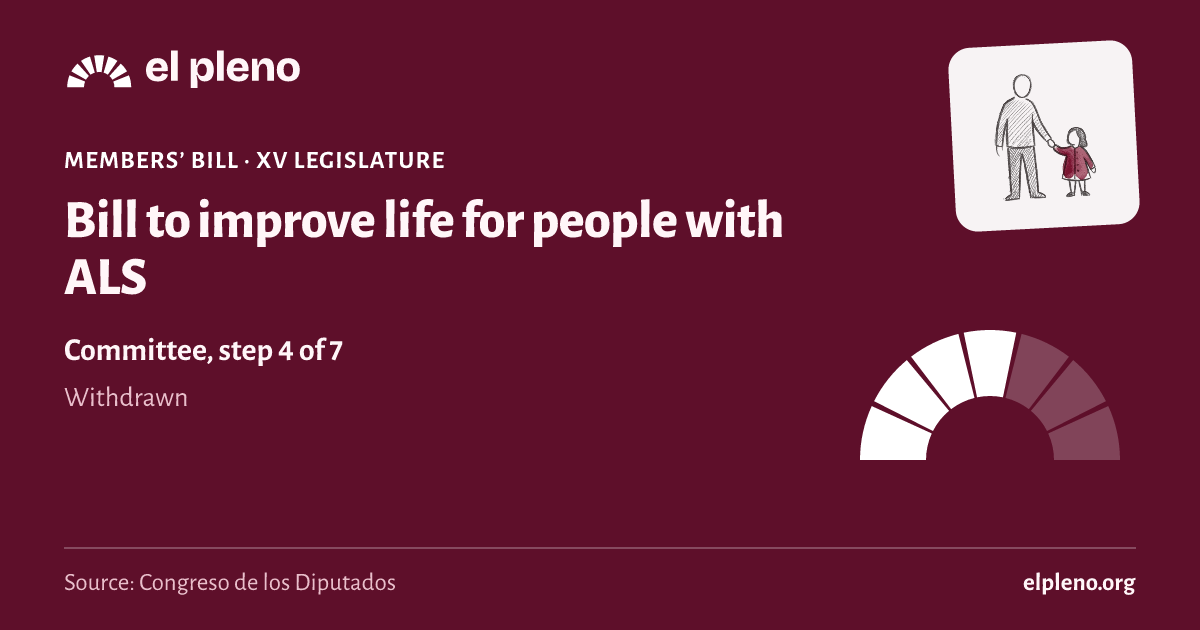
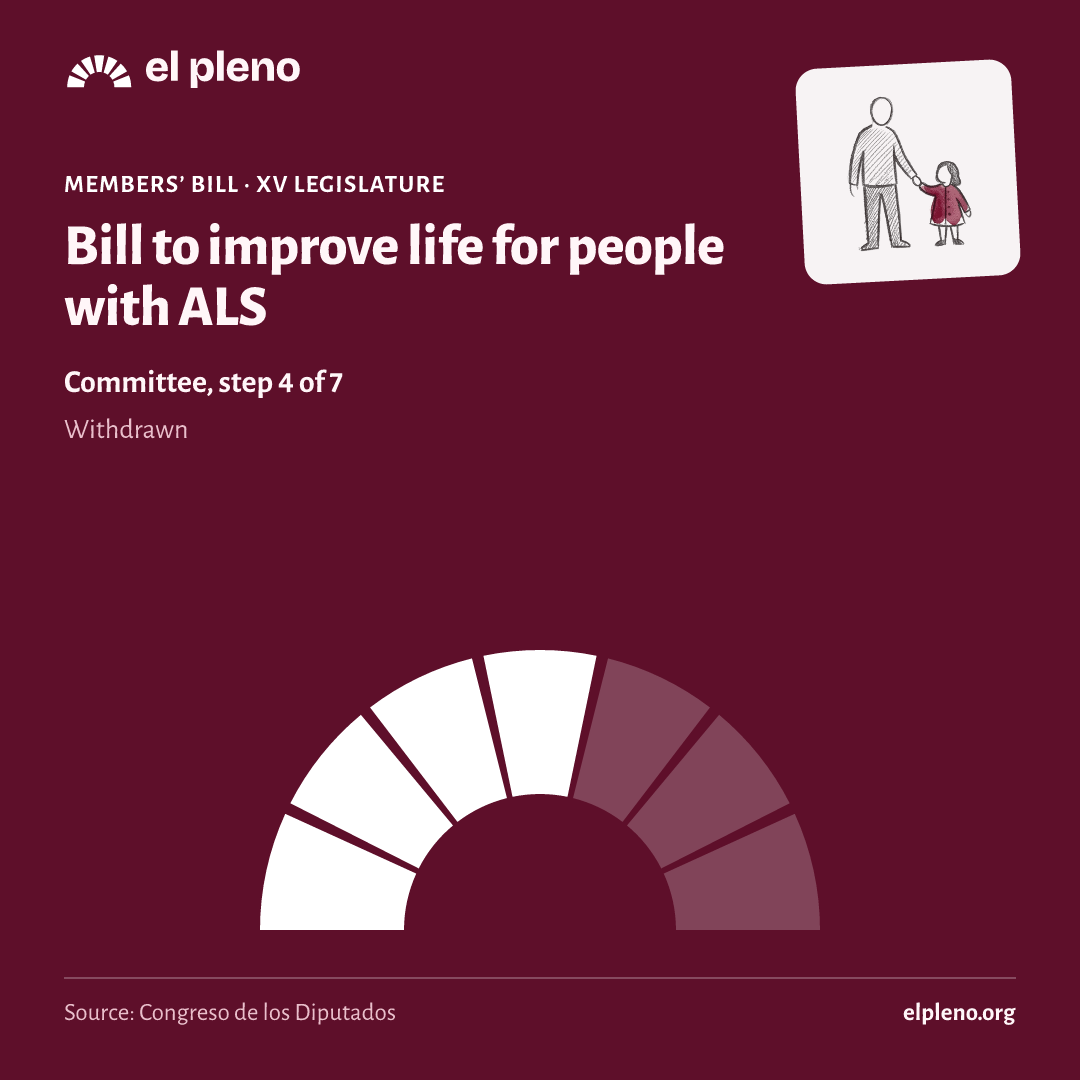
Source: Congreso de los Diputados, file 122/000058· updated 11 Nov
Automatic summary, not yet reviewed
- The bill would give people diagnosed with amyotrophic lateral sclerosis (ALS) a grade 3 severe disability rating, with a minimum of 65%, from the moment of diagnosis, without further assessments. One year later, the rating would automatically rise to grade 4, total disability, unless the disease had already progressed further.
- The bill would add breathing difficulty to the mobility assessment scale, so it counts for ALS patients who can walk but with effort due to respiratory muscle damage. It would also cover people with heart conditions that cause breathing trouble.
- Under the Dependency Law, the bill would provide preferential care in multidisciplinary services, home physiotherapy and 24-hour specialized home care for people with ALS who are greatly dependent, funded by the State. Dependency recognition would be preferential, with grade II from diagnosis, and must be decided within three months; otherwise it would be granted by administrative silence.
- The bill would speed up recognition of permanent disability for people with an ALS diagnosis, allowing the requirement of prior medical treatment to be waived in these cases.
- Family caregivers who left their jobs to care for a person with ALS in a situation of great dependency could keep the contribution base of their last year, so they would not lose Social Security rights.
- Within six months, the Government would have to include travel and lodging subsidies for trips to reference units in other provinces, evaluate the National Health System's Neurodegenerative Diseases Strategy, and could extend these benefits to other chronic neurodegenerative diseases by Royal Decree.
Who it affects
- People with ALS: Would have a high disability and dependency rating from diagnosis, with fewer procedures and shorter waits.
- Family members and caregivers: Could keep their Social Security contributions if they stopped working to provide care, and would get travel and lodging aid.
- People with other neurodegenerative diseases: The Government could extend the same benefits to them by Royal Decree.
Words worth knowing
- Grado de discapacidad (disability rating)
- A percentage recognized by the Administration based on how the disease affects daily life; it gives access to benefits.
- Silencio administrativo (administrative silence)
- If the Administration does not reply within the set deadline, the request is considered approved.
- Baremo (assessment scale)
- A table of percentages used to assess each person's limitations.
- Base de cotización (contribution base)
- The amount used to calculate Social Security contributions and, later, the pension.
It summarizes the text as it was introduced. It is written by artificial intelligence and may contain mistakes: the official text is what counts. Read the official text · How we make summaries
Where it stands
How far did it get?
It took 4 of 7 steps. It reached Committee, and today it is withdrawn.
- Introduced22 February 2024Someone registers the text in the Congreso.
- Admitted27 February 2024The Bureau of the Congreso accepts it and, for a members’ bill, the plenary decides whether to consider it.
- Amendments5 April 2024Groups propose changes.
- Committee11 June 2024A committee goes through the text in detail.
- Plenarynot reachedAll 350 deputies vote.
- Senatenot reachedThe Senate can pass it, amend it or veto it.
- BOEnot reachedIt is published in the Official State Gazette (BOE) and comes into force.
See the 12 official steps on a timeline
20 June 2024
How did the plenary vote?
Voted on: Vote on the amendment to the whole with alternative text to the Private member's bill to improve the quality of life of people with amyotrophic lateral sclerosis, submitted by the VOX Parliamentary Group.
This law had 2 votes; this is the latest with every deputy’s vote. See them all
Source: Congreso de los Diputados, vote 24 of sitting 49· updated 10 Nov
Each dot is a seat. Tap one, or use the arrow keys, to see who it is.
Your province
How did the deputies from your province vote?
And your senators: the Senate does not link its votes to this law in its open data, so we cannot put them side by side here.
Or see how most of each province voted
- A Coruña More votes against 0 yes · 8 no
- Albacete More votes against 0 yes · 4 no
- Alicante/Alacant More votes against 2 yes · 10 no
- Almería More votes against 1 yes · 5 no
- Araba/Álava More votes against 0 yes · 4 no
- Asturias More votes against 1 yes · 6 no
- Ávila More votes against 0 yes · 3 no
- Badajoz More votes against 1 yes · 4 no
- Barcelona More votes against 2 yes · 29 no
- Bizkaia More votes against 0 yes · 8 no
- Burgos More votes against 0 yes · 4 no
- Cáceres More votes against 0 yes · 4 no
- Cádiz More votes against 1 yes · 7 no
- Cantabria More votes against 1 yes · 4 no
- Castellón/Castelló More votes against 1 yes · 4 no
- Ceuta More votes against 0 yes · 1 no
- Ciudad Real More votes against 1 yes · 4 no
- Córdoba More votes against 1 yes · 5 no
- Cuenca More votes against 0 yes · 3 no
- Gipuzkoa More votes against 0 yes · 6 no
- Girona More votes against 0 yes · 6 no
- Granada More votes against 1 yes · 6 no
- Guadalajara More votes against 1 yes · 2 no
- Huelva More votes against 1 yes · 4 no
- Huesca More votes against 0 yes · 3 no
- Illes Balears More votes against 1 yes · 7 no
- Jaén More votes against 1 yes · 4 no
- La Rioja More votes against 0 yes · 4 no
- Las Palmas More votes against 1 yes · 7 no
- León More votes against 0 yes · 4 no
- Lleida More votes against 0 yes · 4 no
- Lugo More votes against 0 yes · 4 no
- Madrid More votes against 5 yes · 32 no
- Málaga More votes against 2 yes · 9 no
- Melilla More votes against 0 yes · 1 no
- Murcia More votes against 2 yes · 8 no
- Navarra More votes against 0 yes · 5 no
- Ourense More votes against 0 yes · 4 no
- Palencia More votes against 0 yes · 3 no
- Pontevedra More votes against 0 yes · 7 no
- Salamanca More votes against 0 yes · 4 no
- Santa Cruz de Tenerife More votes against 0 yes · 7 no
- Segovia More votes against 0 yes · 3 no
- Sevilla More votes against 1 yes · 11 no
- Soria More votes against 0 yes · 2 no
- Tarragona More votes against 0 yes · 6 no
- Teruel More votes against 0 yes · 3 no
- Toledo More votes against 1 yes · 5 no
- Valencia/València More votes against 2 yes · 14 no
- Valladolid More votes against 1 yes · 4 no
- Zamora More votes against 0 yes · 3 no
- Zaragoza More votes against 1 yes · 6 no
More details: how each group and each province voted
The groups
Who voted in favour and who against?
In favour, most of VOX. Against, most of Euskal Herria Bildu, Plurinacional SUMAR, Republicano, Socialista, Vasco (EAJ-PNV), Junts per Catalunya, Mixto and Popular en el Congreso.
By province: in 0 most voted in favour; in 52, against.
Coloured by how most of each province’s deputies voted.
- In favour: 0
- Against: 52
| Group | Seats | How it voted |
|---|---|---|
| Euskal Herria Bildu | 6 | 6 against |
| Plurinacional SUMAR | 27 | 25 against · 2 did not vote |
| Republicano | 7 | 7 against |
| Socialista | 120 | 120 against |
| Vasco (EAJ-PNV) | 5 | 5 against |
| Junts per Catalunya | 7 | 7 against |
| Mixto | 8 | 8 against |
| Popular en el Congreso | 137 | 137 against |
| VOX | 33 | 33 in favour |
What happens next
What happens now?
Whoever introduced it withdrew it, or it was merged into another one. It goes no further.
Sources
Where does all this come from?
- Congreso de los Diputados, file 122/000058
Official title, type, author, dates and stage.
Retrieved 11 November 2026
- Congreso de los Diputados, procedure
The date of each step, with its official wording.
Retrieved 12 November 2026
- Congreso de los Diputados, vote 24 of sitting 49
The count and every seat’s vote.
Retrieved 10 November 2026
- The data comes from the open files of the Congreso, the Senate and the BOE, unaltered.
- Each deputy’s province is the one of their seat on the day of the vote.
- We only say “passed” or “rejected” when the majority needed is certain; otherwise we say which side had more votes.