What it is
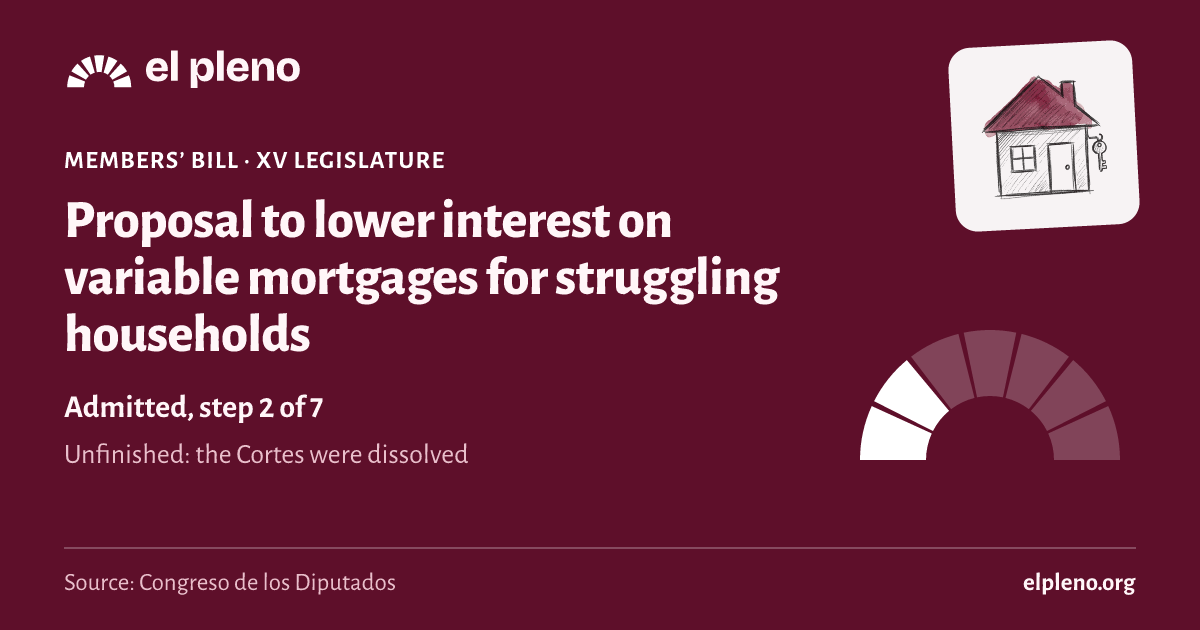
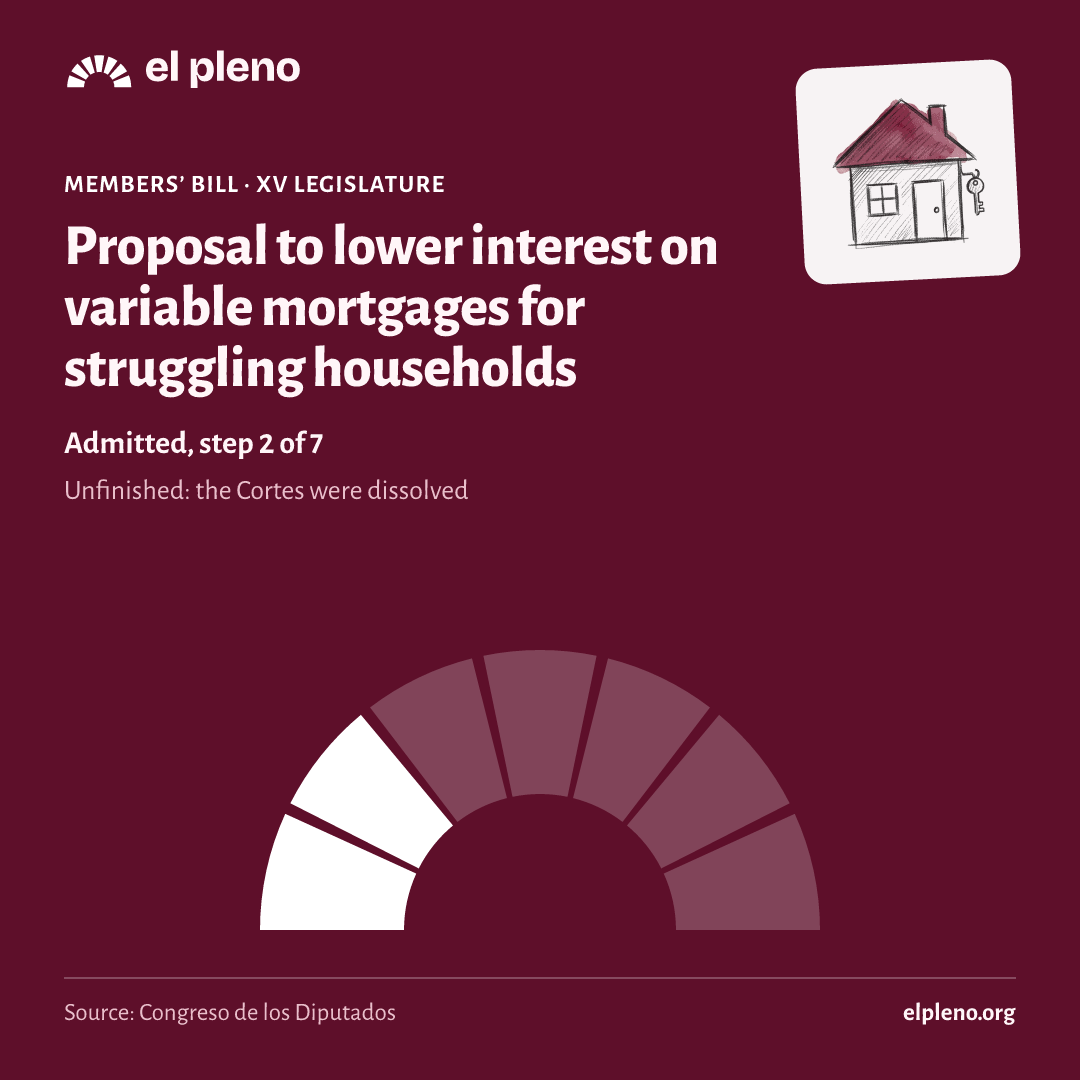
Proposal to lower interest on variable mortgages for struggling households
Admitted step 2 of 7· LapsedIt is a members’ bill. Introduced by parliamentary groups, the Senate, regional governments or citizens. It was introduced on 21 December 2023. Introduced by: Grupo Parlamentario Mixto.
Official title: Private member's bill for the temporary reduction of the differential applicable to variable-rate mortgages on primary residences in situations of economic vulnerability.
Source: Congreso de los Diputados, file 122/000042· updated 11 Nov
Automatic summary, not yet reviewed
- The bill would let people in economic hardship reduce the interest on the variable-rate mortgage on their main home to Euribor plus 0.10% for one year.
- To qualify, income must be at most 1.5 times the IPREM (up to 5 times in some cases, with extra room for children or older people), and the mortgage payment plus basic utilities must equal at least 30% of net income.
- The borrower would prove hardship with documents such as a census registration certificate or sworn statements; if a document cannot be provided, a sworn statement explaining why could replace it.
- The bank would have to apply the reduction within 15 calendar days, tell its customers about this option within one month, and the lender would pay notary and registry fees with a 50% discount.
Who it affects
- People or families with a variable-rate mortgage on their main home who are in financial hardship: They could request an interest reduction for one year.
- Financial institutions: They would have to apply the reduction within 15 days, inform customers, and cover formalization costs.
- Borrowers who use the measure without meeting the requirements: They would be liable for damages, losses and costs.
Words worth knowing
- Euribor
- The reference rate commonly used to set interest on variable-rate mortgages in Spain.
- IPREM
- Indicador Público de Renta de Efectos Múltiples: an annual income reference used to set eligibility limits for aid.
- Diferencial (spread)
- The percentage added to Euribor to calculate the interest on a variable-rate mortgage.
- Declaración responsable (sworn statement)
- A document where you state that you meet certain requirements, under your own responsibility.
- Nota simple
- A document from the Property Registry showing what real estate a person owns.
It summarizes the text as it was introduced. It is written by artificial intelligence and may contain mistakes: the official text is what counts. Read the official text · How we make summaries
Where it stands
How far did it get?
It took 2 of 7 steps. It reached Admitted, and today it is lapsed.
- Introduced21 December 2023Someone registers the text in the Congreso.
- Admitted9 January 2024The Bureau of the Congreso accepts it and, for a members’ bill, the plenary decides whether to consider it.
- Amendmentsnot reachedGroups propose changes.
- Committeenot reachedA committee goes through the text in detail.
- Plenarynot reachedAll 350 deputies vote.
- Senatenot reachedThe Senate can pass it, amend it or veto it.
- BOEnot reachedIt is published in the Official State Gazette (BOE) and comes into force.
See the 6 official steps on a timeline
Was there a plenary vote?
We have no plenary vote linked to this law in the Congreso’s data.
What happens next
What happens now?
The legislature ended before it finished. To go on, someone would have to introduce it again in the new Cortes.
Sources
Where does all this come from?
- Congreso de los Diputados, file 122/000042
Official title, type, author, dates and stage.
Retrieved 11 November 2026
- Congreso de los Diputados, procedure
The date of each step, with its official wording.
Retrieved 12 November 2026
- The data comes from the open files of the Congreso, the Senate and the BOE, unaltered.
- Each deputy’s province is the one of their seat on the day of the vote.
- We never say “passed” because of a vote: the files do not say which majority was needed.