What it is
New rules for staff in Spain's public health services
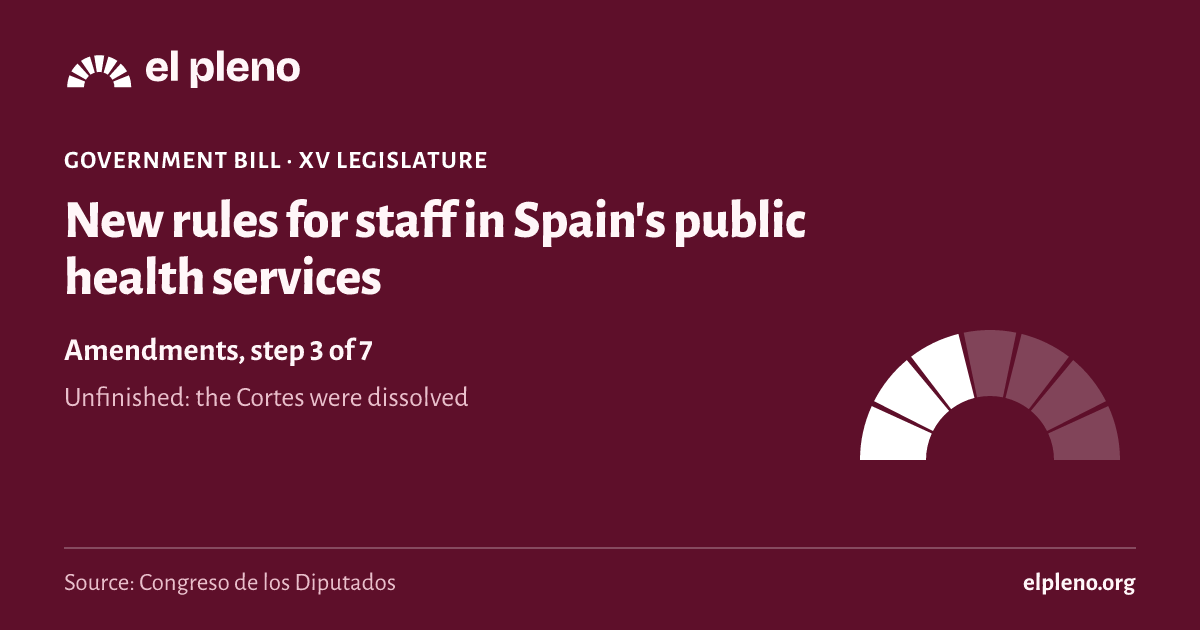
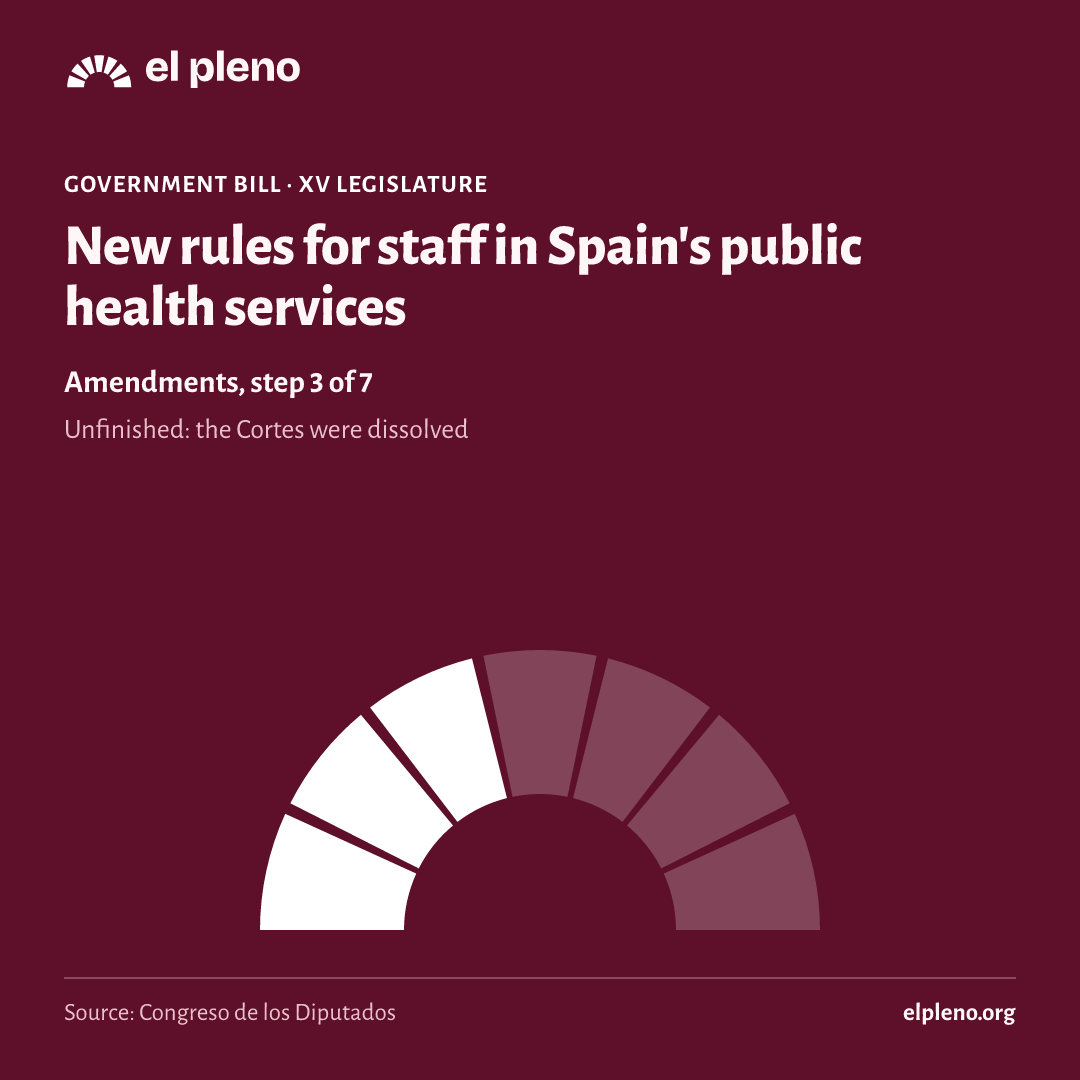
Amendments step 3 of 7· LapsedIt is a government bill. Introduced by the Government. It was introduced on 7 September 2026. Introduced by: Gobierno.
Official title: Government bill for the Framework Statute of statutory personnel of health services.
Source: Congreso de los Diputados, file 121/000112· updated 11 Nov
Automatic summary, not yet reviewed
- The bill would replace the 2003 law governing statutory health service staff, updating their rights and working conditions after more than two decades in force.
- It would set a maximum average working time of 45 hours per week, including on-call shifts, compared with the 48 hours allowed under European rules. On-call shifts could not exceed 17 hours, except with the worker's express consent and a favorable occupational risk prevention report.
- It would limit temporary appointments: vacancies filled with interim staff could only be kept for up to three years, and it would strengthen the duty to announce positions and to compensate abuse of temporary employment.
- It would expand the staff's list of rights, such as the right to disconnect, protection against assaults, advance knowledge of annual work schedules, and measures to balance personal, family and work life.
- It would define excessive workload for the first time as an objective indicator requiring action: occupational risk prevention services would have to issue reports and centers would have to take corrective measures when working time limits are repeatedly exceeded.
- It would regulate exemptions from on-call shifts and night shifts during pregnancy, breastfeeding, reduced hours for childcare, health reasons and, depending on each service, for staff over 55, with mechanisms to avoid pay cuts.
- It would professionalize health management: management positions would require a university degree, selection through a public call evaluating training, experience and a management project, and periodic performance reviews.
- It would improve voluntary mobility between health services through an open, permanent competitive process with resolutions at least once a year, and would strengthen guarantees for forced mobility for service reasons.
Words worth knowing
- Personal estatutario (statutory staff)
- People working in public health services under a special civil-servant-like relationship governed by this law, rather than an ordinary employment contract.
- Jornada de guardia (on-call shift)
- Working time additional to the ordinary shift, to cover emergencies and guarantee continuous care.
- Período de localización (on-call availability period)
- Time when the professional stays available at home and can be called in to work if needed.
- Retribuciones complementarias (complementary pay)
- Payments added to base salary for the position, dedication, productivity or other concepts.
- Excedencia (leave of absence)
- A situation where the professional stops working and receiving pay but keeps their statutory staff status.
It summarizes the text as it was introduced. It is written by artificial intelligence and may contain mistakes: the official text is what counts. Read the official text · How we make summaries
Where it stands
How far did it get?
It took 3 of 7 steps. It reached Amendments, and today it is lapsed.
- Introduced7 September 2026Someone registers the text in the Congreso.
- Admitted15 September 2026The Bureau of the Congreso accepts it and, for a members’ bill, the plenary decides whether to consider it.
- Amendments18 September 2026Groups propose changes.
- Committeenot reachedA committee goes through the text in detail.
- Plenarynot reachedAll 350 deputies vote.
- Senatenot reachedThe Senate can pass it, amend it or veto it.
- BOEnot reachedIt is published in the Official State Gazette (BOE) and comes into force.
See the 5 official steps on a timeline
Was there a plenary vote?
We have no plenary vote linked to this law in the Congreso’s data.
What happens next
What happens now?
The legislature ended before it finished. To go on, someone would have to introduce it again in the new Cortes.
Sources
Where does all this come from?
- Congreso de los Diputados, file 121/000112
Official title, type, author, dates and stage.
Retrieved 11 November 2026
- Congreso de los Diputados, procedure
The date of each step, with its official wording.
Retrieved 12 November 2026
- The data comes from the open files of the Congreso, the Senate and the BOE, unaltered.
- Each deputy’s province is the one of their seat on the day of the vote.
- We never say “passed” because of a vote: the files do not say which majority was needed.