What it is
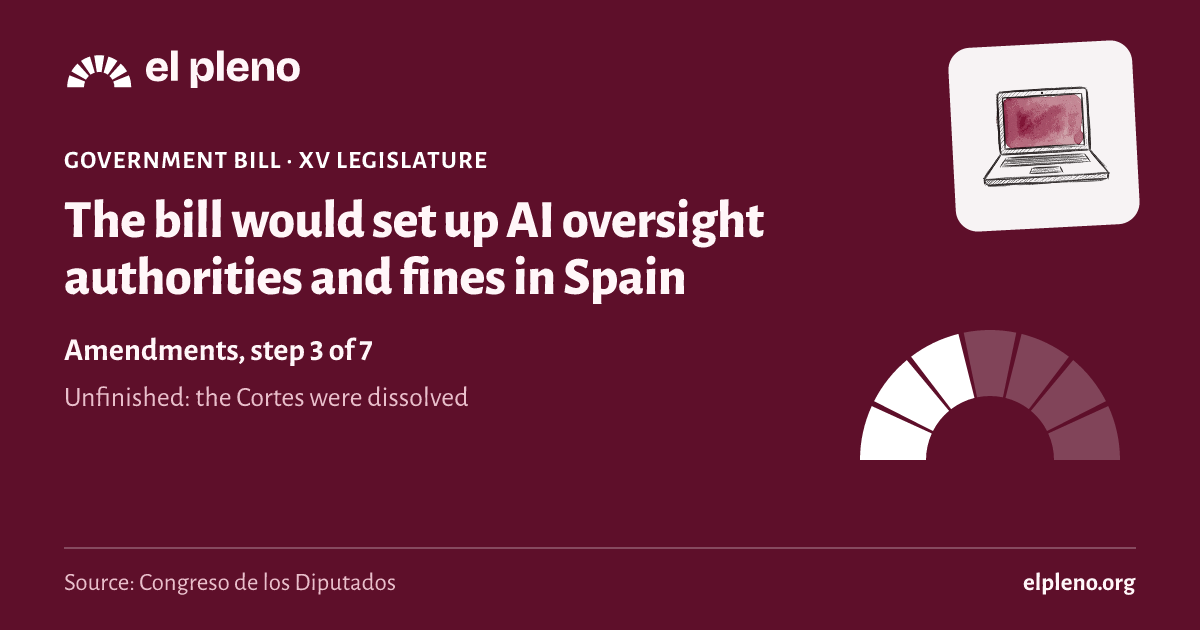
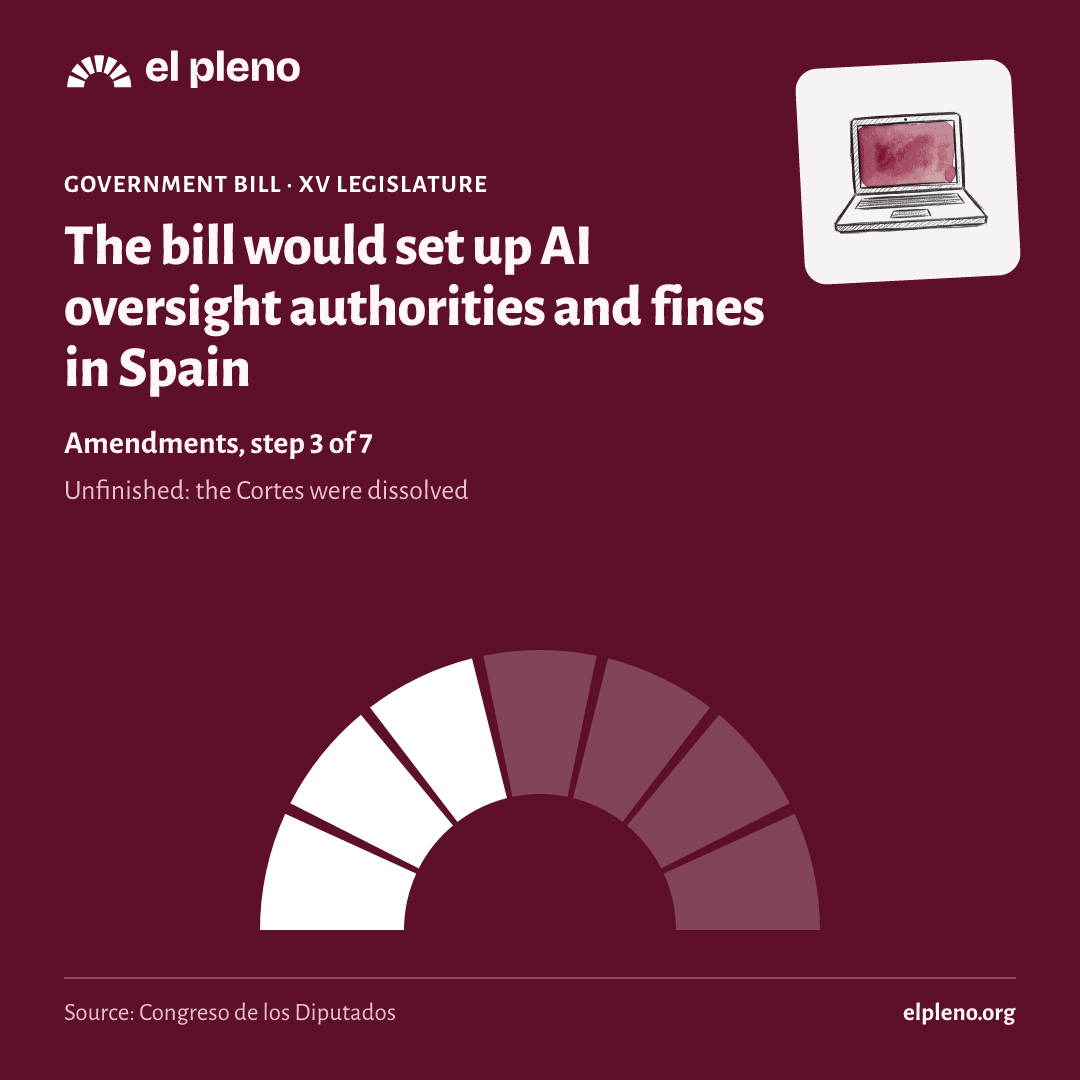
The bill would set up AI oversight authorities and fines in Spain
Amendments step 3 of 7· LapsedIt is a government bill. Introduced by the Government. It was introduced on 28 May 2026. Introduced by: Gobierno.
Official title: Government Organic Bill for the good use and governance of artificial intelligence.
Source: Congreso de los Diputados, file 121/000096· updated 11 Nov
Automatic summary, not yet reviewed
- The bill would adapt Spanish law to the EU Artificial Intelligence Regulation: it designates national oversight authorities and sets a penalty regime for AI systems used in Spain. It affects providers, importers, distributors and those deploying these systems.
- The Directorate General for Artificial Intelligence would be the notifying authority, overseeing bodies that assess system compliance. Market oversight would be shared: AESIA as the general authority, the Spanish Data Protection Agency for biometrics and migration, the General Council of the Judiciary for justice, and the Bank of Spain, the CNMV and the Directorate General for Insurance for financial and insurance systems.
- Anyone could file a complaint with the authorities if they believe the Regulation is being breached, through a single window at AESIA. People who report violations from their job would be protected from retaliation.
- The bill would regulate regulatory sandboxes for AI: environments where innovative systems can be tested before being sold. AESIA would create a mandatory one, and other authorities could create additional ones in their areas.
- State public sector entities would have to disclose the AI systems they use, register them in an inventory, and appoint an AI delegate to coordinate proper use. There are exceptions for defense, national security or cybersecurity.
- Violations would be classified as minor, serious or very serious. Fines would reach up to €35 million or 7% of annual worldwide turnover for very serious ones, such as using prohibited AI practices; minor ones would be capped at €500,000 or 0.5%.
- Penalty proceedings would follow the general administrative procedure law, with resolution deadlines of 18 months for serious violations and 9 for minor ones. Violations would expire after 1, 3 or 5 years depending on severity, and those who acknowledge responsibility could pay with a 25% reduction.
- AESIA would have to be restructured as an independent public entity within six months of the law taking effect. The law would enter into force the day after its publication in the Official State Gazette, though the electoral part would wait for that AESIA restructuring.
Who it affects
- Companies that develop, import, distribute or use AI systems: They would have to comply with the EU AI Regulation and could face fines of up to €35 million or 7% of their turnover.
- Anyone: They could file complaints through AESIA's single window if they believe the Regulation is being breached, and workplace whistleblowers would be protected from retaliation.
- State public sector entities: They would have to disclose the AI systems they use, register them in an inventory and appoint an AI delegate; if they violate the rules they would receive a formal warning instead of fines.
- AESIA, the Spanish Data Protection Agency, the General Council of the Judiciary, the Bank of Spain, the CNMV and other bodies: They would be designated as market oversight or notifying authorities, with supervisory, inspection and penalty powers in their areas.
Words worth knowing
- AESIA
- Agencia Española de Supervisión de Inteligencia Artificial, the Spanish public agency that would oversee AI use.
- Autoridad notificante
- Notifying authority: the body that assesses, designates and supervises the organizations that check whether high-risk AI systems meet requirements.
- Sistema de IA de alto riesgo
- High-risk AI system: an AI system whose use can seriously affect people's health, safety or rights, such as those used in biometrics, education or employment.
- Espacio controlado de pruebas
- Regulatory sandbox: a supervised environment where companies can test innovative AI systems before selling them.
- Multa coercitiva
- Coercive fine: a recurring fine used to force compliance with an order, separate from the fine for the violation itself.
It summarizes the text as it was introduced. It is written by artificial intelligence and may contain mistakes: the official text is what counts. Read the official text · How we make summaries
Where it stands
How far did it get?
It took 3 of 7 steps. It reached Amendments, and today it is lapsed.
- Introduced28 May 2026Someone registers the text in the Congreso.
- Admitted8 June 2026The Bureau of the Congreso accepts it and, for a members’ bill, the plenary decides whether to consider it.
- Amendments12 June 2026Groups propose changes.
- Committeenot reachedA committee goes through the text in detail.
- Plenarynot reachedAll 350 deputies vote.
- Senatenot reachedThe Senate can pass it, amend it or veto it.
- BOEnot reachedIt is published in the Official State Gazette (BOE) and comes into force.
See the 5 official steps on a timeline
Was there a plenary vote?
We have no plenary vote linked to this law in the Congreso’s data.
What happens next
What happens now?
The legislature ended before it finished. To go on, someone would have to introduce it again in the new Cortes.
Sources
Where does all this come from?
- Congreso de los Diputados, file 121/000096
Official title, type, author, dates and stage.
Retrieved 11 November 2026
- Congreso de los Diputados, procedure
The date of each step, with its official wording.
Retrieved 12 November 2026
- The data comes from the open files of the Congreso, the Senate and the BOE, unaltered.
- Each deputy’s province is the one of their seat on the day of the vote.
- We never say “passed” because of a vote: the files do not say which majority was needed.