What it is
Bill to give public management priority in Spanish health care
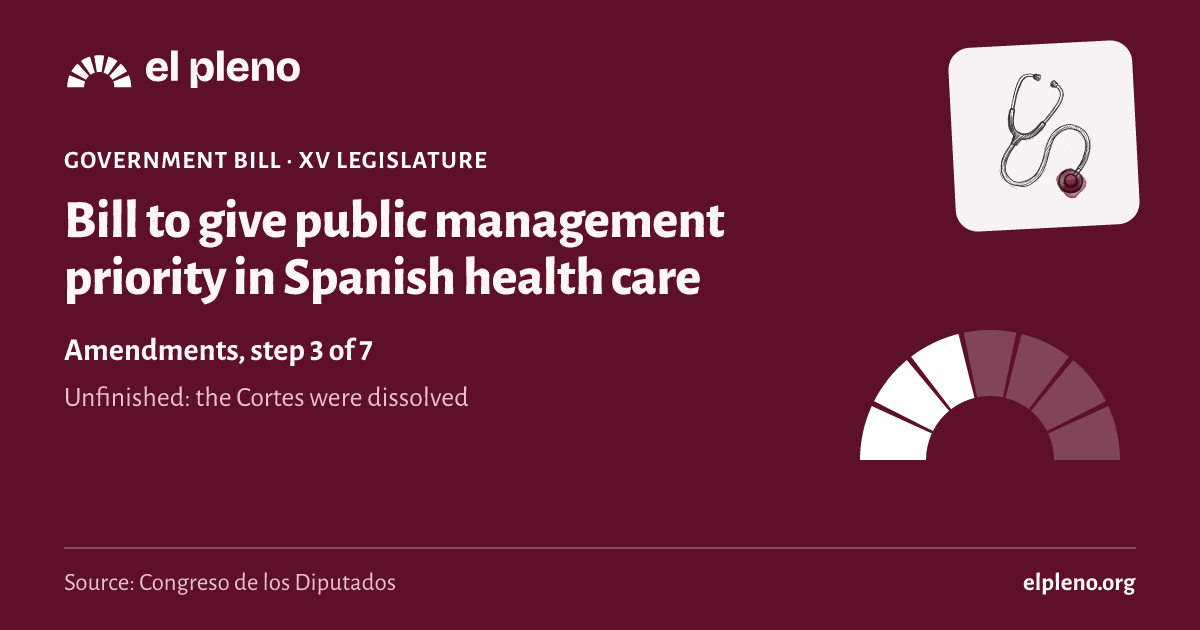
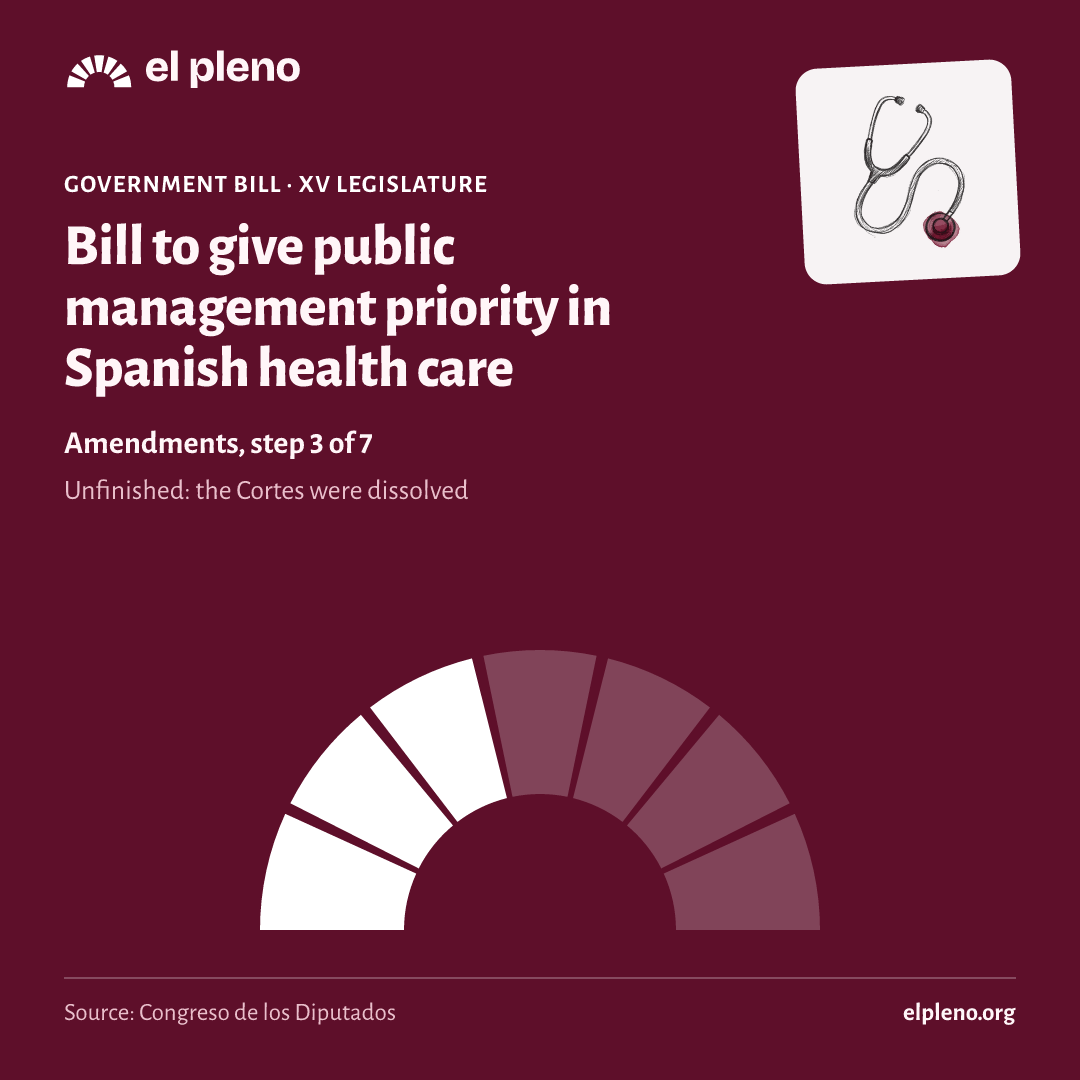
Amendments step 3 of 7· LapsedIt is a government bill. Introduced by the Government. It was introduced on 14 May 2026. Introduced by: Gobierno.
Official title: Government bill on public management and integrity of the National Health System.
Source: Congreso de los Diputados, file 121/000094· updated 11 Nov
Automatic summary, not yet reviewed
- The bill would require health centers and services in the National Health System to be managed publicly and directly, by the administration itself, public entities or consortia. Indirect management, with private participation, would become exceptional.
- Before outsourcing a health service, administrations would have to run a prior evaluation with a report from a collegial body made up of experts, health professionals' representatives and civil society, such as patient organizations. Reports and decisions would be published in the official gazette.
- For service concession contracts, a report from the National Evaluation Office (Oficina Nacional de Evaluación) would be mandatory to check whether the deal is financially sustainable.
- Health consortia would be attached to the health administration of their territory, subject to its budget, accounting and control rules, with an annual audit of their accounts.
- Transparency would be strengthened: periodic publication of data on contracting, agreements, health outcomes and quality, plus annual indicators for every center, whatever its management model. If an external audit is hired, the winning company could not have a conflict of interest with the audited one.
- The bill repeals Law 15/1997, which allowed 'new forms of management', and amends the General Health Law and the public procurement law. In case of a tie in a bidding process, nonprofit entities would get priority. It would take effect twenty days after publication in the 'Boletín Oficial del Estado'.
Who it affects
- Health administrations, which would have to justify any outsourcing of services with a prior evaluation.: They would have to set up evaluation bodies and give reasons for their decisions.
- For-profit private entities, whose role in public health management would be sharply limited.: They could only take part exceptionally and after meeting proven requirements.
- Nonprofit entities, which would win priority in case of a tie in health service tenders.: Their collaboration would be favored over for-profit ones.
- Patients and the public, who would get more public information on contracts, agreements and service quality.: They could take part in oversight and monitoring bodies.
- Private hospitals linked to the public network through special agreements.: They would have to prove their care is free of charge and nonprofit.
Words worth knowing
- Gestión indirecta (indirect management)
- When a public health service is provided by a private entity or through arrangements such as concessions or agreements, instead of by the administration itself.
- Concierto (agreement)
- A deal under which a center, usually private, provides public health services under set conditions.
- Concesión de servicios (service concession)
- A contract under which a company runs a public service for a period of time, under rules set by the administration.
- Órgano colegiado (collegial body)
- A group of several people who meet and decide or report jointly, like a committee.
- Convenio singular (special agreement)
- A specific agreement between the public health system and a private hospital so it treats public patients.
It summarizes the text as it was introduced. It is written by artificial intelligence and may contain mistakes: the official text is what counts. Read the official text · How we make summaries
Where it stands
How far did it get?
It took 3 of 7 steps. It reached Amendments, and today it is lapsed.
- Introduced14 May 2026Someone registers the text in the Congreso.
- Admitted19 May 2026The Bureau of the Congreso accepts it and, for a members’ bill, the plenary decides whether to consider it.
- Amendments22 May 2026Groups propose changes.
- Committeenot reachedA committee goes through the text in detail.
- Plenarynot reachedAll 350 deputies vote.
- Senatenot reachedThe Senate can pass it, amend it or veto it.
- BOEnot reachedIt is published in the Official State Gazette (BOE) and comes into force.
See the 5 official steps on a timeline
Was there a plenary vote?
We have no plenary vote linked to this law in the Congreso’s data.
What happens next
What happens now?
The legislature ended before it finished. To go on, someone would have to introduce it again in the new Cortes.
Sources
Where does all this come from?
- Congreso de los Diputados, file 121/000094
Official title, type, author, dates and stage.
Retrieved 11 November 2026
- Congreso de los Diputados, procedure
The date of each step, with its official wording.
Retrieved 12 November 2026
- The data comes from the open files of the Congreso, the Senate and the BOE, unaltered.
- Each deputy’s province is the one of their seat on the day of the vote.
- We never say “passed” because of a vote: the files do not say which majority was needed.