What it is
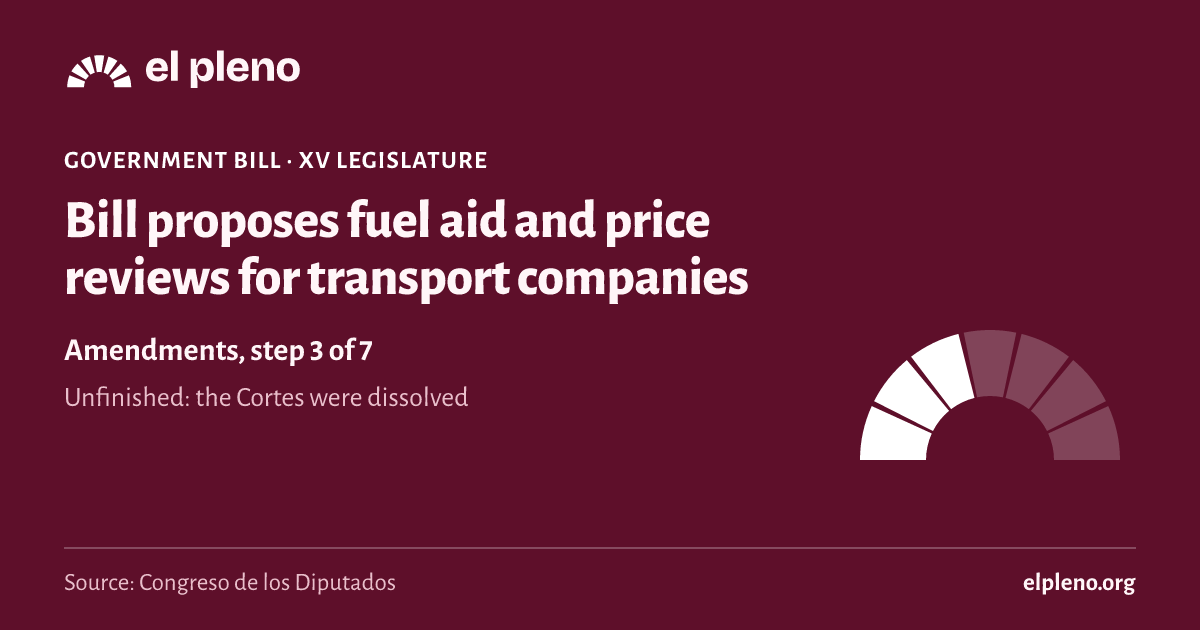
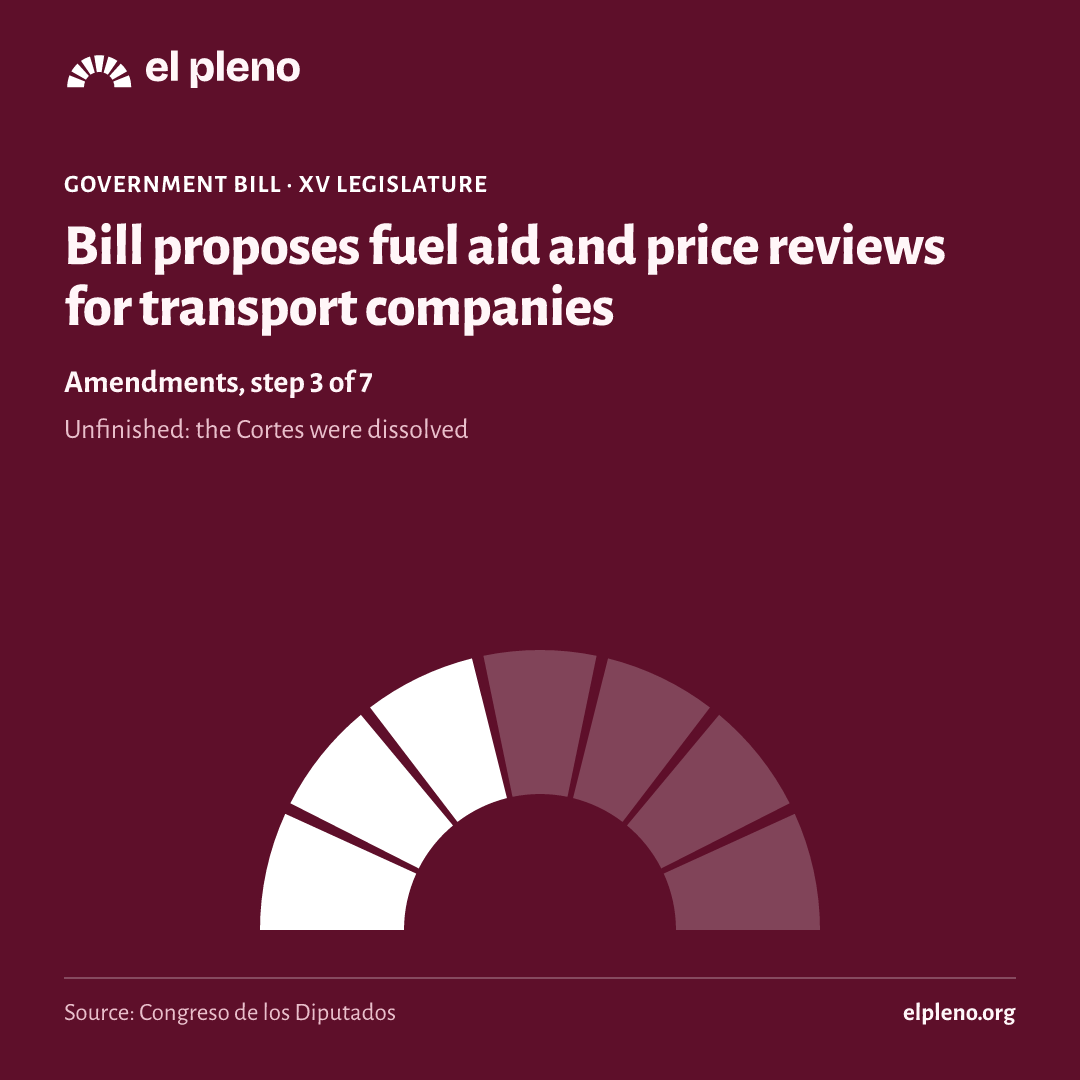
Bill proposes fuel aid and price reviews for transport companies
Amendments step 3 of 7· LapsedIt is a government bill. Introduced by the Government. It was introduced on 30 April 2026. Introduced by: Gobierno.
Official title: Government bill on urgent measures in the field of transport (originating from Royal Decree-Law 9/2026, of April 14).
Source: Congreso de los Diputados, file 121/000093· updated 11 Nov
Automatic summary, not yet reviewed
- The bill would make the review of road transport prices due to fuel price changes mandatory and automatic when the price varies by 5% or more, and the adjustment would always have to be shown itemized on the invoice. Agreements to the contrary would be void.
- It would update the general contracting conditions for road freight transport with a new price review formula based on a coefficient tied to the pre-tax diesel price, which differs by vehicle type. Until June 30, 2026, the calculation may not take into account the aid under Real Decreto-ley 7/2026.
- It would create direct aid for 2026 for rail freight companies: 15,000 euros for each diesel locomotive in operation. To fund this, it approves extraordinary credits totaling 3,150,000 euros in the Ministry of Transport and Sustainable Mobility.
- It would add new violations and fines for those who refuse to show the fuel-related price adjustment itemized on the invoice, with amounts depending on the transport price and higher fines for repeat offenders.
- It would extend the aid under Real Decreto-ley 7/2026 to adapted taxis (eurotaxis) and to regular maritime transport services carrying pure cargo between ports on the mainland, the Balearic and Canary Islands, Ceuta and Melilla, and between ports of the archipelagos. The maritime aid is set at 0.1375266 euro cents per nautical mile per gross ton and is funded with a 37 million euro credit supplement.
- The bill would enter into force the day after its publication in the Official State Gazette (Boletín Oficial del Estado), if it is passed as a law.
Who it affects
- Road freight transport companies: They could review contract prices mandatorily and automatically when diesel prices rise or fall, and see it itemized on the invoice.
- Shippers and parties obliged to pay for transport: They would have to accept the itemized price review on the invoice; refusing would be a punishable violation.
- Rail freight companies: They could receive 15,000 euros per diesel locomotive in operation to offset fuel price increases.
- Owners of adapted taxis (eurotaxis): They would be included in the direct aid to cover the price of energy products.
- Regular cabotage maritime transport companies: They could claim aid per nautical mile, including pure cargo services between ports.
Words worth knowing
- Real decreto-ley (royal decree-law)
- A rule with the force of law that the Government can pass urgently, without prior parliamentary procedure, and which Congress must later validate.
- Porteador (carrier)
- The party responsible for carrying the goods.
- Gasóleo profesional (professional diesel)
- Diesel used in professional transport whose holder can get a partial refund of the hydrocarbons tax.
- Cabotaje (cabotage)
- Shipping between ports of the same country.
- Arqueo bruto (GT) (gross tonnage)
- A measure of a ship's capacity or size.
It summarizes the text as it was introduced. It is written by artificial intelligence and may contain mistakes: the official text is what counts. Read the official text · How we make summaries
Where it stands
How far did it get?
It took 3 of 7 steps. It reached Amendments, and today it is lapsed.
- Introduced30 April 2026Someone registers the text in the Congreso.
- Admitted13 May 2026The Bureau of the Congreso accepts it and, for a members’ bill, the plenary decides whether to consider it.
- Amendments18 May 2026Groups propose changes.
- Committeenot reachedA committee goes through the text in detail.
- Plenarynot reachedAll 350 deputies vote.
- Senatenot reachedThe Senate can pass it, amend it or veto it.
- BOEnot reachedIt is published in the Official State Gazette (BOE) and comes into force.
See the 5 official steps on a timeline
Was there a plenary vote?
We have no plenary vote linked to this law in the Congreso’s data.
What happens next
What happens now?
The legislature ended before it finished. To go on, someone would have to introduce it again in the new Cortes.
Sources
Where does all this come from?
- Congreso de los Diputados, file 121/000093
Official title, type, author, dates and stage.
Retrieved 11 November 2026
- Congreso de los Diputados, procedure
The date of each step, with its official wording.
Retrieved 12 November 2026
- The data comes from the open files of the Congreso, the Senate and the BOE, unaltered.
- Each deputy’s province is the one of their seat on the day of the vote.
- We never say “passed” because of a vote: the files do not say which majority was needed.