What it is
Rules and rights for non-work internships at companies
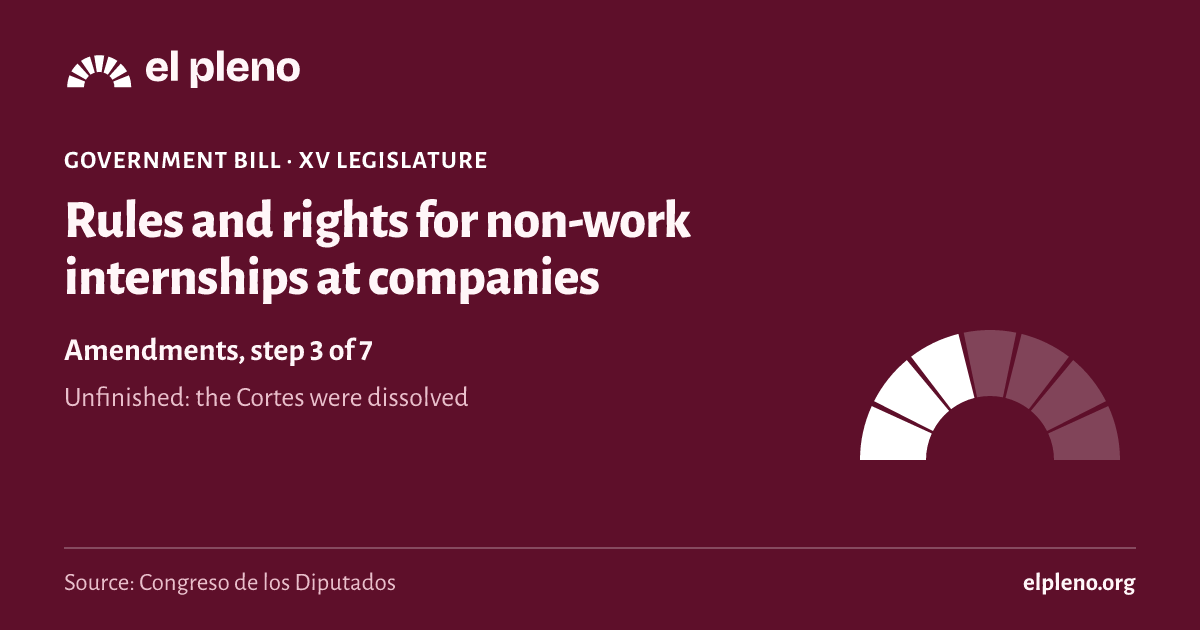
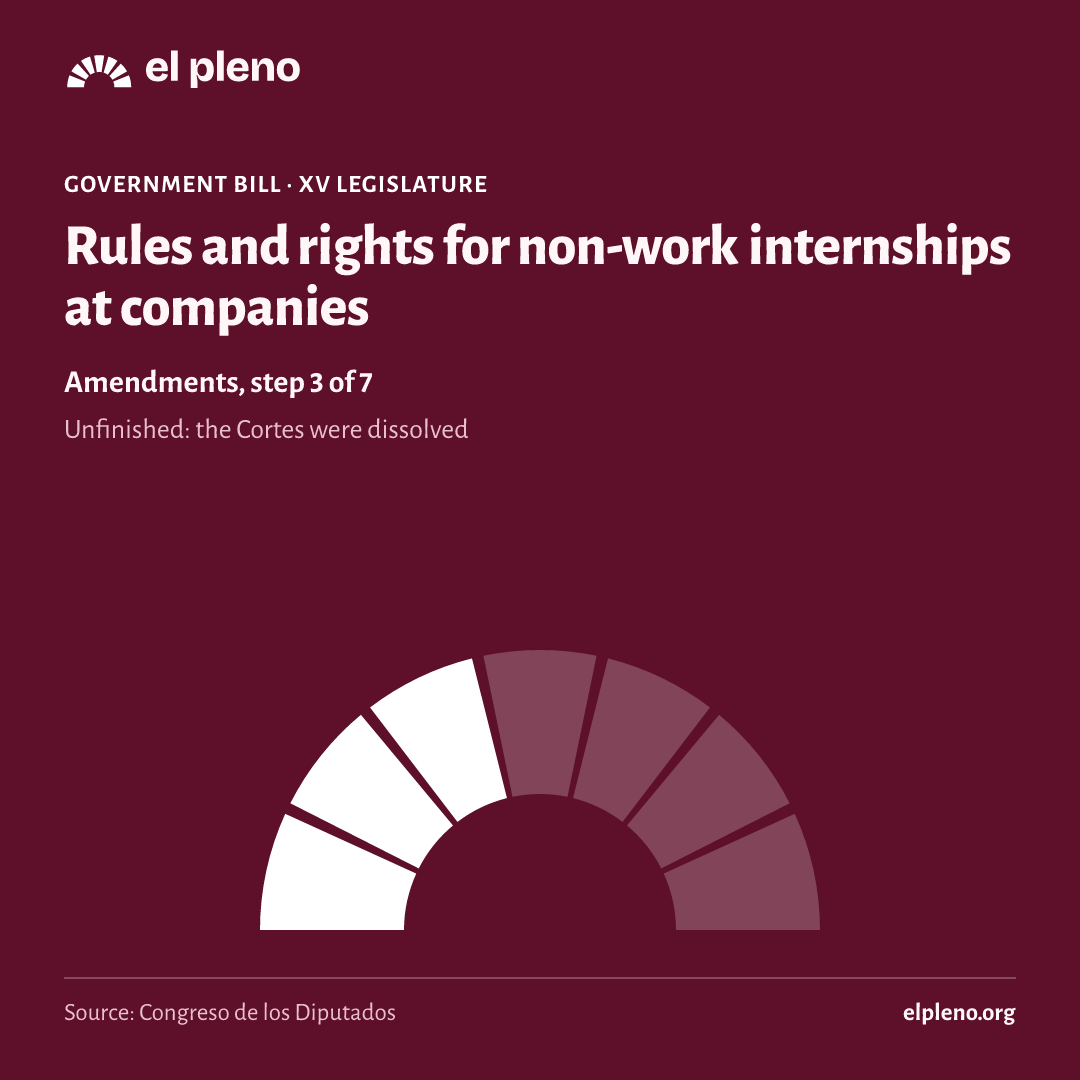
Amendments step 3 of 7· LapsedIt is a government bill. Introduced by the Government. It was introduced on 5 March 2026. Introduced by: Gobierno.
Official title: Government bill on the Statute of persons in non-labor practical training.
Source: Congreso de los Diputados, file 121/000087· updated 11 Nov
Automatic summary, not yet reviewed
- The bill would regulate non-work training internships at companies and organizations and separate them from work activities. It covers vocational training, arts and sports education, national employment system programs, and university curricular and extracurricular internships, with hour limits depending on the type of studies.
- Training at a company would not be an employment relationship as long as the rules are followed. An employment relationship would be presumed if the intern replaces someone in a job position or if the activity has no direct link to the training program. Also, access to these internships could not cost the student any money.
- Internships could only take place under a cooperation agreement between the company and a training center, with minimum content set by law, plus an individual training plan for each student. Tasks must match that plan, with tutoring from both the company and the center, and remote training could not exceed 50% of the total duration.
- Interns would have rights including expense compensation, rest periods and holidays like employees, access to workplace services, protection against violence and harassment, risk prevention, and tutoring. Each tutor could have at most five interns, and interns could not exceed 20% of the site's workforce.
- The company must inform worker representatives in writing about the agreements signed and about the number, conditions, and tutors of interns. Internships would lead, where applicable, to inclusion in the Social Security system under its rules.
- The bill would provide aid and bonuses for companies that tutor interns, a monitoring commission, Labor Inspectorate actions, a penalty regime with fines from €70 to €225,018, and rules for existing agreements and internships, which must adapt before July 31, 2026.
Who it affects
- Companies and entities hosting interns: They must sign agreements, cover expenses, provide tutoring, and respect intern limits; violations bring fines.
- Students doing non-work internships: They would gain rights such as expense compensation, rest periods, harassment protection, and Social Security coverage.
- Training centers and universities: They must sign the agreements and coordinate training with the company.
- Worker representatives: They will receive written information about the agreements and internship conditions.
- Labor Inspectorate (Inspección de Trabajo y Seguridad Social): It will monitor compliance and can sanction violations.
Words worth knowing
- Prácticas no laborales (non-work internships)
- Training activities at a company that, by law, are not an employment contract.
- Falsos becarios (fake interns)
- People made to work like regular staff without a contract or labor rights, under the appearance of a grant.
- Acuerdo o convenio de cooperación (cooperation agreement)
- A document signed by the company and the school to allow internships and set their conditions.
- Créditos ECTS (ECTS credits)
- Units used to measure study workload at university.
It summarizes the text as it was introduced. It is written by artificial intelligence and may contain mistakes: the official text is what counts. Read the official text · How we make summaries
Where it stands
How far did it get?
It took 3 of 7 steps. It reached Amendments, and today it is lapsed.
- Introduced5 March 2026Someone registers the text in the Congreso.
- Admitted10 March 2026The Bureau of the Congreso accepts it and, for a members’ bill, the plenary decides whether to consider it.
- Amendments13 March 2026Groups propose changes.
- Committeenot reachedA committee goes through the text in detail.
- Plenarynot reachedAll 350 deputies vote.
- Senatenot reachedThe Senate can pass it, amend it or veto it.
- BOEnot reachedIt is published in the Official State Gazette (BOE) and comes into force.
See the 5 official steps on a timeline
Was there a plenary vote?
We have no plenary vote linked to this law in the Congreso’s data.
What happens next
What happens now?
The legislature ended before it finished. To go on, someone would have to introduce it again in the new Cortes.
Sources
Where does all this come from?
- Congreso de los Diputados, file 121/000087
Official title, type, author, dates and stage.
Retrieved 11 November 2026
- Congreso de los Diputados, procedure
The date of each step, with its official wording.
Retrieved 12 November 2026
- The data comes from the open files of the Congreso, the Senate and the BOE, unaltered.
- Each deputy’s province is the one of their seat on the day of the vote.
- We never say “passed” because of a vote: the files do not say which majority was needed.