What it is
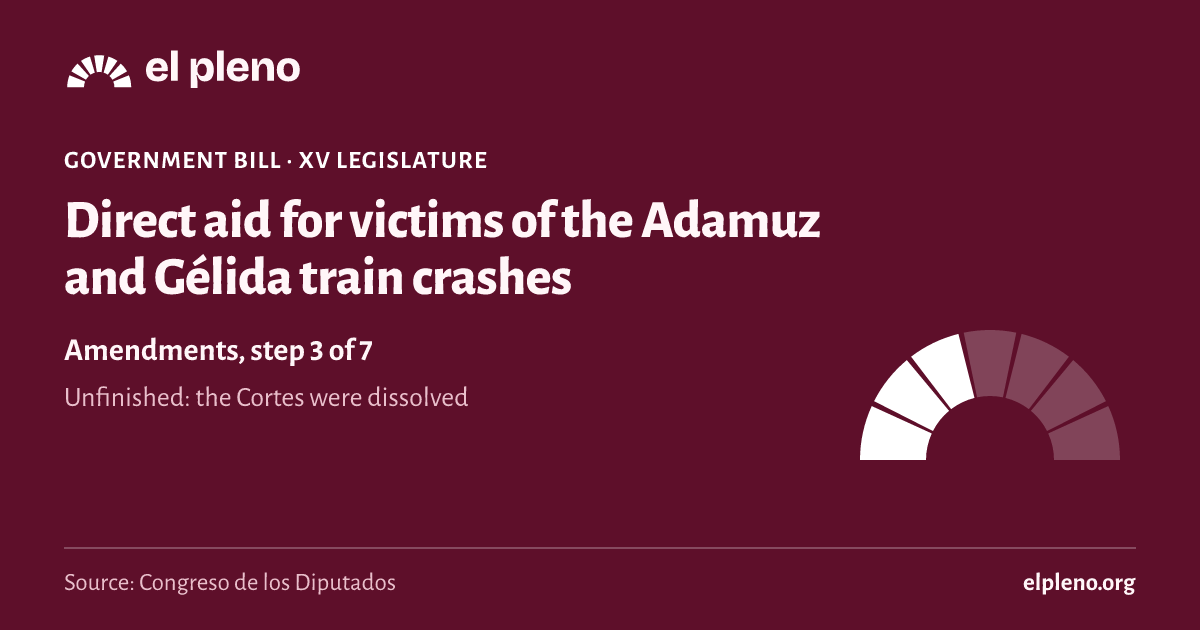
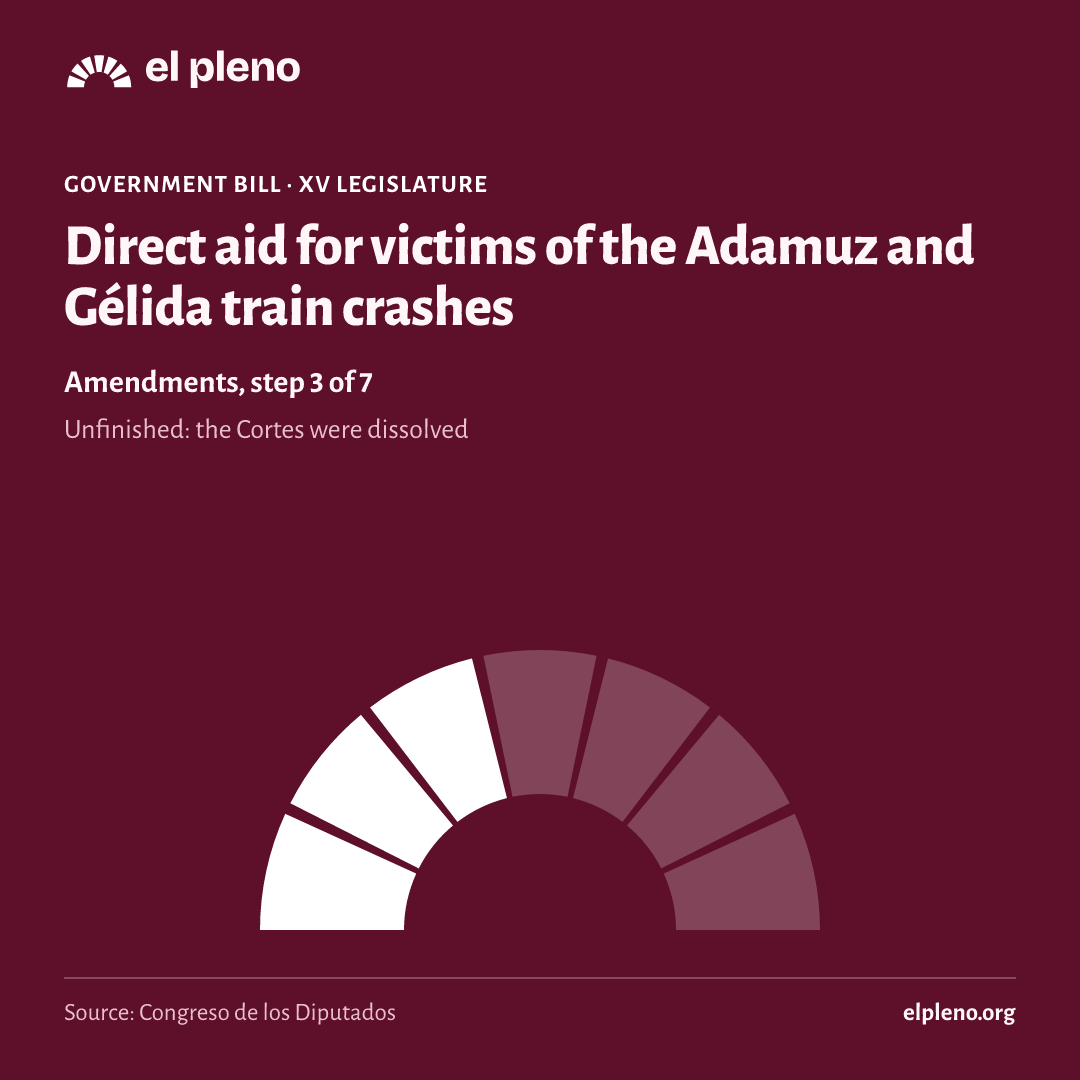
Direct aid for victims of the Adamuz and Gélida train crashes
Amendments step 3 of 7· LapsedIt is a government bill. Introduced by the Government. It was introduced on 26 February 2026. Introduced by: Gobierno.
Official title: Government bill on aid to the victims of the railway accidents in Adamuz (Córdoba) and Gélida (Barcelona) (originating from Royal Decree-Law 1/2026, of January 27).
Source: Congreso de los Diputados, file 121/000085· updated 11 Nov
Automatic summary, not yet reviewed
- The bill would create aid for the victims of the rail accidents in Adamuz (Córdoba), on January 18, 2026, and Gélida (Barcelona), on January 20, 2026. Beneficiaries would be those injured or killed who were traveling or working on the crashed trains, and in case of death also relatives (spouse or partner, children, parents or other ascendants, and siblings, in that order).
- Aid would be €72,121.46 per person killed and, for injuries, amounts between €2,404.04 and €84,141.7 depending on the injury category in an official scale. It would be paid without waiting for a decision on who was responsible for the accident.
- Applications would be filed within three months from publication of the order setting out the procedure. Aid would be granted by resolution of the Secretaría de Estado de Transportes y Movilidad Sostenible and paid in a single payment, with no guarantee required.
- The aid would be compatible with other subsidies and with compensation from insurance and rail sector rules. It would not have to be repaid, would be exempt from personal income tax, and the General Subsidies Law would not apply to it.
- Victims could also request an advance on their future civil liability compensation, in the same amount as the aid. The State would step into the right to collect that compensation: if the final compensation is lower, the difference would not have to be returned, and if it is higher, the victim would receive the excess.
- Comprehensive assistance offices would be set up in Government Delegations and Subdelegations to help process the aid. In addition, workers who could not get to work because of the accidents or service disruptions could not be sanctioned by their employer, and the rail companies would have to give them proof of the disruptions.
Who it affects
- People injured and relatives of those killed in the two accidents: Would receive direct aid of between €2,404.04 and €84,141.7 for injuries, or €72,121.46 for a death, plus the option of an advance on compensation.
- Workers affected by the delays: Could not be sanctioned or harmed in their employment relationship for missing work because of the accidents, and could obtain proof of the disruptions from the rail company.
- Ministry of Transport and Government Delegations: Would process and pay the aid, and would set up comprehensive assistance offices to help victims.
Words worth knowing
- Subrogarse (step into the rights)
- The State takes the victim's place to later claim the compensation from the responsible party, up to the amount of the advance paid.
- Responsabilidad civil (civil liability)
- The obligation to pay for damage caused to others; this is where compensation comes from.
- Baremo (official scale)
- An official table that sets how much is paid for each type of injury or damage.
- Real decreto-ley (royal decree-law)
- A rule with the rank of law that the Government can pass on an urgent basis and that Congress must later approve.
It summarizes the text as it was introduced. It is written by artificial intelligence and may contain mistakes: the official text is what counts. Read the official text · How we make summaries
Where it stands
How far did it get?
It took 3 of 7 steps. It reached Amendments, and today it is lapsed.
- Introduced26 February 2026Someone registers the text in the Congreso.
- Admitted10 March 2026The Bureau of the Congreso accepts it and, for a members’ bill, the plenary decides whether to consider it.
- Amendments13 March 2026Groups propose changes.
- Committeenot reachedA committee goes through the text in detail.
- Plenarynot reachedAll 350 deputies vote.
- Senatenot reachedThe Senate can pass it, amend it or veto it.
- BOEnot reachedIt is published in the Official State Gazette (BOE) and comes into force.
See the 5 official steps on a timeline
Was there a plenary vote?
We have no plenary vote linked to this law in the Congreso’s data.
What happens next
What happens now?
The legislature ended before it finished. To go on, someone would have to introduce it again in the new Cortes.
Sources
Where does all this come from?
- Congreso de los Diputados, file 121/000085
Official title, type, author, dates and stage.
Retrieved 11 November 2026
- Congreso de los Diputados, procedure
The date of each step, with its official wording.
Retrieved 12 November 2026
- The data comes from the open files of the Congreso, the Senate and the BOE, unaltered.
- Each deputy’s province is the one of their seat on the day of the vote.
- We never say “passed” because of a vote: the files do not say which majority was needed.