What it is
Bill proposes discounted and cheap public transport passes for 2026
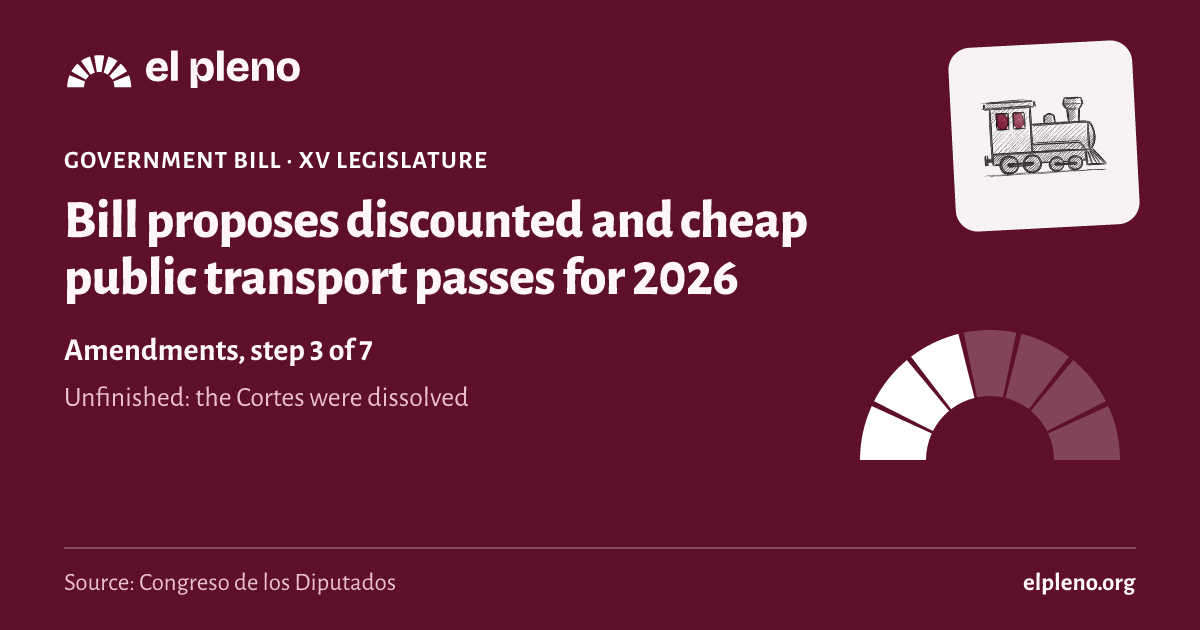
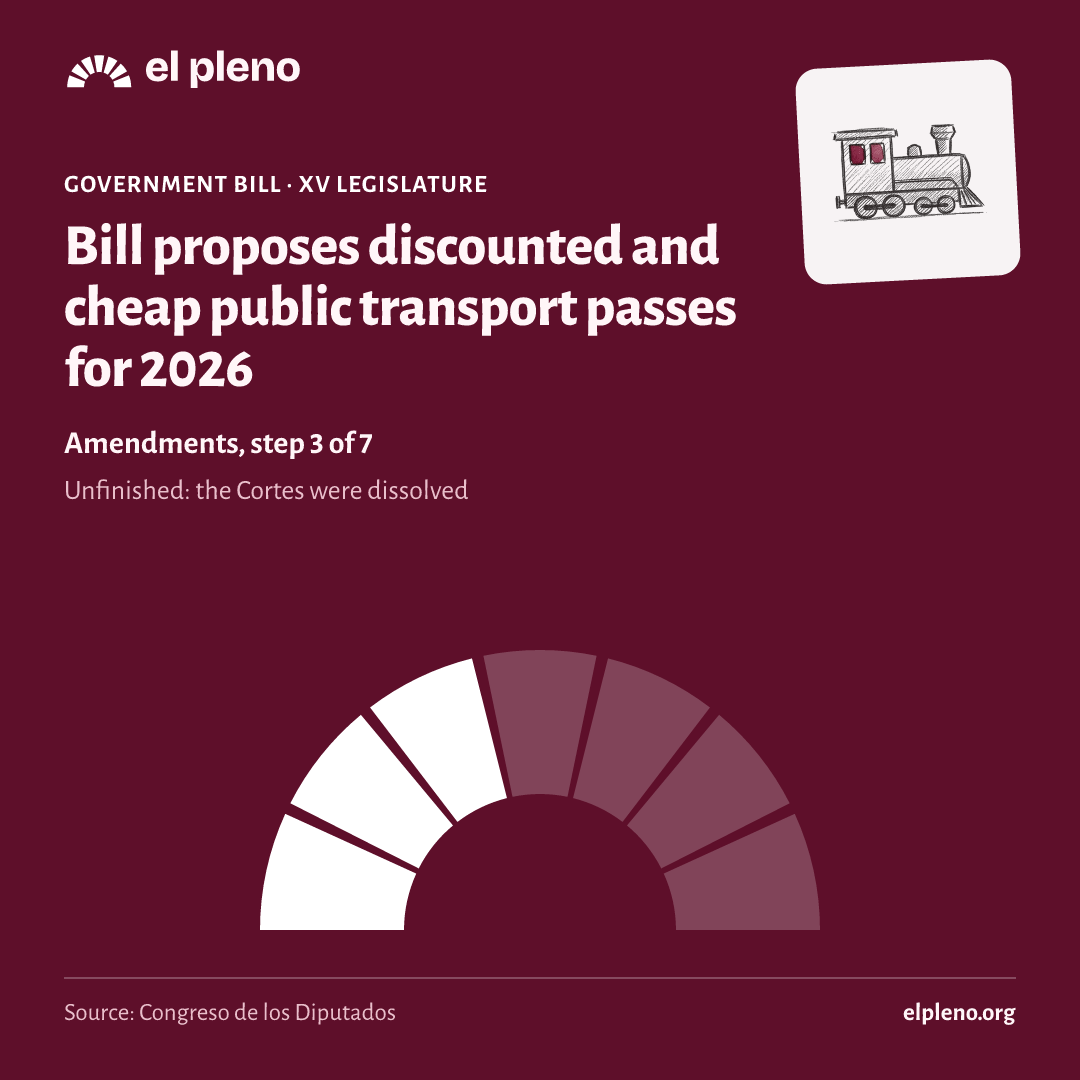
Amendments step 3 of 7· LapsedIt is a government bill. Introduced by the Government. It was introduced on 27 January 2026. Introduced by: Gobierno.
Official title: Government bill on measures to promote the use of public transport through the discounting of passes and multi-ride tickets (originating from Royal Decree-Law 17/2025, of December 23).
Source: Congreso de los Diputados, file 121/000084· updated 11 Nov
Automatic summary, not yet reviewed
- The bill would create discounts on passes and multi-trip tickets on state-run road transport services during 2026: a free pass for children, a 40% discount on a 10-trip pass, a 50% discount on a monthly pass and a 70% discount for young people. It also plans a single-fare pass valid for all origin-destination pairs of these concessions.
- For trains, Renfe Viajeros would create in 2026 a 20-euro monthly pass for all Cercanías and Rodalies networks, a 10-euro one for young people and a free pass for children, plus 40% and 50% discounts on Media Distancia (medium distance) services. A single-fare pass covering all these services is also planned.
- The bill would give direct aid to regional and local governments so they cut their pass and multi-trip ticket prices in 2026: free child tickets, a 50% discount on youth tickets and a 20% discount on the rest, excluding round-trip tickets and tourist tickets.
- The Canary Islands and the Balearic Islands would receive aid to apply a 100% discount on passes for their collective land public transport: 120 million euros for the Canary Islands and 63 million for the Balearic Islands, spread over 2026 and 2027.
- A free multi-trip ticket would be created for frequent users of the Cercanías commuter rail networks in Asturias and Cantabria during each four-month period of 2026.
- The aid would not be governed by the General Subsidies Law, although it would respect its principles of publicity, transparency and equality. The rule would enter into force the day after its publication in the Official State Gazette.
Who it affects
- Frequent users of state-run road transport, including children and young people with larger discounts.: They would pay less for their passes and multi-trip tickets in 2026.
- Users of Renfe's Cercanías, Rodalies and Media Distancia services.: They would have cheap or free monthly passes and discounts in 2026.
- Regional and local governments with urban or interurban transport.: They could apply for state aid to offset the discounts they apply.
- The Canary Islands and the Balearic Islands.: They would receive aid to make their land public transport passes free.
- Road transport concessionaires and Renfe Viajeros.: They would have to create the discounted tickets and would receive payments and settlements from the State.
Words worth knowing
- Abono nominativo
- A transport pass tied to one specific person, which nobody else can use.
- Título multiviaje
- A multi-trip ticket, usually cheaper than buying single tickets.
- Obligación de servicio público
- A transport service the government requires to be provided because it is needed by the public, even if it is not profitable.
- Real decreto-ley
- A rule with the force of law that the Government can adopt on extraordinary and urgent grounds, and which Congress must later validate.
- Usuarios recurrentes
- Frequent transport users, as defined by conditions set in each case.
It summarizes the text as it was introduced. It is written by artificial intelligence and may contain mistakes: the official text is what counts. Read the official text · How we make summaries
Where it stands
How far did it get?
It took 3 of 7 steps. It reached Amendments, and today it is lapsed.
- Introduced27 January 2026Someone registers the text in the Congreso.
- Admitted10 February 2026The Bureau of the Congreso accepts it and, for a members’ bill, the plenary decides whether to consider it.
- Amendments13 February 2026Groups propose changes.
- Committeenot reachedA committee goes through the text in detail.
- Plenarynot reachedAll 350 deputies vote.
- Senatenot reachedThe Senate can pass it, amend it or veto it.
- BOEnot reachedIt is published in the Official State Gazette (BOE) and comes into force.
See the 5 official steps on a timeline
Was there a plenary vote?
We have no plenary vote linked to this law in the Congreso’s data.
What happens next
What happens now?
The legislature ended before it finished. To go on, someone would have to introduce it again in the new Cortes.
Sources
Where does all this come from?
- Congreso de los Diputados, file 121/000084
Official title, type, author, dates and stage.
Retrieved 11 November 2026
- Congreso de los Diputados, procedure
The date of each step, with its official wording.
Retrieved 12 November 2026
- The data comes from the open files of the Congreso, the Senate and the BOE, unaltered.
- Each deputy’s province is the one of their seat on the day of the vote.
- We never say “passed” because of a vote: the files do not say which majority was needed.