What it is
Bill proposes 2.5% raise in 2025 and 1.5% in 2026 for public workers
Amendments step 3 of 7· LapsedIt is a government bill. Introduced by the Government. It was introduced on 11 December 2025. Introduced by: Gobierno.
Official title: Government bill approving urgent measures regarding remuneration in the public sector (originating from Royal Decree-Law 14/2025, of December 2).
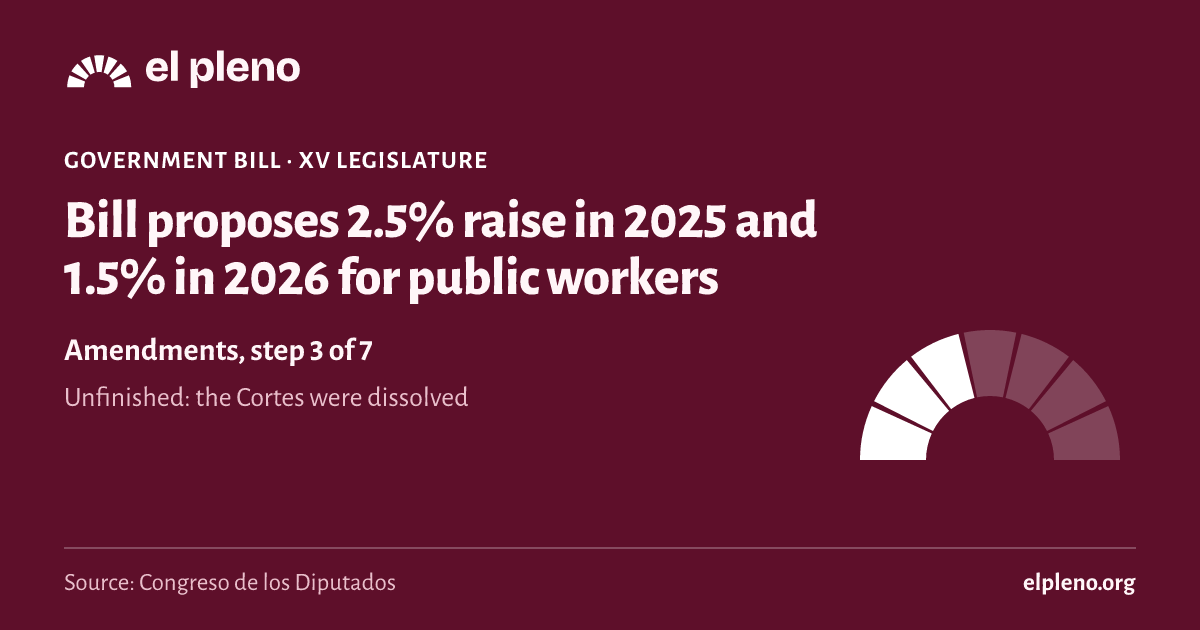
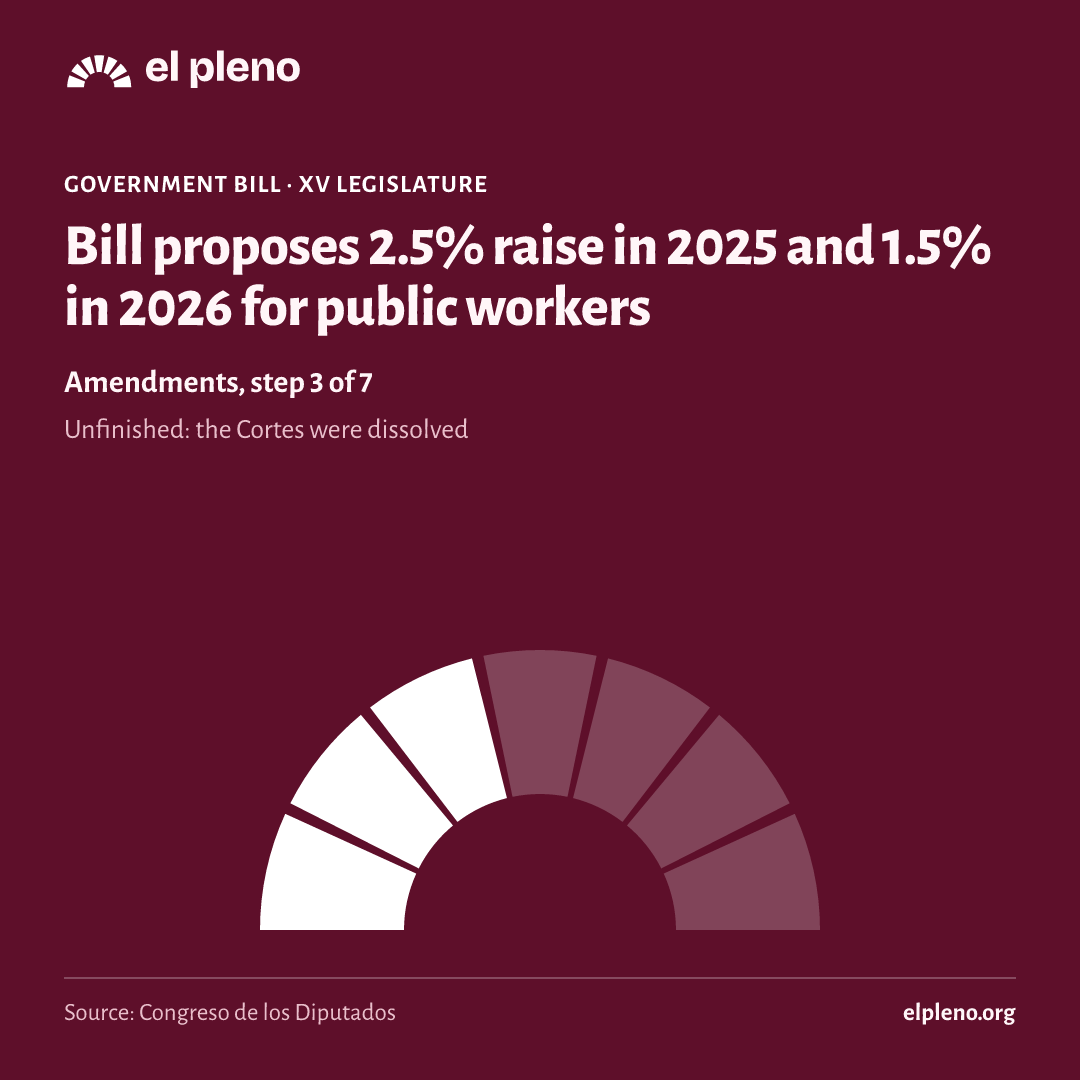
Source: Congreso de los Diputados, file 121/000081· updated 11 Nov
Automatic summary, not yet reviewed
- The bill would allow a maximum pay increase of 2.5% in 2025 for public sector staff, effective January 1, 2025. It would be calculated on the pay in force on December 31, 2024.
- For 2026 it would allow a maximum increase of 1.5% effective January 1, 2026. In addition, if the CPI rises by 1.5% or more in 2026, an extra 0.5% increase would apply, to be paid in the first quarter of 2027.
- Each public administration would set the payment schedule for the 2025 raise and back pay, either spread over 2026 to 2028 or paid in December 2025. In the state public sector it would be paid in December 2025, as back pay from January of that year.
- The State Secretariat for Budgets and Spending could update the amounts and issue payment instructions. The measures are basic state law, so they apply to all public administrations, and the Government may issue rules to implement them. It would take effect the day it is published in the official state gazette (BOE).
Who it affects
- Staff of state, regional and local public sectors: They would receive a 2.5% pay raise in 2025 and 1.5% in 2026, plus a possible extra 0.5% if the 2026 CPI reaches 1.5%.
- Public sector labor employees: Their total wage bill could rise by the same maximum percentages.
- Public administrations: They would set the payment schedule for raises and back pay through union bargaining.
- State Secretariat for Budgets and Spending: It would be empowered to update pay amounts and issue payment instructions at the state level.
Words worth knowing
- Real decreto-ley
- A rule with the force of law that the Government can adopt urgently without prior approval by Congress, though Congress must later validate it.
- Prórroga presupuestaria
- A situation where, because no new budget is passed, the previous year's budget keeps being used.
- IPC
- Spain's Consumer Price Index: it measures how much prices rise.
- Atrasos
- Back pay: a lump sum covering money owed from earlier months that had not yet been paid.
- Consolidable
- A raise that becomes a permanent part of the salary and is not lost the following year.
It summarizes the text as it was introduced. It is written by artificial intelligence and may contain mistakes: the official text is what counts. Read the official text · How we make summaries
Where it stands
How far did it get?
It took 3 of 7 steps. It reached Amendments, and today it is lapsed.
- Introduced11 December 2025Someone registers the text in the Congreso.
- Admitted16 December 2025The Bureau of the Congreso accepts it and, for a members’ bill, the plenary decides whether to consider it.
- Amendments19 December 2025Groups propose changes.
- Committeenot reachedA committee goes through the text in detail.
- Plenarynot reachedAll 350 deputies vote.
- Senatenot reachedThe Senate can pass it, amend it or veto it.
- BOEnot reachedIt is published in the Official State Gazette (BOE) and comes into force.
See the 5 official steps on a timeline
Was there a plenary vote?
We have no plenary vote linked to this law in the Congreso’s data.
What happens next
What happens now?
The legislature ended before it finished. To go on, someone would have to introduce it again in the new Cortes.
Sources
Where does all this come from?
- Congreso de los Diputados, file 121/000081
Official title, type, author, dates and stage.
Retrieved 11 November 2026
- Congreso de los Diputados, procedure
The date of each step, with its official wording.
Retrieved 12 November 2026
- The data comes from the open files of the Congreso, the Senate and the BOE, unaltered.
- Each deputy’s province is the one of their seat on the day of the vote.
- We never say “passed” because of a vote: the files do not say which majority was needed.