What it is
The bill would replace Spain's 1882 criminal procedure law with a new system
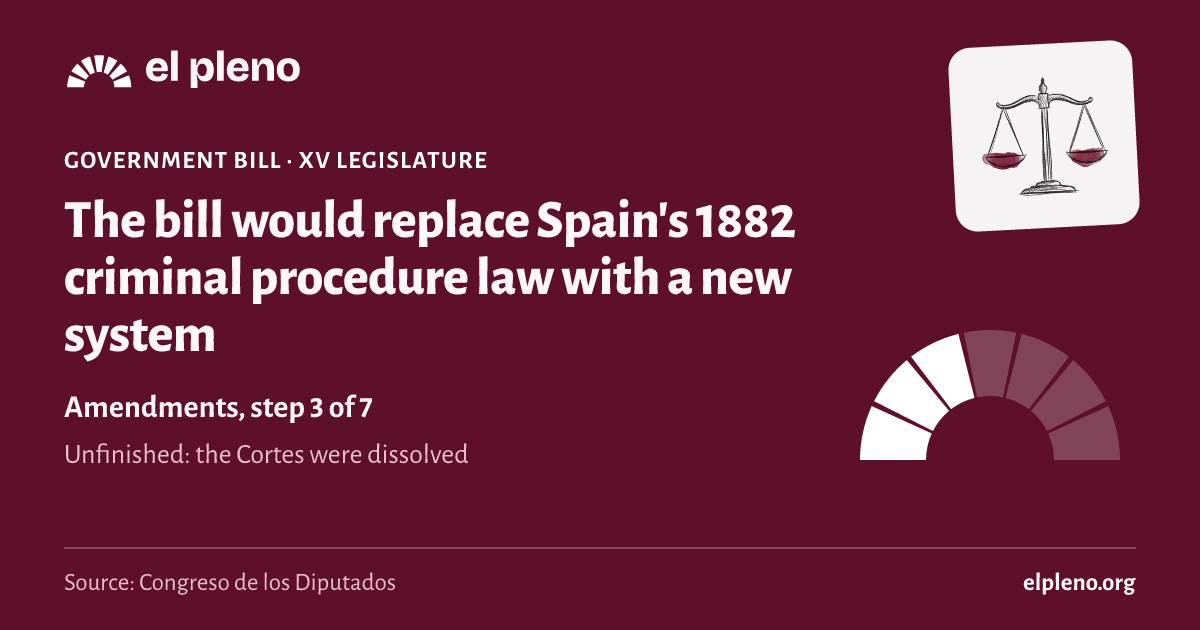
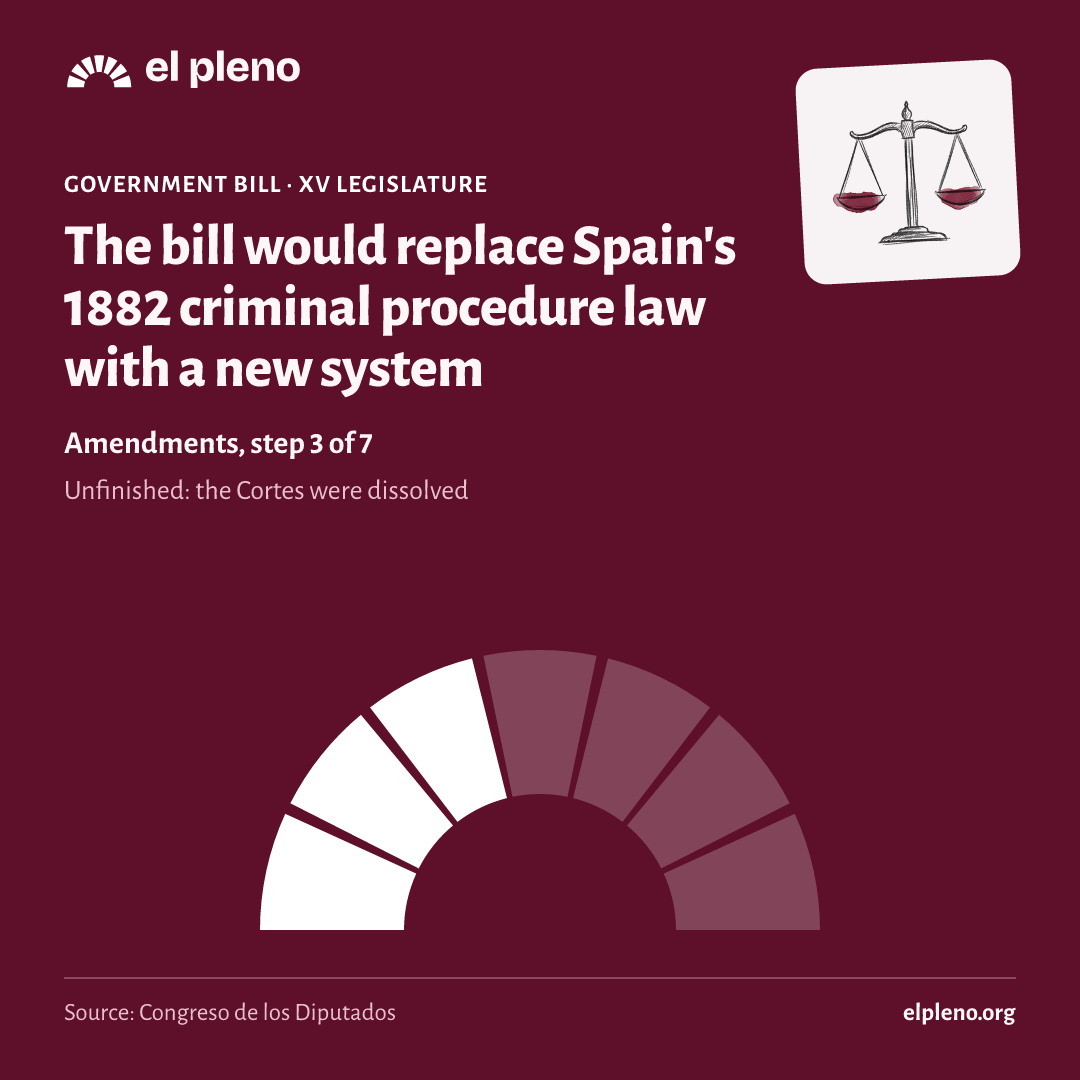
Amendments step 3 of 7· LapsedIt is a government bill. Introduced by the Government. It was introduced on 30 October 2025. Introduced by: Gobierno.
Official title: Government Organic bill on Criminal Procedure.
Source: Congreso de los Diputados, file 121/000074· updated 11 Nov
Automatic summary, not yet reviewed
- The bill would have the Public Prosecutor's Office (Ministerio Fiscal) lead criminal investigations, instead of the current investigating judge. Judges would become impartial guarantors of rights, with no investigative role.
- It would create a Guarantees Judge (Juez de Garantías) to authorize measures affecting fundamental rights (wiretaps, searches, bodily interventions) and to oversee the investigation, without running it.
- The bill would split judicial functions: a Preliminary Hearing Judge (Juez de la Audiencia Preliminar) would decide whether to open trial and screen out unlawful evidence, while other judges would conduct the trial.
- Rights of the accused would be strengthened: defense from the start, access to case files, participation in investigative steps, and the right to remain silent without penalty.
- It would set up a full framework for accused persons with disabilities, with individualized support measures and specific precautionary measures, a gap in current law.
- The bill would introduce the opportunity principle with limits: prosecutors could close or suspend proceedings for crimes punishable by up to three years in prison if conduct rules are met, with judicial oversight and the victim's consent.
- It would expand precautionary measures less severe than prison (bail, no-contact orders, electronic location monitoring, custody) so pretrial detention becomes truly exceptional, with mandatory review every six months.
- Popular accusation would be limited: public administrations, political parties and unions would be excluded, and the prosecutor would have to authorize participation after checking that a general interest is being pursued.
Who it affects
- People investigated or accused in a criminal case: They would have stronger defense rights and a judge with no investigative role protecting their guarantees.
- Victims of crime: They would have recognized rights to information, to be heard and to appeal even without joining the case, and restorative justice could bring them reparation.
- The Public Prosecutor's Office and the police: Prosecutors would lead investigations and the police would be functionally dependent on them.
- Citizens wanting to act as popular accusers: They would face new limits: exclusions by category and prior authorization from the prosecutor.
- Accused persons with disabilities: They would have their own framework with individualized support and adapted precautionary measures.
Words worth knowing
- Encausada
- Spanish term for a person subject to criminal proceedings at any stage (investigated, accused or convicted).
- Medida cautelar
- Precautionary measure: a provisional decision restricting rights (such as detention or seizure) during the case to secure its outcome.
- Prisión provisional
- Pretrial detention: temporary imprisonment before conviction, allowed only as a last resort.
- Principio de oportunidad
- Opportunity principle: the prosecutor's power to drop or suspend a case in certain situations, even if a crime occurred, under conditions set by law.
- Acusación popular
- Popular accusation: the ability of any citizen to act as an accuser in a criminal case, even if not the victim.
It summarizes the text as it was introduced. It is written by artificial intelligence and may contain mistakes: the official text is what counts. Read the official text · How we make summaries
Where it stands
How far did it get?
It took 3 of 7 steps. It reached Amendments, and today it is lapsed.
- Introduced30 October 2025Someone registers the text in the Congreso.
- Admitted11 November 2025The Bureau of the Congreso accepts it and, for a members’ bill, the plenary decides whether to consider it.
- Amendments14 November 2025Groups propose changes.
- Committeenot reachedA committee goes through the text in detail.
- Plenarynot reachedAll 350 deputies vote.
- Senatenot reachedThe Senate can pass it, amend it or veto it.
- BOEnot reachedIt is published in the Official State Gazette (BOE) and comes into force.
See the 5 official steps on a timeline
Was there a plenary vote?
We have no plenary vote linked to this law in the Congreso’s data.
What happens next
What happens now?
The legislature ended before it finished. To go on, someone would have to introduce it again in the new Cortes.
Sources
Where does all this come from?
- Congreso de los Diputados, file 121/000074
Official title, type, author, dates and stage.
Retrieved 11 November 2026
- Congreso de los Diputados, procedure
The date of each step, with its official wording.
Retrieved 12 November 2026
- The data comes from the open files of the Congreso, the Senate and the BOE, unaltered.
- Each deputy’s province is the one of their seat on the day of the vote.
- We never say “passed” because of a vote: the files do not say which majority was needed.