What it is
Bill would allow claims for damages from EU law violations
Amendments step 3 of 7· LapsedIt is a government bill. Introduced by the Government. It was introduced on 9 October 2025. Introduced by: Gobierno.
Official title: Government bill for the partial amendment of Law 39/2015, of October 1, on the Common Administrative Procedure of Public Administrations, and of Law 40/2015, of October 1, on the Legal Regime of the Public Sector, in matters of patrimonial responsibility of the legislating State for damages derived from the infringement of European Union Law.
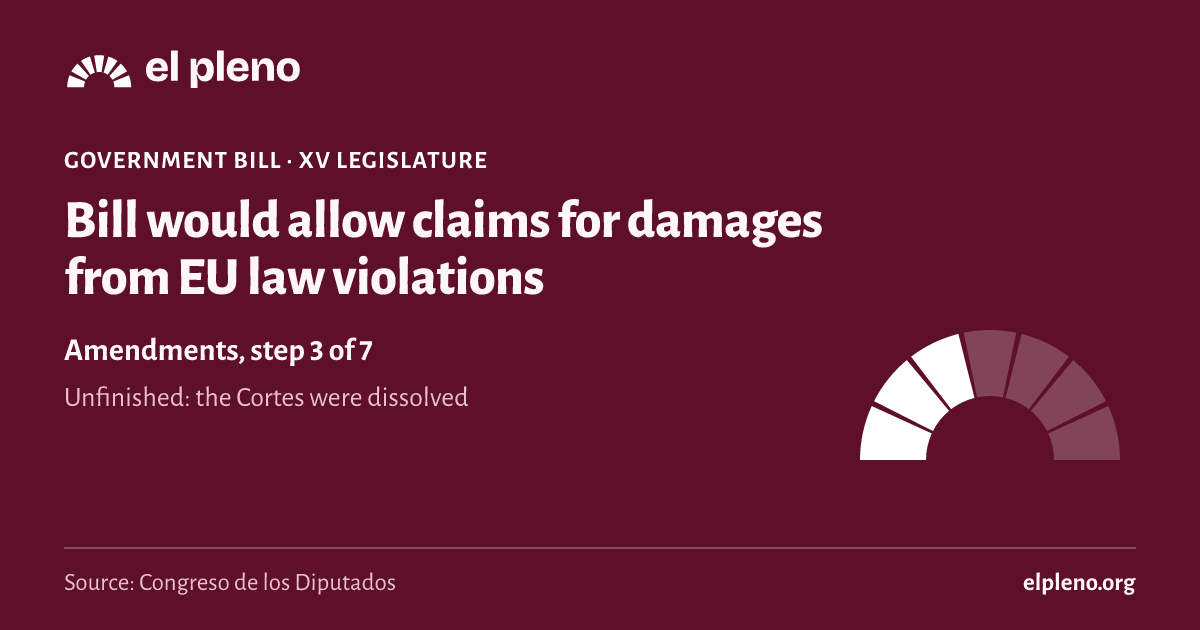
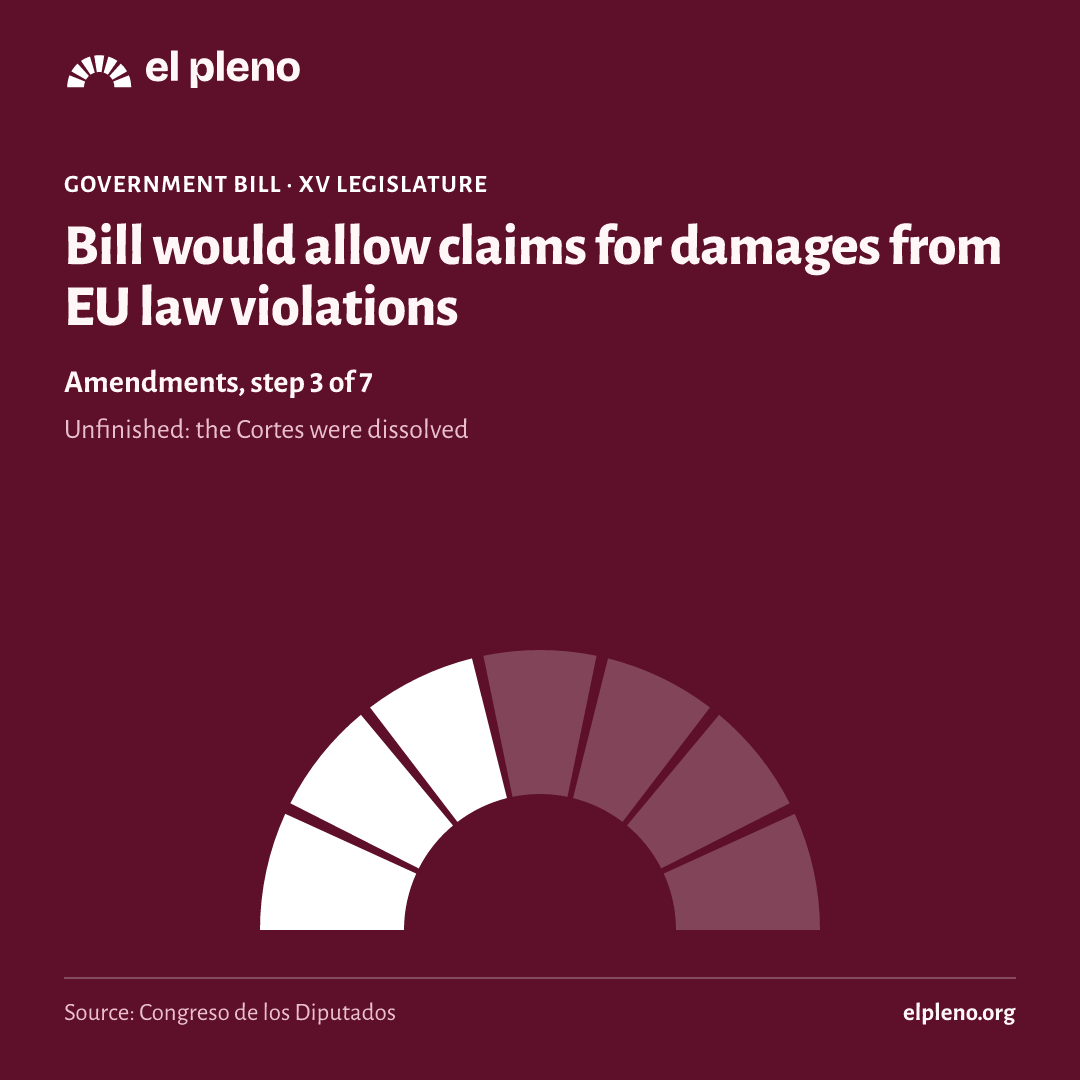
Source: Congreso de los Diputados, file 121/000071· updated 11 Nov
Automatic summary, not yet reviewed
- The bill would create a specific system to claim compensation from public authorities when a rule or action violates European Union law, in a new Article 32 bis of Law 40/2015. For compensation, the rule must confer rights on individuals, the breach must be sufficiently serious, and there must be a direct causal link with the damage.
- It would set out three situations for claims: against administrative actions applying a rule contrary to EU law, when there is no challengeable administrative action, and when the Court of Justice of the EU or the Spanish Supreme Court later declares the violation after the person's appeal or claim was finally dismissed.
- The right to claim would expire after one year. Depending on the case, the period would run from notification of the decision recognizing the violation, from when the harmful effects appear, or from publication of the Supreme Court or EU Court ruling declaring the violation.
- When damages are attributed to State bodies, the Council of Ministers would decide claims in the situations where there is no challengeable action and where a later court ruling declares the violation.
- People who claimed on time and saw their request finally dismissed would be entitled to compensation covering the damages they actually claimed and that had not expired, if a Supreme Court or EU Court ruling later declares the violation.
- Pending proceedings for damages from EU law violations would be handled under the new rules once the law takes effect. The law would enter into force twenty days after its publication in the Official State Gazette.
Who it affects
- Individuals who suffer damage from rules or actions that violate European Union law.: They could claim compensation through the channels the bill would create.
- People who already claimed and received a final dismissal ruling.: They could receive compensation if a Supreme Court or EU Court ruling later declares the violation.
- Public authorities.: They would have to process and decide these compensation claims.
- The Council of Ministers (Consejo de Ministros).: It would decide claims for damages attributed to State bodies in certain cases.
Words worth knowing
- Responsabilidad patrimonial
- The right to compensation from a public authority for damage caused by how it operates.
- Estado legislador
- State liability for damage caused by a law or rule with the rank of law.
- Sentencia firme
- A court ruling against which no further appeal is possible.
- Prescripción
- Loss of the right to claim once the period set by law has passed.
- Cuestión prejudicial
- A question a Spanish judge sends to the Court of Justice of the EU about how to interpret EU law.
It summarizes the text as it was introduced. It is written by artificial intelligence and may contain mistakes: the official text is what counts. Read the official text · How we make summaries
Where it stands
How far did it get?
It took 3 of 7 steps. It reached Amendments, and today it is lapsed.
- Introduced9 October 2025Someone registers the text in the Congreso.
- Admitted14 October 2025The Bureau of the Congreso accepts it and, for a members’ bill, the plenary decides whether to consider it.
- Amendments17 October 2025Groups propose changes.
- Committeenot reachedA committee goes through the text in detail.
- Plenarynot reachedAll 350 deputies vote.
- Senatenot reachedThe Senate can pass it, amend it or veto it.
- BOEnot reachedIt is published in the Official State Gazette (BOE) and comes into force.
See the 5 official steps on a timeline
Was there a plenary vote?
We have no plenary vote linked to this law in the Congreso’s data.
What happens next
What happens now?
The legislature ended before it finished. To go on, someone would have to introduce it again in the new Cortes.
Sources
Where does all this come from?
- Congreso de los Diputados, file 121/000071
Official title, type, author, dates and stage.
Retrieved 11 November 2026
- Congreso de los Diputados, procedure
The date of each step, with its official wording.
Retrieved 12 November 2026
- The data comes from the open files of the Congreso, the Senate and the BOE, unaltered.
- Each deputy’s province is the one of their seat on the day of the vote.
- We never say “passed” because of a vote: the files do not say which majority was needed.