What it is
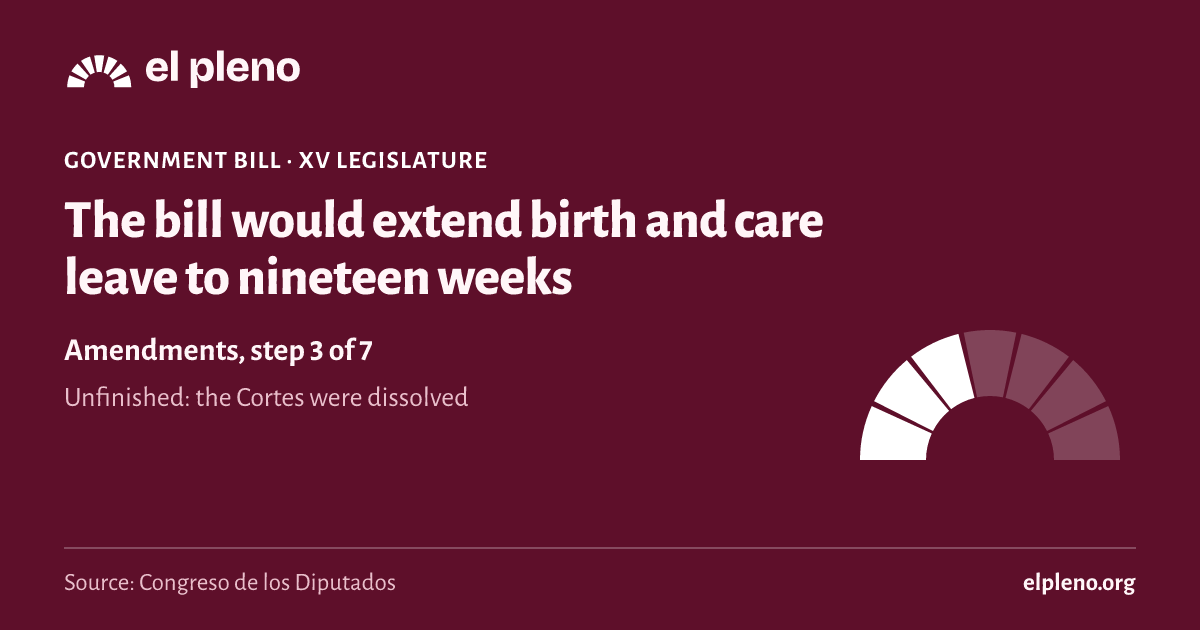
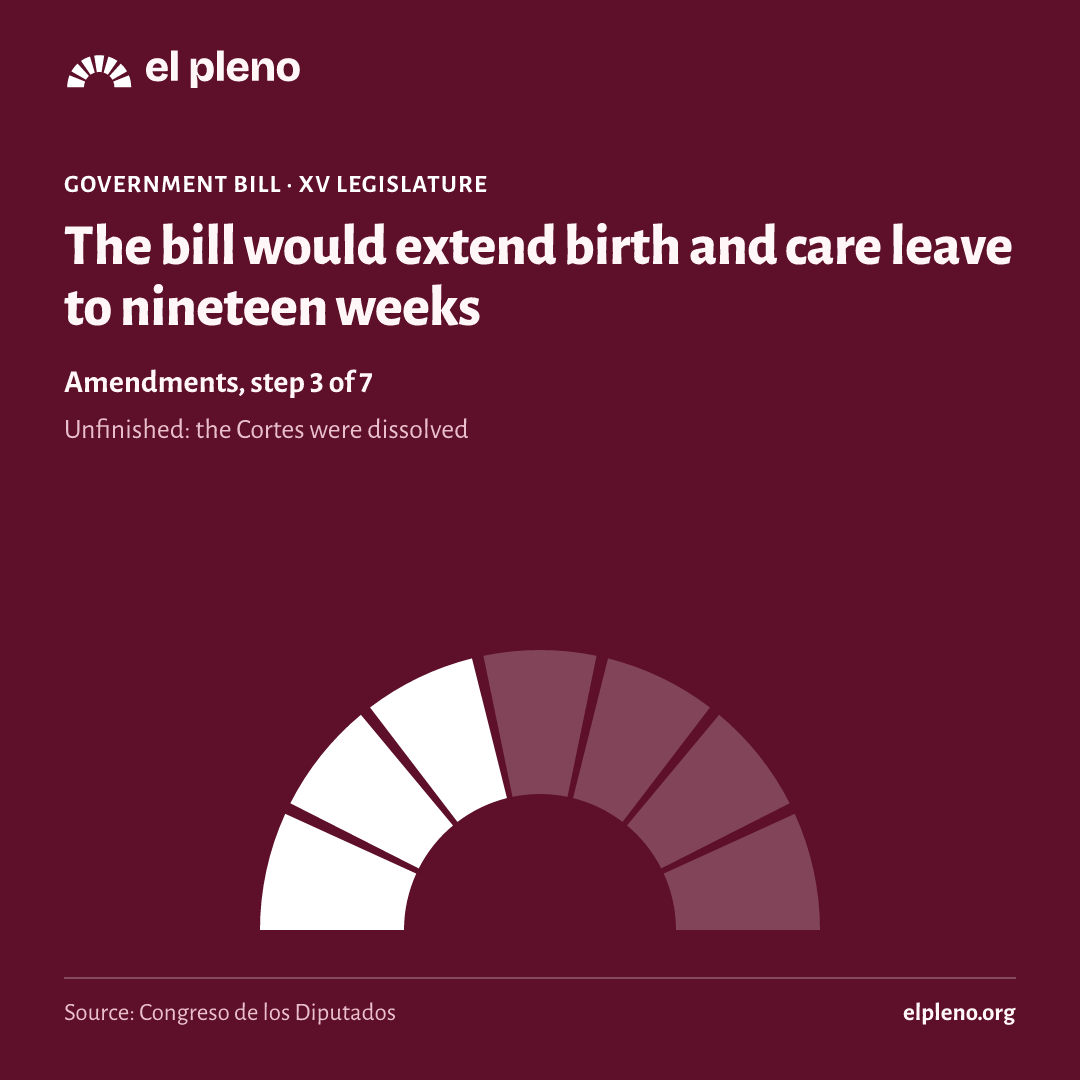
The bill would extend birth and care leave to nineteen weeks
Amendments step 3 of 7· LapsedIt is a government bill. Introduced by the Government. It was introduced on 9 September 2025. Introduced by: Gobierno.
Official title: Government bill extending the birth and care leave, through the amendment of the consolidated text of the Workers' Statute, approved by Royal Legislative Decree 2/2015, of October 23, the consolidated text of the Basic Statute of the Public Employee, approved by Royal Legislative Decree 5/2015, of October 30, and the consolidated text of the General Social Security Law, approved by Royal Legislative Decree 8/2015, of October 30, to complete the transposition of Directive (EU) 2019/1158 of the European Parliament and of the Council, of June 20, 2019, on the reconciliation of family life and working life of parents and carers, and repealing Council Directive 2010/18/EU (originating from Royal Decree-Law 9/2025, of July 29).
Source: Congreso de los Diputados, file 121/000069· updated 11 Nov
Automatic summary, not yet reviewed
- The bill would extend birth, adoption, foster-to-adopt and foster care leave to nineteen weeks for each parent, adoptive parent, guardian or foster carer. In one-parent families, the leave would last thirty-two weeks.
- The leave would be split into three blocks: six mandatory, uninterrupted weeks at full time right after birth or the court decision; eleven weeks that each worker could schedule freely until the child turns twelve months; and two weeks of parental care that could be used until the child turns eight. In one-parent families, the last two blocks would be twenty-two and four weeks.
- The leave would be individual and could not be transferred between parents. For multiple births or adoptions, or when the child has a disability, two extra weeks would be added in total, one for each parent.
- In the public sector, parental leave to care for a child up to age eight would remain unpaid, with a maximum duration of eight weeks, continuous or not.
- Under Social Security rules, workers would need to be registered or in an equivalent situation at the start of each leave period. The birth subsidy for people with insufficient contributions would be extended by fourteen calendar days in cases such as large families, one-parent families, multiple births or disability.
- The two weeks of parental care usable until the child turns eight (four in one-parent families) would apply retroactively to cases arising from August 2, 2024, and could be requested from January 1, 2026 without a new recognition of the right.
Who it affects
- Employees who are biological parents, adoptive parents, guardians or foster carers: They would get longer, more flexible leave: nineteen weeks, or thirty-two in one-parent families.
- One-parent families: They would receive extended leave of thirty-two weeks to match two-parent families.
- Public sector employees: The same leave durations would apply to them, and the unpaid eight-week parental leave would be clarified.
- Workers with insufficient Social Security contributions: They could access the birth subsidy under updated rules, with fourteen extra days in certain cases.
- Employers and public administrations: They would manage fifteen-day advance notices and could limit simultaneous leave by both parents for justified, written reasons.
Words worth knowing
- Guarda con fines de adopción
- A measure by which a court or administration places a child in the care of a person or family while a possible adoption is processed.
- Acogimiento
- Foster care: a family cares for a child without adopting them, temporarily or permanently.
- Suspensión del contrato
- Suspension of the employment contract: a period when the worker does not work or earn wages but keeps their job.
- Subsidio
- A Social Security payment for people who do not meet all the requirements of the standard benefit, such as the minimum contribution period.
- Base reguladora
- The reference amount used to calculate how much a benefit pays, based on contribution bases.
It summarizes the text as it was introduced. It is written by artificial intelligence and may contain mistakes: the official text is what counts. Read the official text · How we make summaries
Where it stands
How far did it get?
It took 3 of 7 steps. It reached Amendments, and today it is lapsed.
- Introduced9 September 2025Someone registers the text in the Congreso.
- Admitted16 September 2025The Bureau of the Congreso accepts it and, for a members’ bill, the plenary decides whether to consider it.
- Amendments19 September 2025Groups propose changes.
- Committeenot reachedA committee goes through the text in detail.
- Plenarynot reachedAll 350 deputies vote.
- Senatenot reachedThe Senate can pass it, amend it or veto it.
- BOEnot reachedIt is published in the Official State Gazette (BOE) and comes into force.
See the 5 official steps on a timeline
Was there a plenary vote?
We have no plenary vote linked to this law in the Congreso’s data.
What happens next
What happens now?
The legislature ended before it finished. To go on, someone would have to introduce it again in the new Cortes.
Sources
Where does all this come from?
- Congreso de los Diputados, file 121/000069
Official title, type, author, dates and stage.
Retrieved 11 November 2026
- Congreso de los Diputados, procedure
The date of each step, with its official wording.
Retrieved 12 November 2026
- The data comes from the open files of the Congreso, the Senate and the BOE, unaltered.
- Each deputy’s province is the one of their seat on the day of the vote.
- We never say “passed” because of a vote: the files do not say which majority was needed.