What it is
Bill to regulate companies that buy and manage non-performing loans
Amendments step 3 of 7· LapsedIt is a government bill. Introduced by the Government. It was introduced on 5 March 2025. Introduced by: Gobierno.
Official title: Government bill on debt administrators and buyers and amending the Law on Measures for the Reform of the Financial System, the Law on consumer credit contracts, the Law on the organization, supervision and solvency of credit institutions, the Law regulating real estate credit contracts, and the consolidated text of the Insolvency Law.
Source: Congreso de los Diputados, file 121/000049· updated 11 Nov
Automatic summary, not yet reviewed
- The bill would make servicing non-performing loans a reserved activity: only companies authorized by the Bank of Spain could do it, along with credit institutions and financial credit establishments, which would not need extra authorization.
- It sets the requirements for authorization: a company based in Spain, honorable and experienced directors, internal control systems, data protection and complaint procedures. The Bank of Spain would decide within 90 calendar days at most and could revoke the authorization if requirements stop being met.
- Some authorized companies could receive and hold borrowers' funds to forward them to loan buyers, always through a separate account at a credit institution. Those funds would be protected even if the company goes into insolvency.
- When a non-performing loan is sold, the borrower must receive a notice, before the first collection of the debt, with the details of the buyer and the servicer, what is owed and where to complain. Companies must treat borrowers in good faith, without harassment or misleading information.
- The sale of the loan would not reduce the borrower's protection: consumer rules and the good practice codes the selling entity signed up to would keep applying, and seller and buyer must agree on the least burdensome way to safeguard those rights.
- Loan buyers would have to appoint an authorized loan servicer when the loans were made to consumers, and buyers from outside the European Union would also have to appoint a representative in the Union who answers to the Bank of Spain.
- The Bank of Spain would be the supervisor and enforcer: it could demand corrective measures, remove unfit directors and impose fines. Violations would be classified as minor, serious or very serious; operating without authorization or collecting funds without being authorized would be very serious.
- The bill would also amend other laws: lenders would need debt renegotiation policies and, if they sell loans of borrowers in economic vulnerability, they would have to offer a payment plan with frozen interest and partial debt forgiveness. It would enter into force twenty days after publication, with exceptions.
Who it affects
- People whose loan has been sold to a third party: They would receive a notice with the new owner's and servicer's details, could complain for free and would keep their previous rights and protections.
- Companies that buy or service non-performing loans: They would need Bank of Spain authorization, registration, and would have to meet information, borrower treatment and complaint obligations.
- Banks and financial credit establishments: As sellers, they would have to give information to the buyer and the Bank of Spain; as servicers, they would be subject to part of the new regime without extra authorization.
- Lenders in general: They would need debt renegotiation policies and would have to offer payment plans with debt forgiveness to vulnerable borrowers whose loans are sold.
Words worth knowing
- Crédito dudoso (non-performing loan)
- A loan the bank considers at high risk of not being repaid, under European accounting rules.
- Administrador de créditos (loan servicer)
- An authorized company that collects, renegotiates and manages non-performing loans on behalf of the buyer.
- Comprador de créditos (loan buyer)
- A person or company that buys non-performing loans to profit from recovering them; not a bank or financial credit establishment.
- Establecimiento financiero de crédito (financial credit establishment)
- A financial entity that grants credit but, unlike a bank, cannot take deposits from the public.
- Quita (debt forgiveness)
- A portion of the debt the creditor agrees not to collect.
It summarizes the text as it was introduced. It is written by artificial intelligence and may contain mistakes: the official text is what counts. Read the official text · How we make summaries
Where it stands
How far did it get?
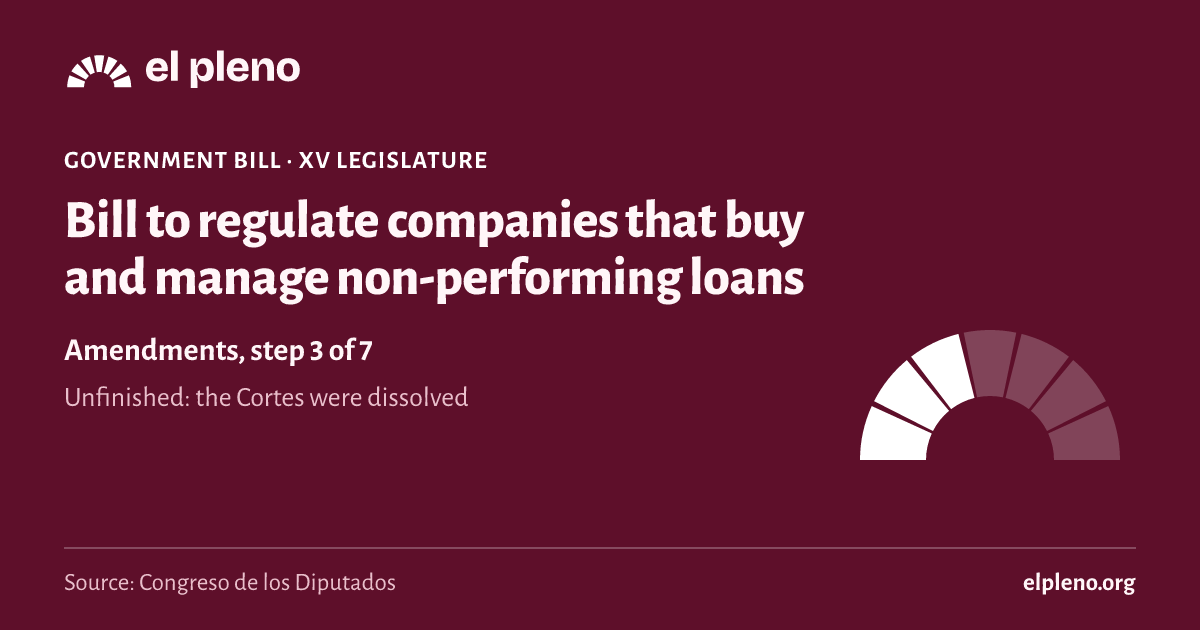
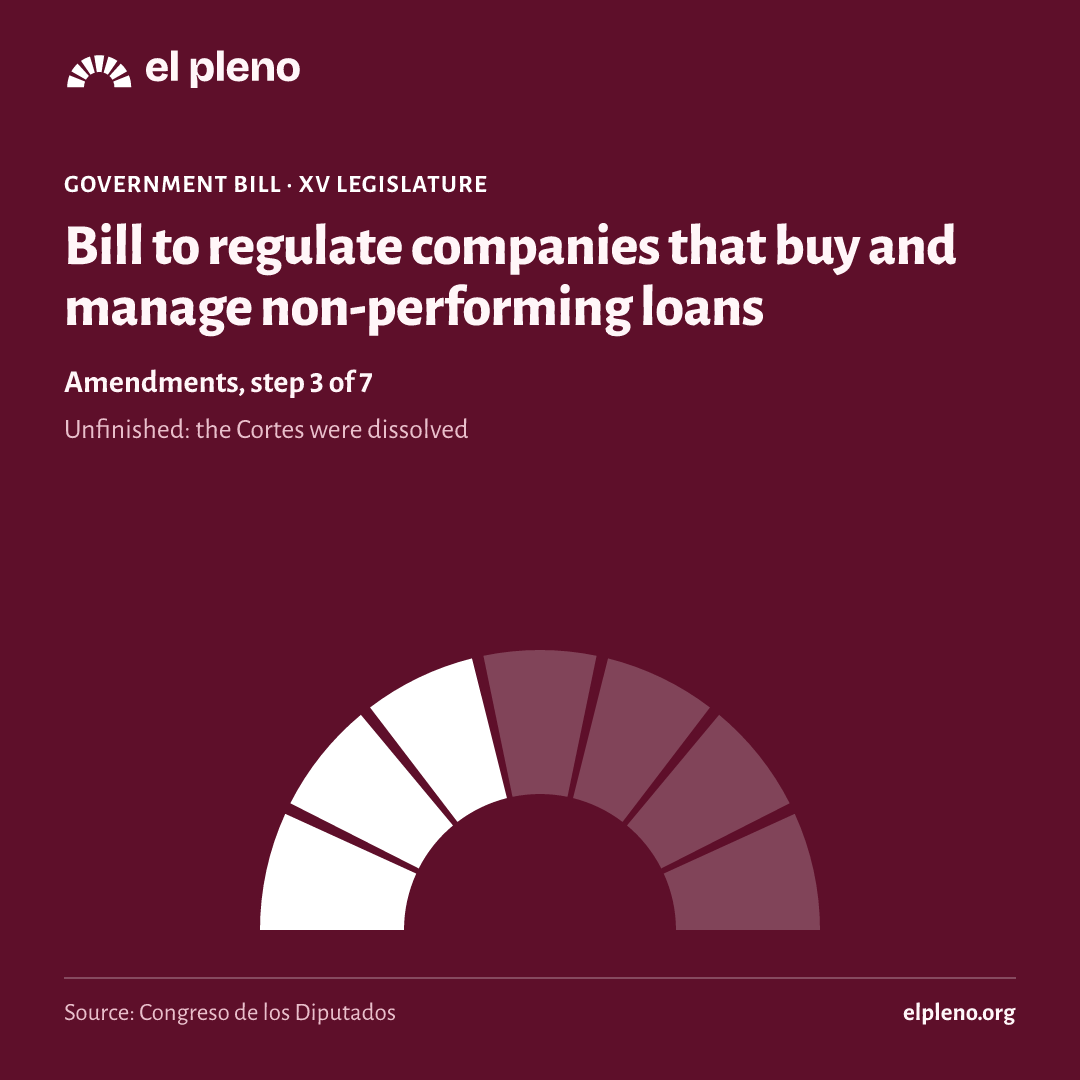
It took 3 of 7 steps. It reached Amendments, and today it is lapsed.
- Introduced5 March 2025Someone registers the text in the Congreso.
- Admitted11 March 2025The Bureau of the Congreso accepts it and, for a members’ bill, the plenary decides whether to consider it.
- Amendments14 March 2025Groups propose changes.
- Committeenot reachedA committee goes through the text in detail.
- Plenarynot reachedAll 350 deputies vote.
- Senatenot reachedThe Senate can pass it, amend it or veto it.
- BOEnot reachedIt is published in the Official State Gazette (BOE) and comes into force.
See the 5 official steps on a timeline
Was there a plenary vote?
We have no plenary vote linked to this law in the Congreso’s data.
What happens next
What happens now?
The legislature ended before it finished. To go on, someone would have to introduce it again in the new Cortes.
Sources
Where does all this come from?
- Congreso de los Diputados, file 121/000049
Official title, type, author, dates and stage.
Retrieved 11 November 2026
- Congreso de los Diputados, procedure
The date of each step, with its official wording.
Retrieved 12 November 2026
- The data comes from the open files of the Congreso, the Senate and the BOE, unaltered.
- Each deputy’s province is the one of their seat on the day of the vote.
- We never say “passed” because of a vote: the files do not say which majority was needed.