What it is
The bill proposes a new law on industry and strategic autonomy
Amendments step 3 of 7· LapsedIt is a government bill. Introduced by the Government. It was introduced on 13 December 2024. Introduced by: Gobierno.
Official title: Government bill on Industry and Strategic Autonomy.
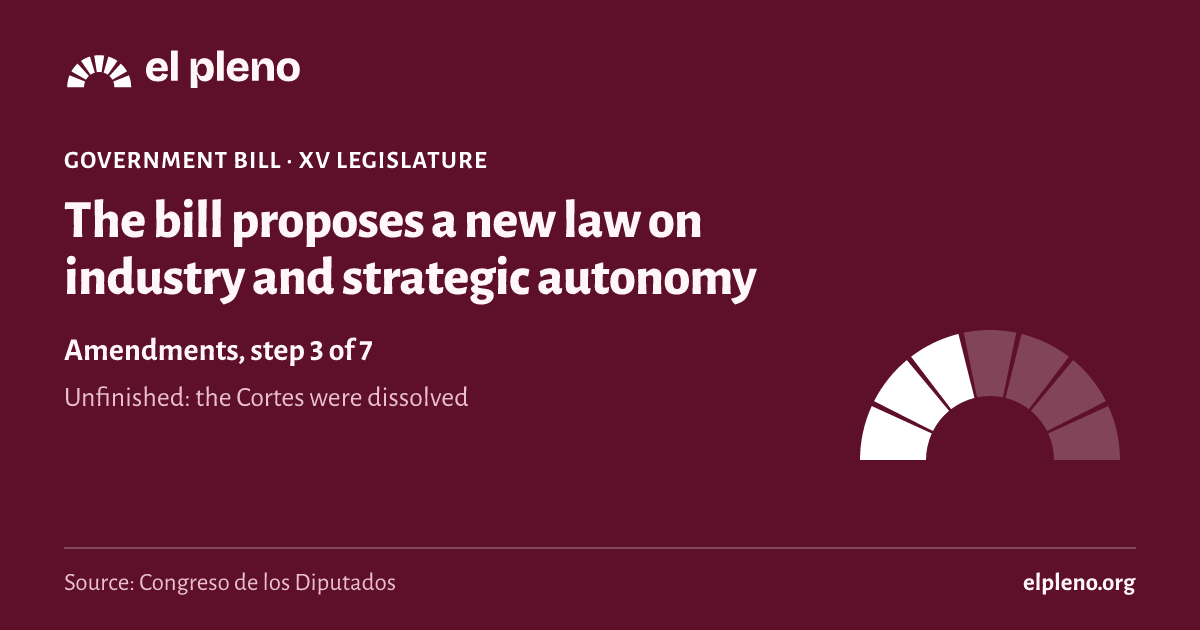
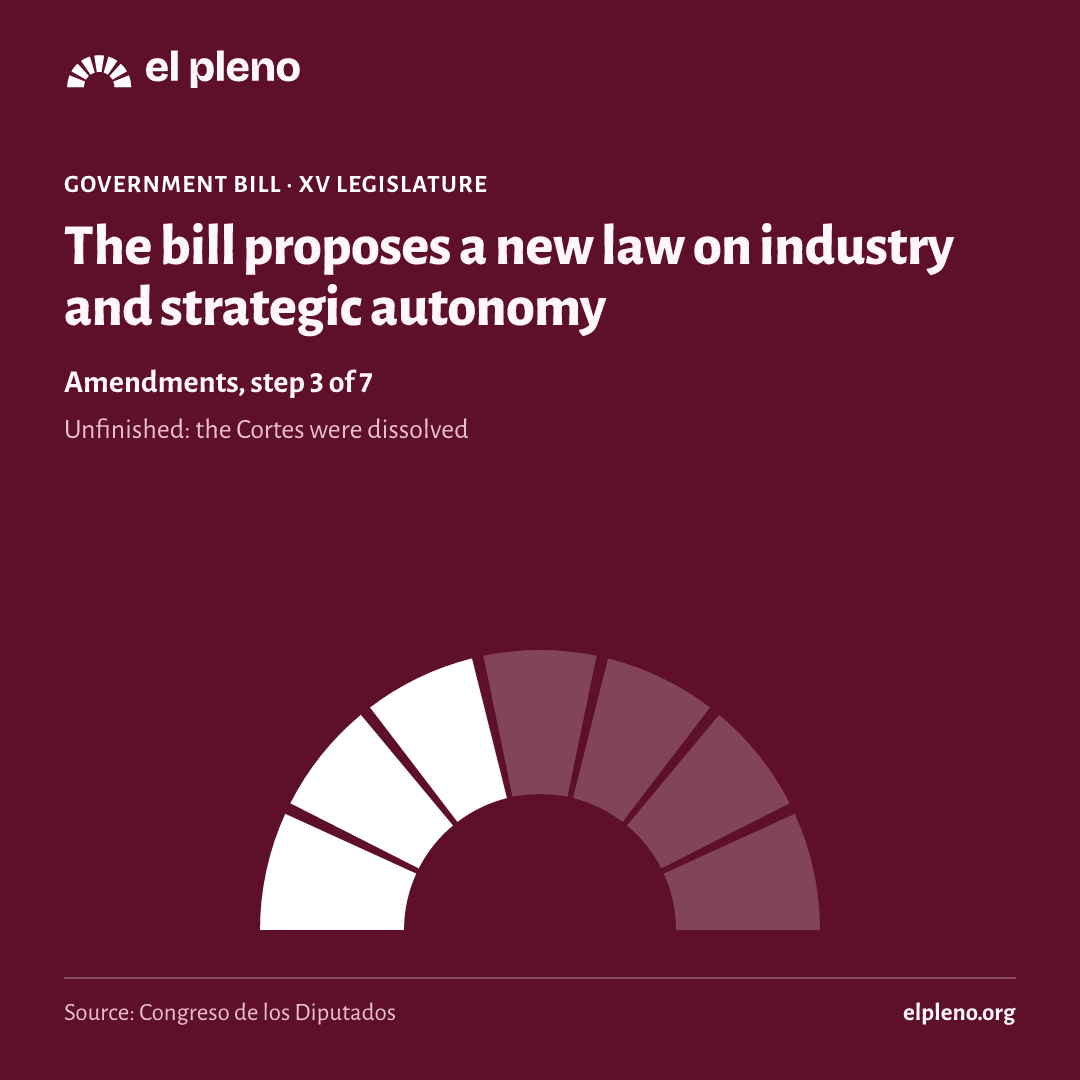
Source: Congreso de los Diputados, file 121/000043· updated 11 Nov
Automatic summary, not yet reviewed
- The bill would replace the 1992 Industry Law and set the foundations of Spanish industrial policy, with goals such as strategic autonomy, decarbonization, the circular economy and digitalization of the sector.
- It would create a Spanish Strategy for Industry and Strategic Autonomy lasting six years, developed through three-year state plans, and strengthen governance bodies: the State Council for Industrial Policy, the Industry and SME Sectoral Conference and the High-Level Forum for Spanish Industry.
- Companies receiving public aid above €3 million over five years would have to keep the productive activity running for two to five years depending on their size. If they cut production by more than 65% or their workforce by 500 people, they would have to repay the aid.
- Projects could be declared Strategic Industrial Projects, which would get urgent processing, priority handling of patent applications and possible access to aid without competitive bidding. The declaration could be revoked if the project breaks its conditions.
- Companies planning a closure or a major cutback would have to notify the State Secretariat for Industry at least nine months in advance. A Reindustrialization Board would be created to look for alternatives that keep the activity and jobs.
- It would create the Strategic Reserve based on National Industrial Production Capacities (RECAPI), managed by CECOPIE, to guarantee the supply of essential resources in a crisis, along with a company certification for strategic autonomy.
- On industrial safety, it would strengthen market surveillance: inspectors would have the status of authority agents, control measures would apply nationwide, and administrations could charge companies the testing costs for non-compliant products.
- The penalty regime would classify minor, serious and very serious offenses, with fines of up to €71,000, €7,100,000 and €118,000,000 respectively, plus accessory penalties such as closure for up to five years.
Who it affects
- Industrial companies: They would face new obligations: keep the activity running if they receive aid, notify closures nine months in advance, and submit to safety and market surveillance controls.
- Small and medium-sized enterprises (SMEs): The bill gives them preferential treatment in support measures, training, financing and certifications.
- Workers: If a factory closes or cuts back, a Reindustrialization Board would be activated to try to keep the activity and jobs.
- Consumers and users: They would get more protection against unsafe industrial products, with stronger controls and free remedies if a product is recalled for safety reasons.
- Autonomous communities (comunidades autónomas): They would take part in the Strategy, send data to the Integrated Industrial Register and carry out market surveillance in their territory.
Words worth knowing
- Declaración responsable (responsible declaration)
- A written statement in which a company declares it meets the legal requirements to start an activity, without waiting for prior authorization.
- Silencio administrativo (administrative silence)
- What is deemed answered when the administration does not reply in time. For industrial safety, the bill sets a negative effect: no reply means the request is considered denied.
- Concurrencia no competitiva (non-competitive award)
- Granting public aid without comparing several applications against each other, in order of arrival until the budget runs out.
- RECAPI
- Strategic Reserve based on National Industrial Production Capacities: a set of measures to ensure Spain can produce essential resources in case of a supply crisis.
- Evaluación de la conformidad (conformity assessment)
- The process of checking that a product, installation or service meets the required standards, through certification, inspection or testing.
It summarizes the text as it was introduced. It is written by artificial intelligence and may contain mistakes: the official text is what counts. Read the official text · How we make summaries
Where it stands
How far did it get?
It took 3 of 7 steps. It reached Amendments, and today it is lapsed.
- Introduced13 December 2024Someone registers the text in the Congreso.
- Admitted17 December 2024The Bureau of the Congreso accepts it and, for a members’ bill, the plenary decides whether to consider it.
- Amendments20 December 2024Groups propose changes.
- Committeenot reachedA committee goes through the text in detail.
- Plenarynot reachedAll 350 deputies vote.
- Senatenot reachedThe Senate can pass it, amend it or veto it.
- BOEnot reachedIt is published in the Official State Gazette (BOE) and comes into force.
See the 5 official steps on a timeline
Was there a plenary vote?
We have no plenary vote linked to this law in the Congreso’s data.
What happens next
What happens now?
The legislature ended before it finished. To go on, someone would have to introduce it again in the new Cortes.
Sources
Where does all this come from?
- Congreso de los Diputados, file 121/000043
Official title, type, author, dates and stage.
Retrieved 11 November 2026
- Congreso de los Diputados, procedure
The date of each step, with its official wording.
Retrieved 12 November 2026
- The data comes from the open files of the Congreso, the Senate and the BOE, unaltered.
- Each deputy’s province is the one of their seat on the day of the vote.
- We never say “passed” because of a vote: the files do not say which majority was needed.