What it is
Bill would reform unemployment benefits and work-life balance leave
Amendments step 3 of 7· LapsedIt is a government bill. Introduced by the Government. It was introduced on 20 June 2024. Introduced by: Gobierno.
Official title: Government bill adopting urgent measures for the simplification and improvement of the service level of unemployment protection, and to complete the transposition of Directive (EU) 2019/1158 of the European Parliament and of the Council, of 20 June 2019, on the work-life balance of parents and carers, and repealing Council Directive 2010/18/EU (originating from Royal Decree-Law 2/2024, of 21 May).
Source: Congreso de los Diputados, file 121/000027· updated 11 Nov
Automatic summary, not yet reviewed
- The bill would expand the nursing leave: one hour off work (or a half-hour reduction of the workday) until the child turns nine months old, which could be accumulated into full days and extended up to twelve months if both parents take it, with a proportional salary reduction after nine months.
- Collective agreements at the regional (autonomous community) level would take priority over state-level agreements when their terms are more favorable to workers and they have the required negotiating majorities.
- The bill would expand coverage of the unemployment subsidy: people under forty-five without family responsibilities who have used up a 360-day benefit, those with less than six months of contributions, and seasonal farm workers, previously excluded, would all be able to qualify.
- Requirements would be simplified: the one-month waiting period after the contributory benefit ends would be removed, family responsibilities would be assessed based on the whole household's income (not just the applicant's), and the subsidy would be granted in three-month periods, with income proven through a signed declaration.
- The subsidy amount would decrease over time: 95% of the IPREM for the first 180 days, 90% up to day 360, and 80% after that. The subsidy for people over fifty-two would stay unchanged in amount.
- The subsidy and unemployment benefit would be compatible with paid work through an employment support supplement, capped at 180 days, so returning to work is not penalized. Receiving the subsidy would also be tied to an activity agreement, whose breach would suspend payment.
- Repaying benefits received by mistake would be easier: the managing agency could allow installment payments and partial offsets against new benefits, instead of only full offset.
- People who exhaust the subsidy without finding work could move to the minimum vital income without extra paperwork: the unemployment agency would send their data to the minimum income agency, with their consent, to process the new benefit.
Who it affects
- Unemployed people who exhaust the contributory benefit or have too few contributions: Groups previously excluded could access the unemployment subsidy, with simpler requirements and an amount that decreases over time.
- Workers with nursing-age children: Improved nursing leave that can be accumulated into full days or taken as a shorter workday, and extended up to twelve months.
- Subsidy recipients who find a job: Could combine the subsidy with work through an employment support supplement for up to 180 days.
- Seasonal farm workers: Their right to the unemployment subsidy would be recognized under the general rules, and the minimum number of required working days would be reduced in Andalusia and Extremadura.
- Victims of gender or sexual violence and returning Spanish emigrants: A specific subsidy of up to 30 months would be recognized for them, and returning Spanish emigrants would get one of up to 18 months.
Words worth knowing
- Prestación contributiva (contributory benefit)
- The unemployment benefit you get after contributing enough while working.
- Nivel asistencial / subsidio (assistance level / subsidy)
- Unemployment aid for those who do not qualify for the contributory benefit, with a lower amount and income requirements.
- IPREM
- A public income index used in Spain as a reference amount to calculate some benefits and subsidies.
- Acuerdo de actividad (activity agreement)
- A commitment signed with public employment services that includes actively looking for work and taking part in job placement plans.
- Declaración responsable (signed declaration)
- A document where a person declares, under their own responsibility, that the information given is true; it is checked later.
It summarizes the text as it was introduced. It is written by artificial intelligence and may contain mistakes: the official text is what counts. Read the official text · How we make summaries
Where it stands
How far did it get?
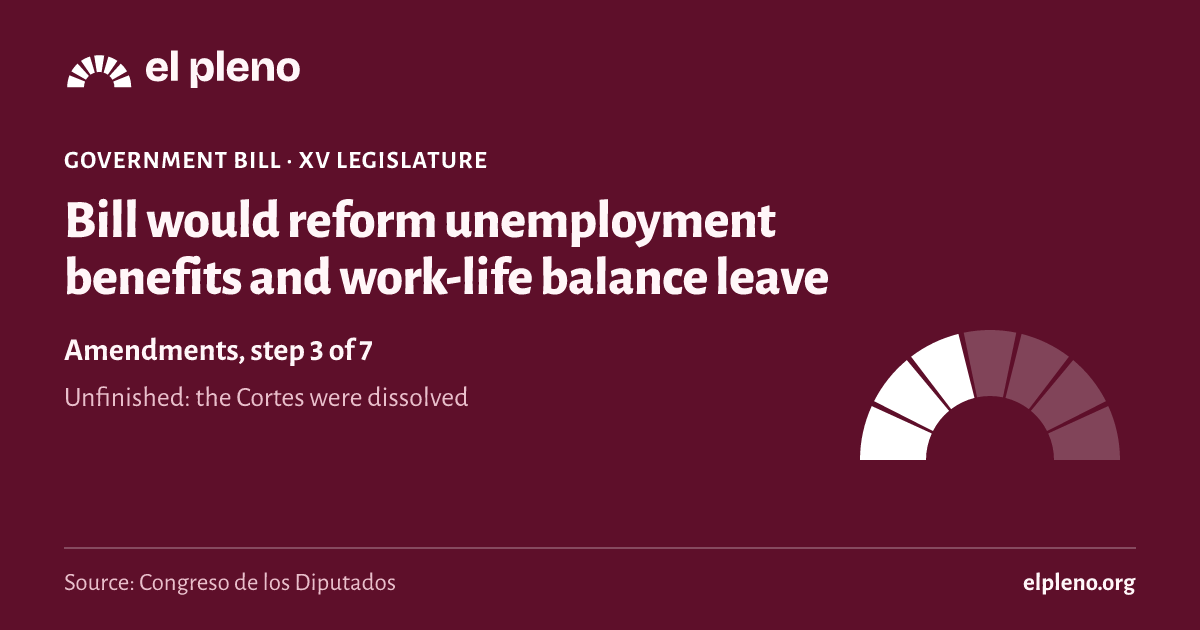
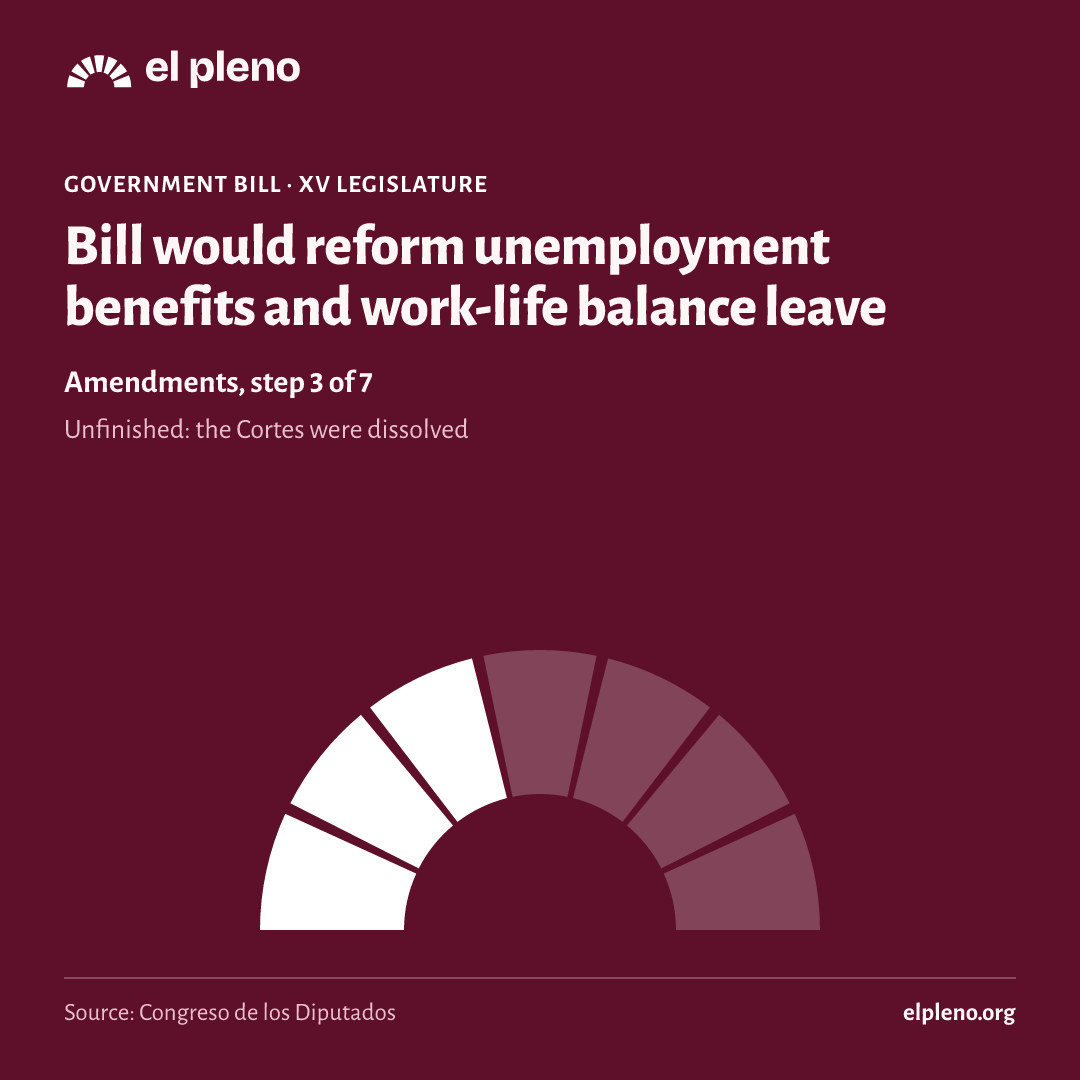
It took 3 of 7 steps. It reached Amendments, and today it is lapsed.
- Introduced20 June 2024Someone registers the text in the Congreso.
- Admitted25 June 2024The Bureau of the Congreso accepts it and, for a members’ bill, the plenary decides whether to consider it.
- Amendments28 June 2024Groups propose changes.
- Committeenot reachedA committee goes through the text in detail.
- Plenarynot reachedAll 350 deputies vote.
- Senatenot reachedThe Senate can pass it, amend it or veto it.
- BOEnot reachedIt is published in the Official State Gazette (BOE) and comes into force.
See the 5 official steps on a timeline
Was there a plenary vote?
We have no plenary vote linked to this law in the Congreso’s data.
What happens next
What happens now?
The legislature ended before it finished. To go on, someone would have to introduce it again in the new Cortes.
Sources
Where does all this come from?
- Congreso de los Diputados, file 121/000027
Official title, type, author, dates and stage.
Retrieved 11 November 2026
- Congreso de los Diputados, procedure
The date of each step, with its official wording.
Retrieved 12 November 2026
- The data comes from the open files of the Congreso, the Senate and the BOE, unaltered.
- Each deputy’s province is the one of their seat on the day of the vote.
- We never say “passed” because of a vote: the files do not say which majority was needed.