What it is
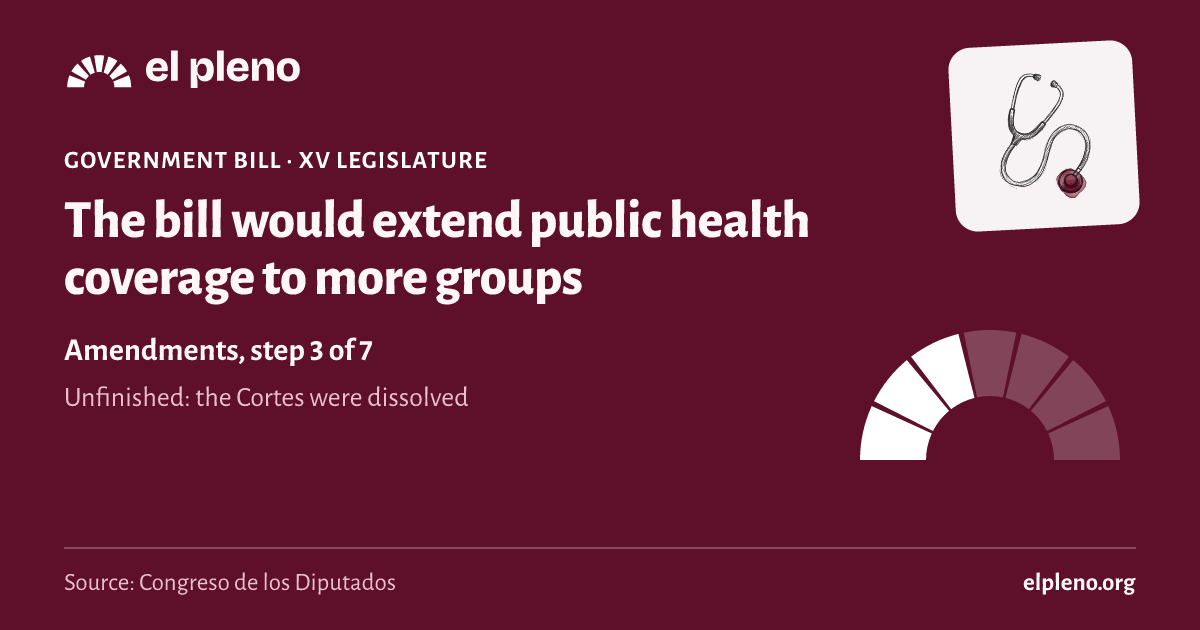
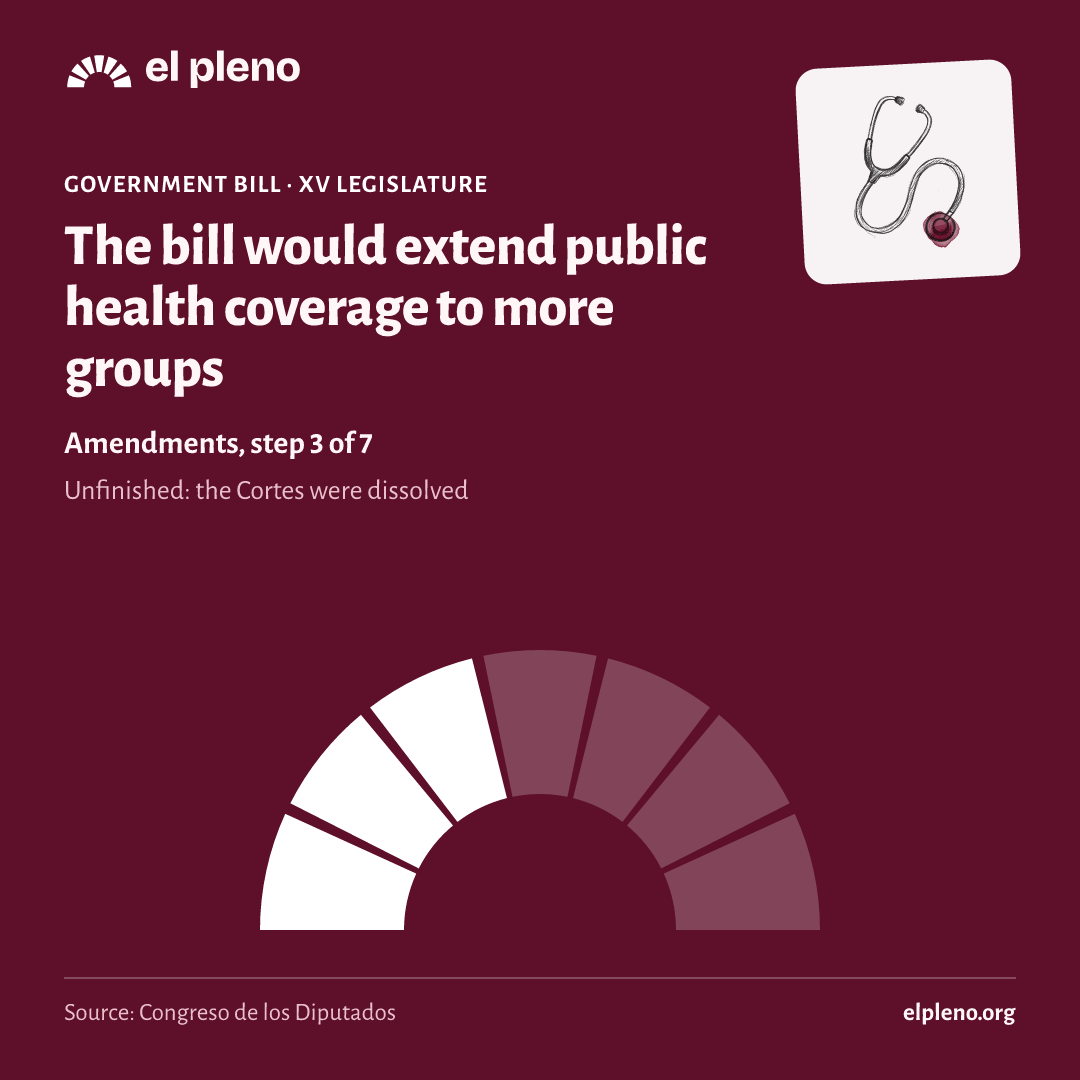
The bill would extend public health coverage to more groups
Amendments step 3 of 7· LapsedIt is a government bill. Introduced by the Government. It was introduced on 17 May 2024. Introduced by: Gobierno.
Official title: Government bill on the universality of the National Health System.
Source: Congreso de los Diputados, file 121/000021· updated 11 Nov
Automatic summary, not yet reviewed
- The bill would extend public health coverage to Spanish citizens by origin living abroad who make temporary trips to Spain, to the family members accompanying them, and to reunified ascendants (such as parents) who depend on their son or daughter, provided no third party is obligated to pay for their care.
- It would also guarantee healthcare, under the same conditions as rights holders, for foreign applicants for international protection, applicants for and beneficiaries of temporary protection, victims of human trafficking or sexual exploitation, and foreigners who are neither registered nor authorized as residents in Spain.
- The bill would restore the National Health System's single common portfolio of services, replacing the three categories created in 2012, and would prevent new healthcare copayments from being introduced. User contributions would remain for pharmaceutical, orthopedic and accessory services.
- Public health services would be expressly included in the common portfolio of services. Specialized care would explicitly include precision, personalized, predictive, preventive, participatory and population-based medicine, and rehabilitation for patients with functional deficits would be better defined.
- The bill would set a 40% share of the retail price as the contribution of the newly covered groups for medicines dispensed at pharmacies, and would expressly repeal Royal Decree-Law 7/2018 of July 27 on universal access to the National Health System, since its content is taken up by this bill.
- The law would take effect twenty days after its publication in the Official State Gazette (Boletín Oficial del Estado). It would also recognize the exceptional nature of deceased-donor organ transplants and prohibit anyone from accessing the transplant waiting list by paying for it.
Who it affects
- Spanish citizens by origin living abroad and their accompanying family members: They would be entitled to public healthcare during temporary stays in Spain, if they lack coverage through other channels.
- Reunified ascendants (such as parents) of a rights holder: They would get public health coverage if they depend on their son or daughter and no third party owes payment; no health insurance would be required for their residence authorization.
- Foreigners neither registered nor authorized as residents in Spain: They would keep the right to healthcare under the same conditions as rights holders, with requirements to prevent improper use of the right.
- Applicants for international protection, people under temporary protection, and victims of trafficking or sexual exploitation: They would be included in the law itself as entitled to health protection, something currently found only in regulations.
- Users of the National Health System: The portfolio of services would become a single one again and no new copayments could be created; contributions would remain for medicines, orthopedic products and accessory services.
Words worth knowing
- Cartera común de servicios (common portfolio of services)
- The set of healthcare services (appointments, tests, medicines, etc.) that the National Health System offers to the whole population.
- Copago (copayment)
- The share of a healthcare service's cost paid by the user, on top of what public funds cover.
- Convenio especial (special agreement)
- A contract by which a person not entitled to public healthcare pays a fee to receive it.
- Prestación ortoprotésica (orthopedic and prosthetic benefit)
- Prostheses, orthoses, wheelchairs and other medical products provided to patients.
- Protección temporal (temporary protection)
- A special protection scheme activated when a mass influx of displaced people arrives in Spain, as in the case of Ukraine.
It summarizes the text as it was introduced. It is written by artificial intelligence and may contain mistakes: the official text is what counts. Read the official text · How we make summaries
Where it stands
How far did it get?
It took 3 of 7 steps. It reached Amendments, and today it is lapsed.
- Introduced17 May 2024Someone registers the text in the Congreso.
- Admitted21 May 2024The Bureau of the Congreso accepts it and, for a members’ bill, the plenary decides whether to consider it.
- Amendments24 May 2024Groups propose changes.
- Committeenot reachedA committee goes through the text in detail.
- Plenarynot reachedAll 350 deputies vote.
- Senatenot reachedThe Senate can pass it, amend it or veto it.
- BOEnot reachedIt is published in the Official State Gazette (BOE) and comes into force.
See the 5 official steps on a timeline
Was there a plenary vote?
We have no plenary vote linked to this law in the Congreso’s data.
What happens next
What happens now?
The legislature ended before it finished. To go on, someone would have to introduce it again in the new Cortes.
Sources
Where does all this come from?
- Congreso de los Diputados, file 121/000021
Official title, type, author, dates and stage.
Retrieved 11 November 2026
- Congreso de los Diputados, procedure
The date of each step, with its official wording.
Retrieved 12 November 2026
- The data comes from the open files of the Congreso, the Senate and the BOE, unaltered.
- Each deputy’s province is the one of their seat on the day of the vote.
- We never say “passed” because of a vote: the files do not say which majority was needed.