What it is
Bill would stop urban plans being voided over minor flaws
It is a government bill. Introduced by the Government. It was introduced on 27 March 2024. Introduced by: Gobierno.
Official title: Government bill amending the consolidated text of the Land and Urban Rehabilitation Act, approved by Royal Legislative Decree 7/2015, of 30 October.
Source: Congreso de los Diputados, file 121/000019· updated 11 Nov
Automatic summary, not yet reviewed
- The bill would allow territorial and urban planning instruments to be declared null and void for formal or procedural flaws only in very serious cases, such as approval by a clearly incompetent body, skipping the environmental assessment, or completely omitting public information. Other flaws could be corrected without voiding the plan.
- A four-year deadline, counted from publication of the final approval, would apply to indirectly challenging a plan on strictly formal, non-substantial grounds. Currently there is no such time limit.
- The actio popularis, which lets anyone demand compliance with urban planning law, would be limited against plans: it could only address material aspects unless formal flaws have a significant influence, and the person using it must prove that. Also, no financial compensation would be allowed for dropping the case.
- The compensation for preventing someone from taking part in a new development would be corrected, after a Constitutional Court ruling struck down the previous criterion. It would be calculated by applying the developer profit percentage to the land value once the development is finished, minus pending costs and obligations.
- New rules for the Property Registry are added: how to cancel the recorded right of repurchase in urban expropriations, and a seven-year expiration period for the encumbrance on land from the benefit and burden distribution process. A 30-year expiration is also added to the expropriation law.
- The Ministry of Housing and Urban Agenda would set up, within one year of the law taking effect, an online platform to speed up the request, issuance and tracking of sector reports affecting urban plans.
Who it affects
- Local governments and public administrations: They could correct flaws in their urban plans without the plans being voided, and would get a platform to speed up sector reports.
- Landowners: They would have a new criterion for compensation if barred from taking part in a development, plus clearer rules on the right of repurchase.
- Anyone using the urban planning public action: They would face limits: they must prove the relevance of formal flaws they claim, and cannot get financial compensation for dropping the case.
- The cities of Ceuta and Melilla: A typo in the rule on their urban planning powers would be corrected.
Words worth knowing
- Instrumentos de ordenación territorial y urbanística
- Planning instruments that decide how land is used in a territory: what can be built, where, and for what purpose.
- Nulidad de pleno derecho
- Full nullity: a rule or act is considered invalid from the start, as if it never existed.
- Acción pública
- Public action: the right of any person to go to the courts or the administration to demand compliance with urban planning law, without proving personal harm.
- Derecho de reversión
- Right of repurchase: the expropriated owner's right to get the property back if it is not used for the purpose that justified the expropriation.
- Equidistribución de beneficios y cargas
- Distribution of benefits and burdens: sharing among landowners the gains and costs of a development project.
It summarizes the text as it was introduced. It is written by artificial intelligence and may contain mistakes: the official text is what counts. Read the official text · How we make summaries
Where it stands
How far did it get?
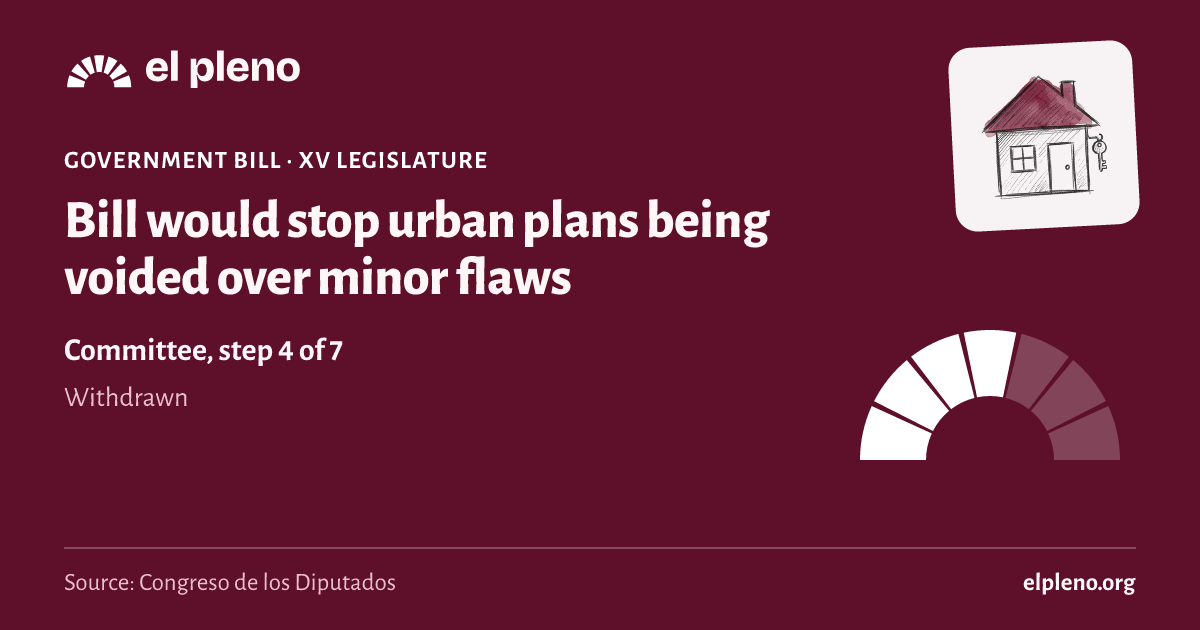
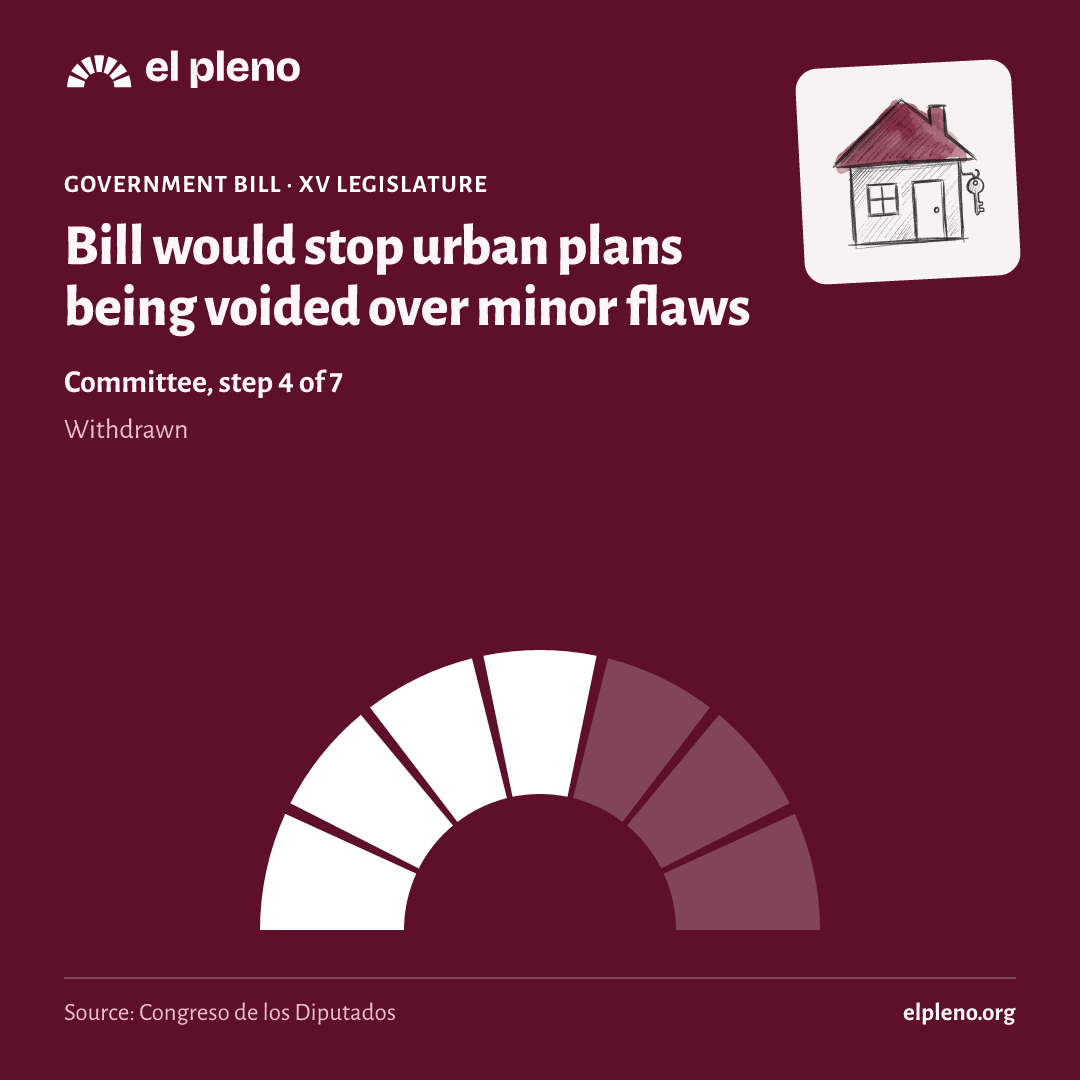
It took 4 of 7 steps. It reached Committee, and today it is withdrawn.
- Introduced27 March 2024Someone registers the text in the Congreso.
- Admitted2 April 2024The Bureau of the Congreso accepts it and, for a members’ bill, the plenary decides whether to consider it.
- Amendments5 April 2024Groups propose changes.
- Committee25 April 2024A committee goes through the text in detail.
- Plenarynot reachedAll 350 deputies vote.
- Senatenot reachedThe Senate can pass it, amend it or veto it.
- BOEnot reachedIt is published in the Official State Gazette (BOE) and comes into force.
See the 7 official steps on a timeline
Was there a plenary vote?
We have no plenary vote linked to this law in the Congreso’s data.
What happens next
What happens now?
Whoever introduced it withdrew it, or it was merged into another one. It goes no further.
Sources
Where does all this come from?
- Congreso de los Diputados, file 121/000019
Official title, type, author, dates and stage.
Retrieved 11 November 2026
- Congreso de los Diputados, procedure
The date of each step, with its official wording.
Retrieved 12 November 2026
- The data comes from the open files of the Congreso, the Senate and the BOE, unaltered.
- Each deputy’s province is the one of their seat on the day of the vote.
- We only say “passed” or “rejected” when the majority needed is certain; otherwise we say which side had more votes.