What it is
The bill proposes a single body to complain against your bank
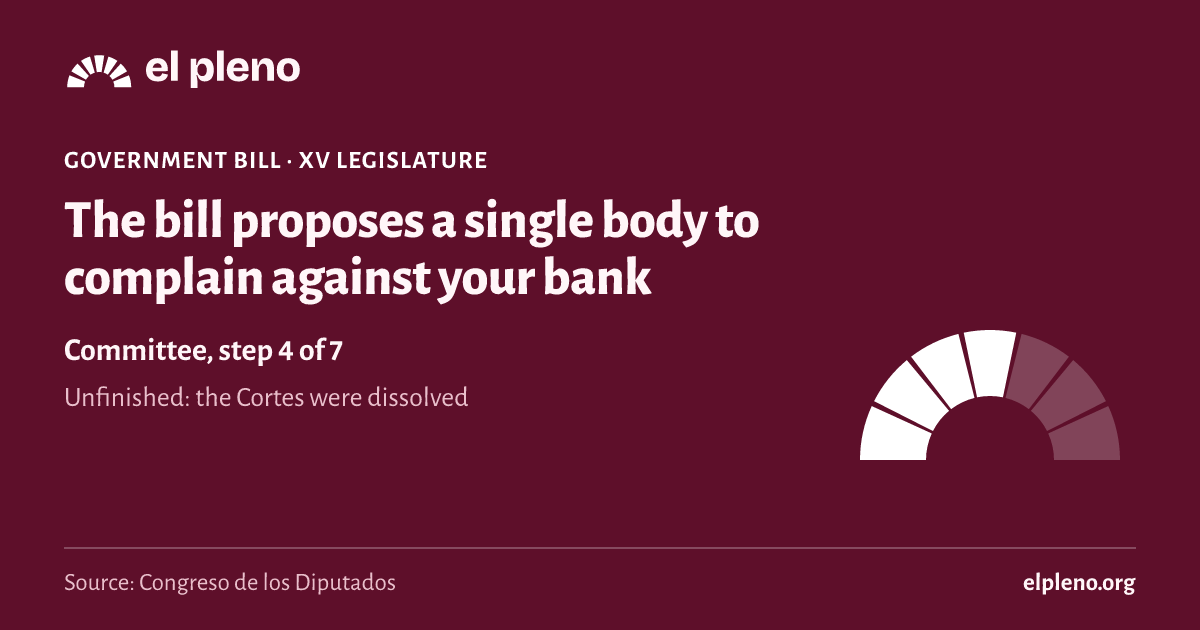
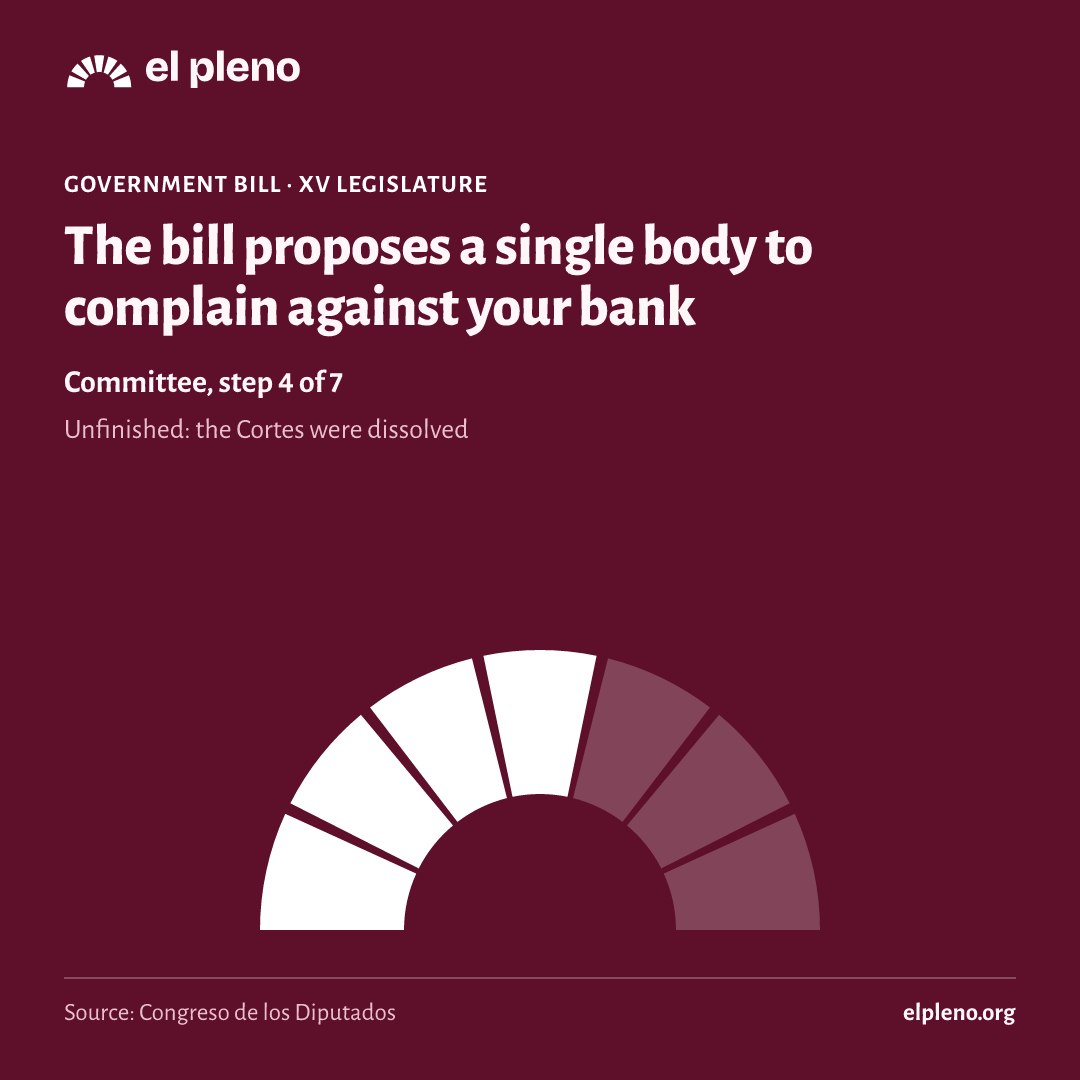
Committee step 4 of 7· LapsedIt is a government bill. Introduced by the Government. It was introduced on 21 March 2024. Introduced by: Gobierno.
Official title: Government bill for the creation of the Independent Administrative Authority for the Defense of the Financial Customer for the out-of-court resolution of conflicts between financial entities and their customers.
Source: Congreso de los Diputados, file 121/000018· updated 11 Nov
Automatic summary, not yet reviewed
- The bill would create the Independent Administrative Authority for the Defense of the Financial Customer, a public and independent body that would resolve disputes between customers and financial entities without going to court.
- Filing a complaint would be free for customers, with no lawyer or court representative needed. In-person, phone and online channels would be available, with personalized assistance for older people, people with disabilities and those at risk of financial exclusion.
- Before going to the Authority, customers must first complain to the entity's customer care service or customer ombudsman. If there is no answer within one month, or the answer is unfavorable, the complaint can be filed with the Authority within one year.
- Decisions would be binding on the financial entity when the complaint concerns conduct rules or abusive clauses and the amount is under €20,000. The entity would have to comply within 30 business days or face sanctions.
- The procedure would be fast: the investigation stage may not exceed 45 business days, and the decision must be notified within 20 more business days, with an overall maximum of 90 calendar days from filing.
- Either party could later go to the civil courts against binding decisions. Non-binding decisions would carry the weight of an expert report if the dispute reaches a court.
- Entities that fail to comply with a binding decision could be fined up to 2% of their annual turnover, capped at €2 million, and their executives could be fined up to €1 million for serious violations.
- The new Authority would be funded by an annual fee paid by financial entities, not customers, and would absorb the current complaint services of the Bank of Spain (Banco de España), the CNMV and the Directorate General for Insurance and Pension Funds.
Who it affects
- Customers of financial services: They could complain for free, quickly and without a lawyer against their bank, insurer or investment firm, and get binding decisions for amounts under €20,000.
- Financial entities: They would be required to take part in the procedure, comply with binding decisions, pay the annual fee and provide contract documentation.
- Consumer associations and vulnerable groups: They could file complaints on behalf of their members and sit on the new Authority's Advisory Council.
- Complaint services of current supervisors: They would stop handling complaints once the Authority starts operating, though they would keep their advisory role.
Words worth knowing
- Resolución vinculante (binding decision)
- A decision the financial entity must comply with, though it can later challenge it in the civil courts.
- Cláusula abusiva (abusive clause)
- A contract term, not individually negotiated, that causes a significant and unjustified imbalance against the customer.
- Normas de conducta (conduct rules)
- Rules requiring financial entities to treat customers fairly and give them proper information.
- Defensor de la clientela (customer ombudsman)
- A person or internal service at the entity that handles customer complaints before the Authority is involved.
- Silencio desestimatorio (rejection by silence)
- If the Authority does not answer in time, the complaint is deemed rejected and only a court challenge remains.
It summarizes the text as it was introduced. It is written by artificial intelligence and may contain mistakes: the official text is what counts. Read the official text · How we make summaries
Where it stands
How far did it get?
It took 4 of 7 steps. It reached Committee, and today it is lapsed.
- Introduced21 March 2024Someone registers the text in the Congreso.
- Admitted2 April 2024The Bureau of the Congreso accepts it and, for a members’ bill, the plenary decides whether to consider it.
- Amendments5 April 2024Groups propose changes.
- Committee6 November 2024A committee goes through the text in detail.
- Plenarynot reachedAll 350 deputies vote.
- Senatenot reachedThe Senate can pass it, amend it or veto it.
- BOEnot reachedIt is published in the Official State Gazette (BOE) and comes into force.
See the 8 official steps on a timeline
21 November 2024
How did the plenary vote?
Voted on: Request for the Plenary of the Chamber to take over the deliberation and final vote on the Government bill, submitted by the Popular Parliamentary Group in the Congress.
This law had 2 votes; this is the latest with every deputy’s vote. See them all
Source: Congreso de los Diputados, vote 64 of sitting 79· updated 10 Nov
Each dot is a seat. Tap one, or use the arrow keys, to see who it is.
Your province
How did the deputies from your province vote?
And your senators: the Senate does not link its votes to this law in its open data, so we cannot put them side by side here.
Or see how most of each province voted
- A Coruña More votes in favour 8 yes · 0 no
- Albacete More votes in favour 4 yes · 0 no
- Alicante/Alacant More votes in favour 12 yes · 0 no
- Almería More votes in favour 6 yes · 0 no
- Araba/Álava More votes in favour 4 yes · 0 no
- Asturias More votes in favour 7 yes · 0 no
- Ávila More votes in favour 3 yes · 0 no
- Badajoz More votes in favour 5 yes · 0 no
- Barcelona More votes in favour 28 yes · 4 no
- Bizkaia More votes in favour 8 yes · 0 no
- Burgos More votes in favour 4 yes · 0 no
- Cáceres More votes in favour 4 yes · 0 no
- Cádiz More votes in favour 9 yes · 0 no
- Cantabria More votes in favour 5 yes · 0 no
- Castellón/Castelló More votes in favour 5 yes · 0 no
- Ceuta More votes in favour 1 yes · 0 no
- Ciudad Real More votes in favour 5 yes · 0 no
- Córdoba More votes in favour 6 yes · 0 no
- Cuenca More votes in favour 3 yes · 0 no
- Gipuzkoa More votes in favour 6 yes · 0 no
- Girona More votes in favour 5 yes · 1 no
- Granada More votes in favour 7 yes · 0 no
- Guadalajara More votes in favour 3 yes · 0 no
- Huelva More votes in favour 5 yes · 0 no
- Huesca More votes in favour 3 yes · 0 no
- Illes Balears More votes in favour 8 yes · 0 no
- Jaén More votes in favour 5 yes · 0 no
- La Rioja More votes in favour 4 yes · 0 no
- Las Palmas More votes in favour 8 yes · 0 no
- León More votes in favour 4 yes · 0 no
- Lleida More votes in favour 3 yes · 1 no
- Lugo More votes in favour 4 yes · 0 no
- Madrid More votes in favour 37 yes · 0 no
- Málaga More votes in favour 11 yes · 0 no
- Melilla More votes in favour 1 yes · 0 no
- Murcia More votes in favour 10 yes · 0 no
- Navarra More votes in favour 5 yes · 0 no
- Ourense More votes in favour 4 yes · 0 no
- Palencia More votes in favour 3 yes · 0 no
- Pontevedra More votes in favour 7 yes · 0 no
- Salamanca More votes in favour 4 yes · 0 no
- Santa Cruz de Tenerife More votes in favour 7 yes · 0 no
- Segovia More votes in favour 3 yes · 0 no
- Sevilla More votes in favour 12 yes · 0 no
- Soria More votes in favour 2 yes · 0 no
- Tarragona More votes in favour 5 yes · 1 no
- Teruel More votes in favour 3 yes · 0 no
- Toledo More votes in favour 6 yes · 0 no
- Valencia/València More votes in favour 15 yes · 0 no
- Valladolid More votes in favour 5 yes · 0 no
- Zamora More votes in favour 3 yes · 0 no
- Zaragoza More votes in favour 7 yes · 0 no
More details: how each group and each province voted
The groups
Who voted in favour and who against?
In favour, most of Euskal Herria Bildu, Plurinacional SUMAR, Socialista, Vasco (EAJ-PNV), Junts per Catalunya, Mixto, Popular en el Congreso and VOX. Against, most of Republicano.
By province: in 52 most voted in favour; in 0, against.
Coloured by how most of each province’s deputies voted.
- In favour: 52
- Against: 0
| Group | Seats | How it voted |
|---|---|---|
| Euskal Herria Bildu | 6 | 6 in favour |
| Plurinacional SUMAR | 27 | 27 in favour |
| Republicano | 7 | 7 against |
| Socialista | 120 | 120 in favour |
| Vasco (EAJ-PNV) | 5 | 5 in favour |
| Junts per Catalunya | 7 | 7 in favour |
| Mixto | 8 | 7 in favour · 1 did not vote |
| Popular en el Congreso | 137 | 137 in favour |
| VOX | 33 | 33 in favour |
What happens next
What happens now?
The legislature ended before it finished. To go on, someone would have to introduce it again in the new Cortes.
Sources
Where does all this come from?
- Congreso de los Diputados, file 121/000018
Official title, type, author, dates and stage.
Retrieved 11 November 2026
- Congreso de los Diputados, procedure
The date of each step, with its official wording.
Retrieved 12 November 2026
- Congreso de los Diputados, vote 64 of sitting 79
The count and every seat’s vote.
Retrieved 10 November 2026
- The data comes from the open files of the Congreso, the Senate and the BOE, unaltered.
- Each deputy’s province is the one of their seat on the day of the vote.
- We never say “passed” because of a vote: the files do not say which majority was needed.