What it is
Bill to make working conditions clearer and more predictable
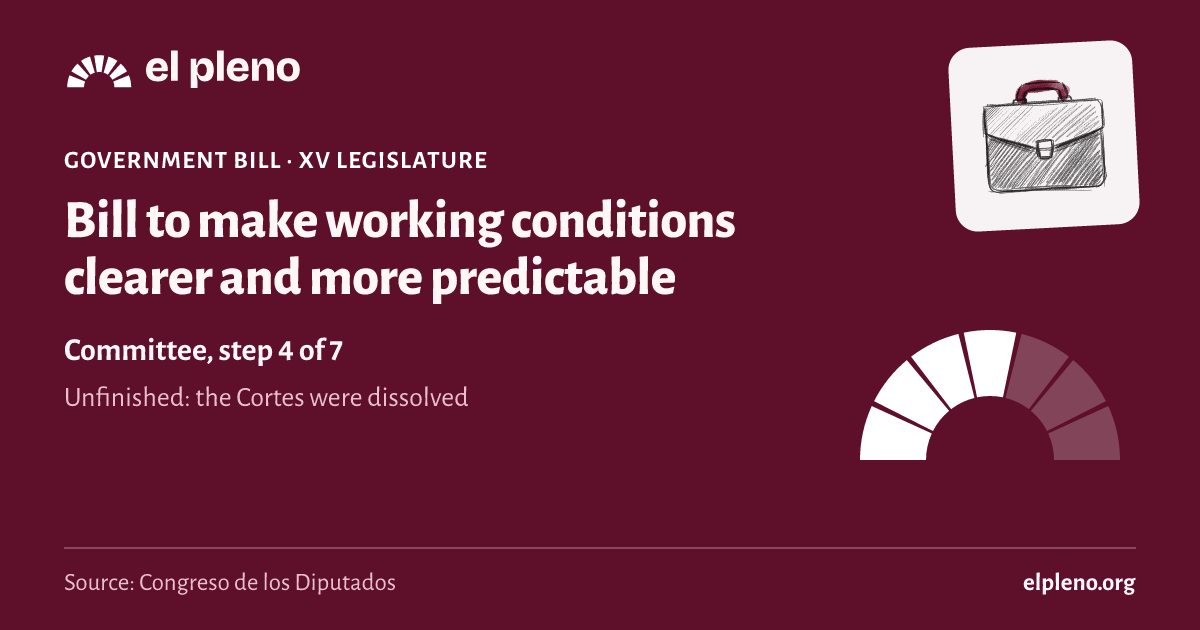
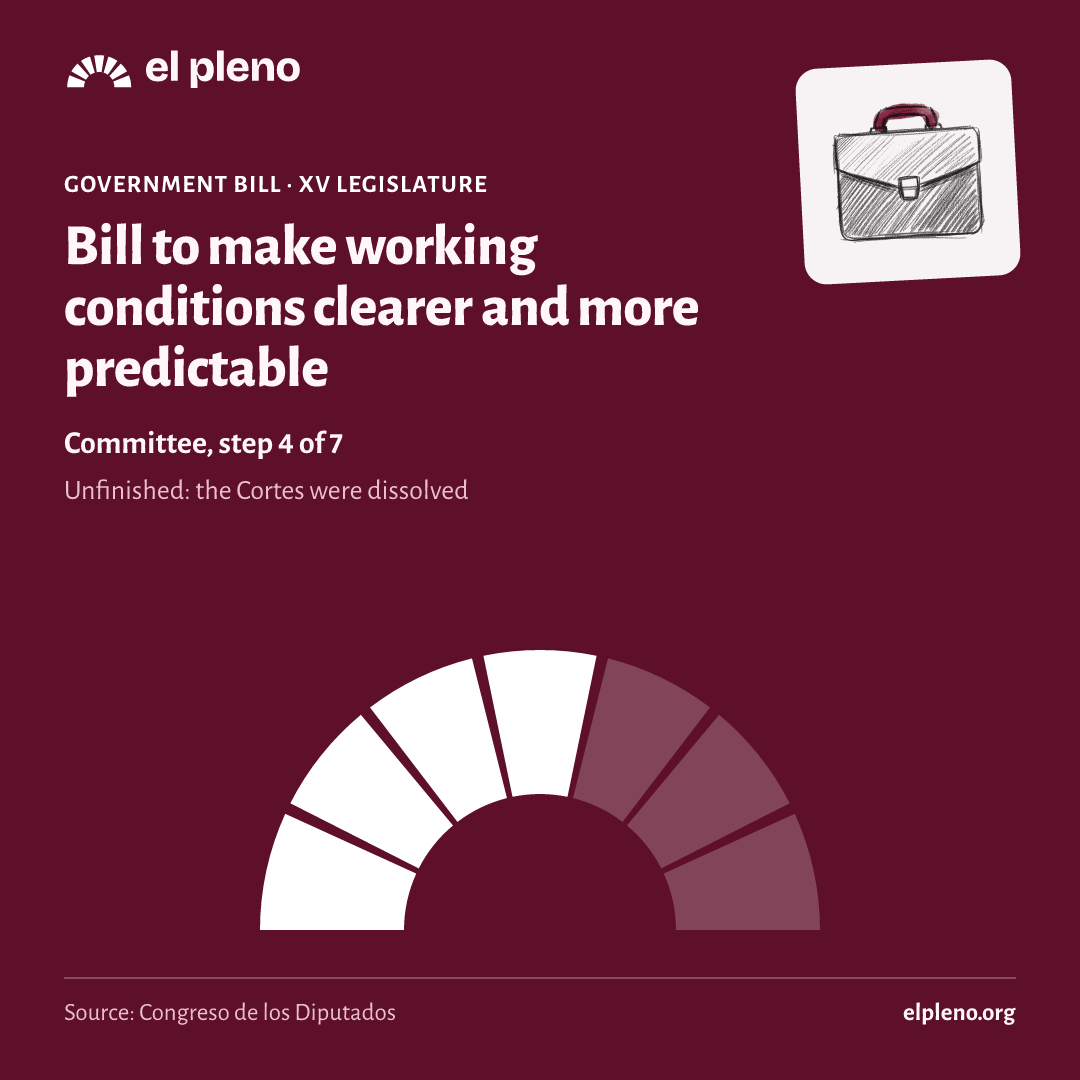
Committee step 4 of 7· LapsedIt is a government bill. Introduced by the Government. It was introduced on 9 February 2024. Introduced by: Gobierno.
Official title: Government bill amending the consolidated text of the Workers' Statute, approved by Royal Legislative Decree 2/2015, of 23 October, and other provisions in labor matters, for the transposition of Directive (EU) 2019/1152 of the European Parliament and of the Council, of 20 June 2019, on transparent and predictable working conditions in the European Union.
Source: Congreso de los Diputados, file 121/000008· updated 11 Nov
Automatic summary, not yet reviewed
- The bill would require the employer to give workers written information about the essential elements of their employment relationship, both when it starts and whenever something changes, and this would apply to all contracts, including those under four weeks.
- It would define when a working condition is predictable: when the worker can know in advance, in writing, their work pattern or the criteria under which it may change. If the employer fails to inform about contract duration, working hours or the trial period, the contract would be presumed indefinite and full time.
- For part-time contracts, it would require the hours record to include the exact start and end times of each workday, make any change in hours voluntary, and require complementary hours agreements to state the reference days and hours when work can be requested, with at least three days notice.
- It would limit the trial period: at most six months for qualified professionals and two months for other workers, and one month for temporary contracts of six months or longer, reduced proportionally for shorter contracts.
- It would bar employers from prohibiting or limiting workers from working for other companies, and workers with at least six months on the job could request in writing a more stable or predictable form of employment, with a reasoned written answer within a set deadline.
- It would add penalties: failing to provide written information about the essential elements of the contract would be a serious offense, and treating a worker badly for having several jobs would be a very serious offense. The rule would take effect the day after its publication in the Official State Gazette.
Who it affects
- Workers, especially part-time, temporary or shift-based workers: They would receive more written information about their contract and their conditions would be more predictable.
- Employers: They would face new information and record-keeping duties, with penalties if they fail to comply.
- People who want to hold several jobs at once: The employer could not stop them or treat them badly for it, except for objective reasons.
- Public sector employees: The rules on parallel employment and moving to another form of employment would apply to them, under their specific regulations.
- Sea workers and domestic workers: The new rules would apply to them unless incompatible with the special features of their work.
Words worth knowing
- Transposición de una directiva (transposition of a directive)
- Adapting a European Union rule into Spanish law so it applies in Spain.
- Horas complementarias (complementary hours)
- Extra hours an employer can ask a part-time worker to work, if agreed in writing.
- Pluriempleo (multiple employment)
- Working for more than one company at the same time.
- Periodo de prueba (trial period)
- An initial period of the contract during which either side can end the relationship easily.
- Infracción grave o muy grave (serious or very serious offense)
- Categories of employer penalties: very serious is the most severe of the three levels (minor, serious, very serious).
It summarizes the text as it was introduced. It is written by artificial intelligence and may contain mistakes: the official text is what counts. Read the official text · How we make summaries
Where it stands
How far did it get?
It took 4 of 7 steps. It reached Committee, and today it is lapsed.
- Introduced9 February 2024Someone registers the text in the Congreso.
- Admitted13 February 2024The Bureau of the Congreso accepts it and, for a members’ bill, the plenary decides whether to consider it.
- Amendments16 February 2024Groups propose changes.
- Committee21 March 2024A committee goes through the text in detail.
- Plenarynot reachedAll 350 deputies vote.
- Senatenot reachedThe Senate can pass it, amend it or veto it.
- BOEnot reachedIt is published in the Official State Gazette (BOE) and comes into force.
See the 6 official steps on a timeline
21 March 2024
How did the plenary vote?
Voted on: Vote on the request for the Plenary of the Chamber to take over the deliberation and final vote on the Government Bill amending the consolidated text of the Workers' Statute, approved by Royal Legislative Decree 2/2015, of October 23, and other provisions in labor matters, for the transposition of Directive (EU) 2019/1152 of the European Parliament and of the Council, of June 20, 2019, on transparent and predictable working conditions in the European Union, submitted by the VOX Parliamentary Group.
Source: Congreso de los Diputados, vote 18 of sitting 33· updated 10 Nov
Each dot is a seat. Tap one, or use the arrow keys, to see who it is.
Your province
How did the deputies from your province vote?
And your senators: the Senate does not link its votes to this law in its open data, so we cannot put them side by side here.
Or see how most of each province voted
- A Coruña More votes in favour 7 yes · 0 no
- Albacete More votes in favour 4 yes · 0 no
- Alicante/Alacant More votes in favour 12 yes · 0 no
- Almería More votes in favour 6 yes · 0 no
- Araba/Álava More votes in favour 3 yes · 0 no
- Asturias More votes in favour 7 yes · 0 no
- Ávila More votes in favour 3 yes · 0 no
- Badajoz More votes in favour 5 yes · 0 no
- Barcelona More votes in favour 28 yes · 0 no · 2 abst.
- Bizkaia More votes in favour 6 yes · 0 no
- Burgos More votes in favour 4 yes · 0 no
- Cáceres More votes in favour 4 yes · 0 no
- Cádiz More votes in favour 9 yes · 0 no
- Cantabria More votes in favour 4 yes · 0 no
- Castellón/Castelló More votes in favour 5 yes · 0 no
- Ceuta More votes in favour 1 yes · 0 no
- Ciudad Real More votes in favour 5 yes · 0 no
- Córdoba More votes in favour 6 yes · 0 no
- Cuenca More votes in favour 3 yes · 0 no
- Gipuzkoa More votes in favour 4 yes · 0 no
- Girona More votes in favour 6 yes · 0 no
- Granada More votes in favour 7 yes · 0 no
- Guadalajara More votes in favour 3 yes · 0 no
- Huelva More votes in favour 5 yes · 0 no
- Huesca More votes in favour 3 yes · 0 no
- Illes Balears More votes in favour 7 yes · 1 no
- Jaén More votes in favour 5 yes · 0 no
- La Rioja More votes in favour 4 yes · 0 no
- Las Palmas More votes in favour 8 yes · 0 no
- León More votes in favour 4 yes · 0 no
- Lleida More votes in favour 3 yes · 0 no · 1 abst.
- Lugo More votes in favour 4 yes · 0 no
- Madrid More votes in favour 34 yes · 0 no
- Málaga More votes in favour 11 yes · 0 no
- Melilla More votes in favour 1 yes · 0 no
- Murcia More votes in favour 10 yes · 0 no
- Navarra More votes in favour 5 yes · 0 no
- Ourense More votes in favour 4 yes · 0 no
- Palencia More votes in favour 3 yes · 0 no
- Pontevedra More votes in favour 7 yes · 0 no
- Salamanca More votes in favour 4 yes · 0 no
- Santa Cruz de Tenerife More votes in favour 7 yes · 0 no
- Segovia More votes in favour 2 yes · 0 no
- Sevilla More votes in favour 12 yes · 0 no
- Soria More votes in favour 2 yes · 0 no
- Tarragona More votes in favour 5 yes · 0 no · 1 abst.
- Teruel More votes in favour 3 yes · 0 no
- Toledo More votes in favour 6 yes · 0 no
- Valencia/València More votes in favour 15 yes · 0 no
- Valladolid More votes in favour 5 yes · 0 no
- Zamora More votes in favour 3 yes · 0 no
- Zaragoza More votes in favour 7 yes · 0 no
More details: how each group and each province voted
The groups
Who voted in favour and who against?
In favour, most of Euskal Herria Bildu, Plurinacional SUMAR, Socialista, Junts per Catalunya, Mixto, Popular en el Congreso and VOX. 4 deputies voted differently from their group.
By province: in 52 most voted in favour; in 0, against.
Coloured by how most of each province’s deputies voted.
- In favour: 52
- Against: 0
| Group | Seats | How it voted |
|---|---|---|
| Euskal Herria Bildu | 6 | 6 in favour |
| Plurinacional SUMAR | 27 | 24 in favour · 1 against · 2 did not vote |
| Republicano | 7 | 3 in favour · 4 abst. |
| Socialista | 120 | 119 in favour · 1 did not vote |
| Vasco (EAJ-PNV) | 5 | 5 did not vote |
| Junts per Catalunya | 7 | 6 in favour · 1 did not vote |
| Mixto | 8 | 7 in favour · 1 did not vote |
| Popular en el Congreso | 137 | 133 in favour · 4 did not vote |
| VOX | 33 | 33 in favour |
What happens next
What happens now?
The legislature ended before it finished. To go on, someone would have to introduce it again in the new Cortes.
Sources
Where does all this come from?
- Congreso de los Diputados, file 121/000008
Official title, type, author, dates and stage.
Retrieved 11 November 2026
- Congreso de los Diputados, procedure
The date of each step, with its official wording.
Retrieved 12 November 2026
- Congreso de los Diputados, vote 18 of sitting 33
The count and every seat’s vote.
Retrieved 10 November 2026
- The data comes from the open files of the Congreso, the Senate and the BOE, unaltered.
- Each deputy’s province is the one of their seat on the day of the vote.
- We never say “passed” because of a vote: the files do not say which majority was needed.